


Facelifts consistently rank among the top five cosmetic surgical procedures performed worldwide — yet they remain among the most misunderstood. The myths range from mild exaggerations to outright falsehoods, and almost all of them trace back to the same source: outdated techniques from decades past that bear little resemblance to what modern surgery actually involves.
At ABmedi Team Clinic, we spend a significant portion of every facelift consultation not explaining what the surgery does, but correcting what patients have already been told — by the internet, by friends, by social media, and occasionally by other practitioners. This article addresses the most persistent myths directly.
Myth 1: “Facelifts always make you look windswept, frozen, or obviously done.”
This is the most common fear we hear during consultations, and it deserves a direct answer: a windswept appearance is not an inherent outcome of modern facial rejuvenation.
It is the byproduct of an outdated, skin-only pulling technique from decades past. When the skin carries all the structural tension, the face looks stretched, and natural expressions become distorted.
How Modern Deep Plane Facelift Surgery Works:
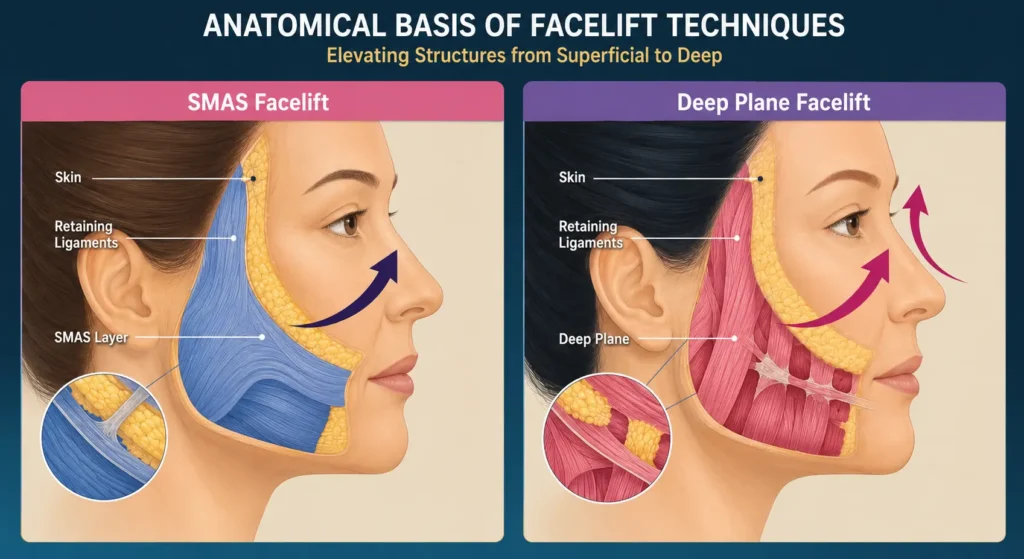
Contemporary techniques operate entirely on the deeper structural layers of the face—principally the SMAS (Superficial Musculoaponeurotic System), a fibromuscular layer beneath the skin.
- Structural Lift: By repositioning the SMAS alongside underlying fat pads and ligaments, surgeons achieve lift without placing tension on the skin itself.
- Natural Redistribution: The skin is then re-draped gently over the newly corrected, youthful framework.
- Unified Movement: The advanced deep plane facelift takes this a step further by releasing the anchoring ligaments of the midface. This allows the entire facial envelope—skin, mỡ, and muscle—to move seamlessly as one cohesive unit.
The ultimate result looks refreshed, not reconstructed. You will not look like a different person; you will simply look like a well-rested version of yourself from a decade ago.
Myth 2: “Facelifts are only for women.” |
| Aging affects everyone who has a face. Men develop jowls, neck laxity, deepening nasolabial folds, and loss of jaw definition just as women do — sometimes more dramatically due to heavier facial musculature. The misconception that facelifts are a female domain is cultural, not anatomical.
Male facelift requests have grown substantially over the past decade. Men who undergo facelifts typically have different aesthetic goals — they want to look sharper and more defined, not softer — but the surgical objectives are equally achievable. Technique modifications account for male anatomy: beard-bearing skin must be handled differently to avoid repositioning facial hair onto non-anatomical zones, and incisions are placed accordingly.
Any patient — regardless of gender — who has structural facial aging that is bothering them and is in good enough health to undergo surgery is a legitimate candidate for evaluation. |
Myth 3: “You are too young at 40 — and too old at 70 — to have a facelift.” |
| Age is one of the least decisive factors in determining facelift candidacy. What matters far more is anatomy: the degree and nature of facial aging, skin quality, overall health, and the structural changes that need to be addressed.
On being “too young” at 40: Patients in their early-to-mid 40s can be excellent surgical candidates, particularly for a mini facelift or deep plane technique targeting early jowling and neck laxity. Younger facial tissues are typically more elastic and heal more readily, often producing results that last 10–15 years. If the anatomy warrants surgical correction and the patient understands what they are choosing, the mid-40s is a clinically sound window.
On being “too old” at 70: Age alone does not disqualify anyone. Patients in their 60s, 70s, and even older can achieve dramatic and satisfying results. The relevant questions are about health, not birth year: Is cardiovascular function sound? Is the patient a good anesthetic candidate? Is healing likely to proceed normally? Many patients in their late 60s and 70s are, by these criteria, better surgical candidates than some people in their 50s. Healthy older patients also frequently report the highest satisfaction rates, partly because their expectations tend to be most realistic.
A reasonable general framework: first facelift in the mid-40s to early 50s, with the option of a secondary refresh in the mid-to-late 60s if desired. But anatomy and health always override age in the actual decision. |
Myth 4: “A liquid facelift, Ultherapy, or fillers can replace surgery.” |
| Non-surgical facial rejuvenation has genuinely improved over the past decade. Botulinum toxin, dermal fillers, focused ultrasound, radiofrequency, and laser treatments are all valuable tools — and we use them regularly at ABmedi Team Clinic. But valuing these tools means being honest about what they can and cannot do.
None of them can reposition descended tissue. None of them can tighten a lax platysma muscle in the neck. None of them can restore the jaw-to-neck angle that defines a youthful lower face. They address volume, surface texture, and to a modest degree, skin firmness — but they do not address the structural anatomical changes that cause the face to look older in the first place. The “liquid facelift” — a combination of strategic filler placements and Botox — is a legitimate maintenance strategy for younger patients with mild volume loss and early laxity. For a patient in their late 50s with genuine jowling, descended cheeks, and neck laxity, it is simply the wrong tool for the problem. There is also a cumulative cost argument worth considering honestly. Fillers last 9–18 months and need repeating. Botox lasts 3–4 months. Over several years of ongoing treatment, the total outlay often significantly exceeds the cost of surgery — without achieving equivalent structural correction. |
Myth 5: “Thread lifts last just as long as a surgical facelift.” |
| Thread lifts utilize dissolvable barbed sutures placed beneath the skin to physically lift tissue and trigger mild collagen production. For early jowling or minor skin laxity in younger patients, a thread lift offers visible improvement with minimal downtime.
However, these two procedures are not comparable in longevity or structural capability:
While thread lifts serve as a great maintenance tool on the non-surgical treatment ladder, they are never a permanent substitute for surgery. |
Myth 6: “Facelift recovery is extremely painful and takes months.” |
| Pain is one of the most consistently overestimated aspects of facelift recovery. The vast majority of patients at ABmedi Team Clinic describe the postoperative experience as uncomfortable rather than painful — and most transition off prescription-strength pain medication within 48 to 72 hours, managing the remainder with over-the-counter options.
What facelift recovery does involve: significant bruising and swelling for the first one to two weeks; tightness across the face and neck; temporary numbness in areas where superficial sensory nerves have been disturbed; and fatigue from anesthesia. These are real but manageable. A practical timeline: most patients are comfortable being seen in public — with light cosmetic coverage — by end of week two. Return to sedentary work typically occurs around day 10–14. Strenuous activity is cleared around week four. Final results continue refining for three to six months as residual swelling resolves. Notably, deep plane facelifts often produce less bruising than traditional techniques because the dissection occurs beneath the vascular superficial layers. This surprises most patients — but it is consistently reflected in clinical experience. |
Myth 7: “A facelift leaves obvious, permanent scars.” |
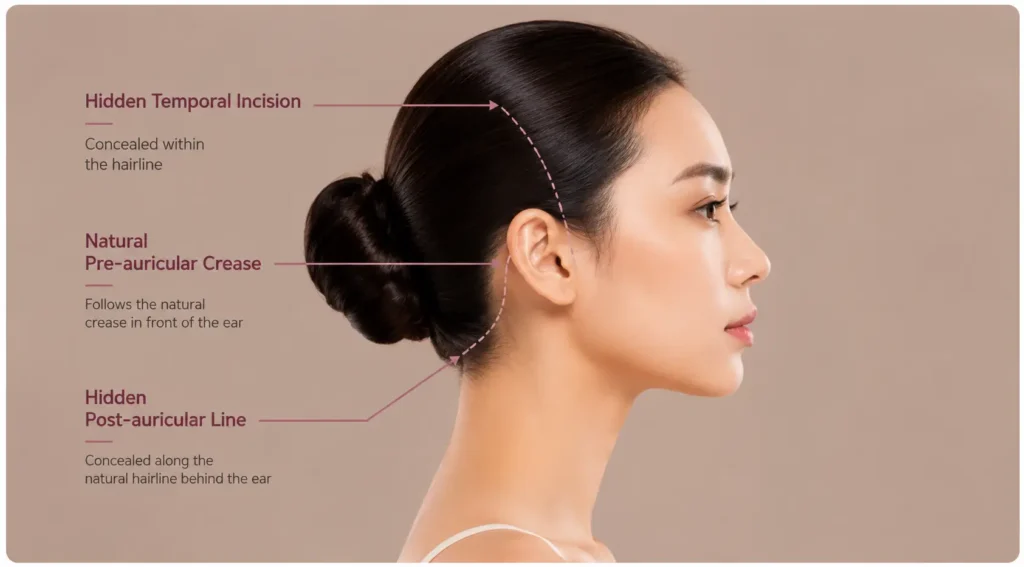
| Facelift incisions are deliberately designed to be inconspicuous. They are placed in the natural crease in front of the ear, behind the earlobe where the ear meets the scalp, and within the hairline at the temples. A small incision under the chin may be added for neck work — it sits in the natural submental crease and is essentially invisible once healed.
In the deep plane technique, a key advantage is tension-free skin closure. Because the lifting force is applied to the deep structural layers rather than the skin, the skin incisions close under virtually no tension. Tension is the primary driver of poor scar formation — it causes widening, thickening, and visibility. A tension-free closure heals with finer, more discreet lines. Scars also mature over time. What appears pink at six weeks typically fades to a thin, pale line by six months, and is often imperceptible at one year. With a skilled surgeon, diligent sun protection on healing incisions, and consistent scar management, most patients can wear their hair up within months of surgery without concern. |
Myth 8: “A facelift will change my facial expression or make me unrecognizable.” |
| A well-executed facelift does not alter facial expression. It does not change the character of your face, the way you smile, or the features that make you recognizably yourself. The goal is not transformation — it is restoration. We are repositioning structures that have descended from where they were a decade ago, not redesigning the face.
Where expression change does occur, it is almost always a consequence of the same cause behind the pulled look: excessive skin tension. Correct the technique — use deep structural lifting with tension-free skin closure — and expression is preserved. At ABmedi Team Clinic, we often use old photographs as a reference during consultation — not to replicate a younger version of you exactly, but to understand the natural architecture of your face before aging altered it. The surgical plan is built around restoring that architecture, not building something new. |
Myth 9: “All board-certified plastic surgeons deliver the same facelift results.” |
| Board certification is a necessary baseline — it confirms completed accredited training and rigorous examinations. It is not, on its own, a guarantee of facelift quality. Facial surgery is a subspecialty that requires an additional layer of experience, artistic judgment, and technical refinement that general board certification does not specifically reflect.
What actually predicts facelift outcomes: the volume of facelift cases performed, specific expertise with the technique being used (deep plane surgery is significantly more demanding than SMAS plication), a documented track record of natural-looking results rather than aggressive over-correction, and the surgeon’s ability to honestly assess anatomy and communicate realistic expectations. When evaluating a facelift surgeon, ask to see a substantial gallery of before-and-after results from real patients — ideally at multiple time points, not just immediately after surgery. Ask specifically what technique they use and why. Ask about complication rates. A surgeon confident in their outcomes will answer these questions without hesitation. |
What to look for in a facelift surgeon
Specialization in facial surgery, demonstrated experience with the specific technique proposed, a consistent gallery showing natural-looking results, and a consultation process built around genuine anatomical assessment — not a preset treatment menu. At ABmedi Team Clinic, each facelift consultation is allocated a minimum of one full hour.
10. Surgical vs. Non-Surgical Facelift: Honest Comparison
| Factor | Surgical Facelift | Non-Surgical (Fillers / HIFU / RF) | Thread Lift |
| Structural tissue repositioning
|
Yes — SMAS, ligaments, fat pads | No | Minimal / temporary |
| Results longevity | 7–15 years | 6–18 months per session | 12–18 months |
| Addresses jowls and neck laxity
|
Yes, definitely | Modestly / temporarily | Partially for mild cases |
| Downtime
|
2–4 weeks | Minimal to none | Days |
| Cumulative 5-year cost
|
One-time investment | Often exceeds surgery cost | Multiple repeats needed |
| Best suited for | Moderate to advanced facial aging | Early signs; ongoing maintenance | Mild descent; short-term goals |
11. A Surgeon’s Honest Perspective
The persistence of facelift myths frustrates me — not because it reflects badly on the procedure, but because it keeps people from making decisions that could genuinely improve their quality of life. I have seen patients spend years and significant money on repeated non-surgical treatments that were never going to address their underlying anatomy, because they were convinced that surgery was too risky, too obvious, or not for someone like them. That is a failure of information, not a failure of medicine.
Modern facelift surgery, performed by a surgeon with genuine expertise and a commitment to natural results, is one of the most reliable and durable interventions in all of aesthetic medicine. The outcomes are structural — not surface-level — and they last. The recovery is real but manageable. The scars, when properly placed and closed, are genuinely inconspicuous.
None of that means surgery is the right answer for every patient. It is not. For someone in their late 30s with mild volume loss, surgery is premature. For someone in their mid-50s with actual tissue descent and structural aging, continuing to layer fillers onto a structural problem is, at best, an expensive delay. The appropriate recommendation depends entirely on an honest assessment of what is actually happening anatomically — and that is what a good consultation delivers.
12. Frequently Asked Questions
Q1: How long does a facelift actually last?
A well-performed surgical facelift typically lasts 7–10 years before meaningful re-aging becomes noticeable. Deep plane techniques tend toward the longer end of this range — and patients who receive their first facelift in their 40s with good skin quality often see results lasting 10–15 years. Aging continues after surgery, but it restarts from an elevated, corrected baseline rather than from the pre-surgical state.
Q2: Can Ultherapy or other energy devices truly replace a facelift?
For genuine structural facial aging — jowling, neck laxity, descended cheeks — no device currently available produces equivalent results to surgery. Focused ultrasound and radiofrequency devices can produce modest skin tightening and are useful as maintenance or delay strategies for early-stage aging. They work at the skin and superficial tissue level; they do not address the ligamentous attachments and muscular structures that drive the deeper descent of facial tissue over time.
Q3: Will I need to repeat the procedure?
Not necessarily. Many patients find their first facelift result satisfying for the remainder of their life when supported with good skincare and periodic non-surgical maintenance. Some choose a lighter secondary procedure 10–15 years after the first. The decision is entirely personal, based on how much further aging occurs and how much it matters to the individual.
Q4: Does a facelift also address the neck?
The lower face and neck are anatomically connected, and most comprehensive facelifts include some neck component — platysma tightening, submental liposuction, or both. At ABmedi Team Clinic, we evaluate the neck as part of every facelift assessment. Addressing only the face while leaving the neck untouched often creates a visible mismatch between the two regions. When significant neck changes are present, a full neck lift component is incorporated into the plan.
Q5: What are the real risks of facelift surgery?
The most significant risk in facelift surgery is hematoma — a collection of blood beneath the skin flap — which occurs in roughly 1–3% of cases and is typically detected and managed early. Nerve injury, particularly to the temporal branch of the facial nerve, is rare but can cause temporary or, in very rare cases, prolonged brow weakness. Infection, poor wound healing, skin loss, and unfavorable scarring are all possible but uncommon with proper technique and patient selection. Smoking increases risk in essentially every category, which is why cessation is a non-negotiable requirement before surgery at ABmedi Team Clinic.
Q6: How do I choose the right facelift surgeon?
Look beyond board certification. Seek out a surgeon who specializes in facial surgery specifically, who can show you a substantial gallery of before-and-after results from real patients at multiple time points, and who explains clearly which technique they recommend for your anatomy and why. A surgeon confident in their outcomes will answer your questions directly. Any deflection or pressure to decide quickly is a warning sign — not a buying signal.
📞 💬 WhatsApp / Chat: [http://wa.me/84975142666] 🌐 Book online: [+84-975-142-666]
Consultations are available in-clinic and online for international patients. Most patients leave their first appointment knowing exactly what they need — and feeling confident about the path ahead.
