


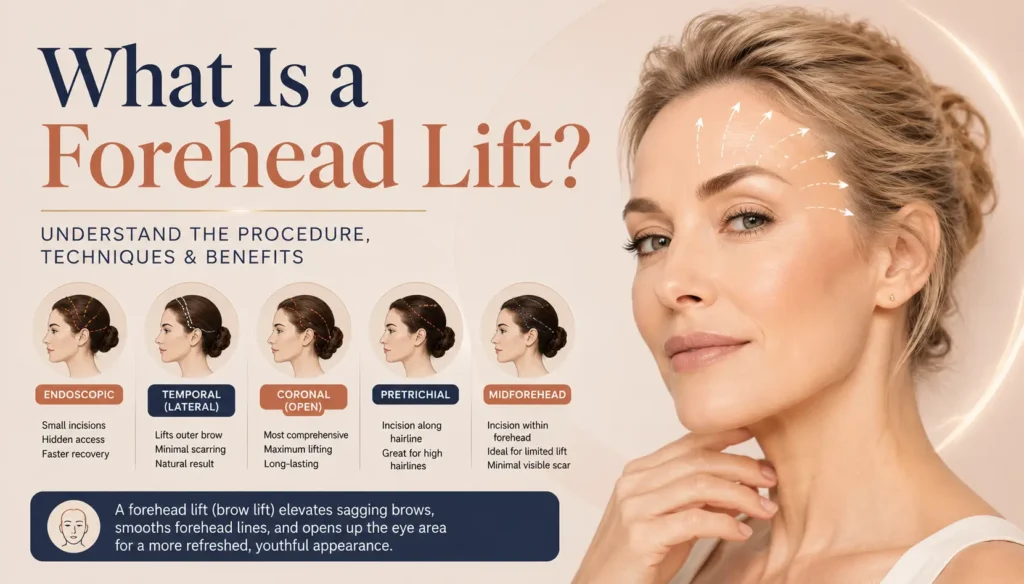
You catch yourself in the mirror and notice something that wasn’t there a few years ago — your brow sits lower, your forehead creases run deeper, and somehow you look perpetually tired or tense, even when you’re perfectly relaxed. Before you resign yourself to that reflection, it’s worth understanding one of the most effective — yet often misunderstood — procedures in facial rejuvenation: the forehead lift.
Decoding the Definitions: Forehead Lift vs. Brow Lift
1.1 What is a forehead lift?
A forehead lift is a comprehensive cosmetic surgical procedure designed to correct the visible signs of aging throughout the upper third of the face, spanning from the eyebrows up to the anterior hairline. As we age, structural support weakens, leading to tissue laxity. This procedure directly targets the underlying frontalis muscle and overlying skin, effectively smoothing stubborn horizontal forehead creases, softening permanent frown lines, and elevating the entire forehead canvas to restore a refreshed, structurally sound upper face.
At ABmedi Team Clinic, we frequently consult with patients who complain that their upper face feels “heavy.” This heaviness is rarely just a skin-deep issue; it involves the descent of deeper soft-tissue layers that press down on the upper eyelids, occasionally even restricting the upper peripheral visual field.
1.2 What is a brow lift?
A brow lift is a more localized surgical intervention focused specifically on altering the position, shape, and height of the eyebrows. This procedure addresses browptosis (sagging eyebrows) by lifting the descended brow tissue back to its ideal anatomical position—typically resting right at or slightly above the supraorbital rim for men, and higher with a gentle arch for women. By lifting the brow, it naturally tightens the redundant skin in the upper eyelid zone, revealing a more awake and youthful eye appearance.
1.3 Is a forehead lift the same as a brow lift?
Yes, in modern plastic surgery and clinical practice at ABmedi Team Clinic, these terms are largely used interchangeably. While “forehead lift” technically emphasizes the smoothing of the entire upper frontal zone and “brow lift” focuses on the eyebrow position, they are executed using the exact same surgical techniques. Whether your surgeon calls it a browplasty, forehead rejuvenation, or a temporal brow lift, the core objective remains identical: lifting and securing the upper facial structures into a more youthful alignment.
Quick Answer
Forehead lift and brow lift refer to the exact same surgical procedure. The difference is merely colloquial. Your surgeon will customize the underlying technique based entirely on your unique facial anatomy and hairline position.
How Does a Forehead Lift Work?
A forehead lift works by modifying and repositioning the complex network of soft tissues, muscles, and skin on your upper face. During the procedure, the surgeon gently detaches the forehead tissue from the underlying facial bone. Once released, the hyperactive muscles responsible for creating dynamic wrinkles—specifically the corrugator and procerus muscles (the ones that cause the vertical “11” lines between your eyes)—are selectively altered or weakened.
The entire tissue complex is then advanced upward. To ensure long-lasting results, the lifted tissue must be securely anchored into its new position. At ABmedi Team Clinic, our surgeons utilize advanced bio-absorbable fixation devices, most notably Endotine technology.
An Endotine implant is a sub-miniature device featuring micro-tines that gently grip the elevated tissue, distributing the tension evenly to prevent the sagging tissue from slipping backward. Over the course of 3 to 6 months, your forehead tissue naturally re-anchors and fuses directly to the bone in its new, elevated position. Once this natural biological bonding is complete, the Endotine device safely dissolves and is completely absorbed by the body, leaving no foreign material behind. Any excess, redundant skin is then precisely trimmed away before closing the incisions.
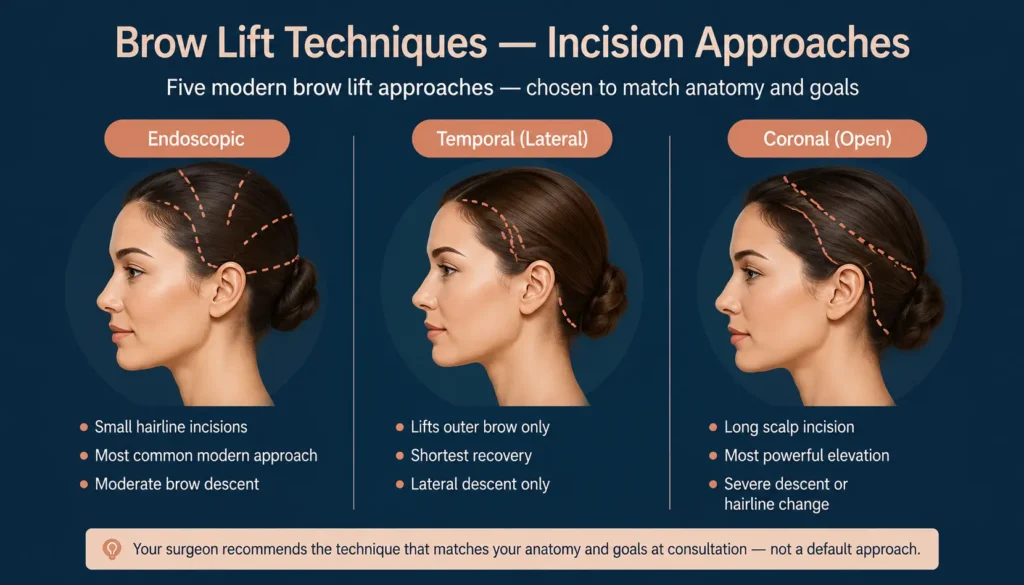
A comparative guide to modern forehead lift techniques, illustrating precise incision placements and their respective target rejuvenation zones.
Gender-Specific Anatomical Considerations
At ABmedi Team Clinic, we strictly emphasize that a forehead lift cannot be approached with a “one-size-fits-all” mindset. Aesthetic ideals and underlying anatomy differ drastically between genders:
- The Female Brow: Typically rests above the supraorbital rim, exhibiting an elegant, soft arch where the outer tail sits higher than the inner corner. The surgical goal is to restore this graceful arch without over-elevating, which causes a “surprised” look.
- The Male Brow: Sits lower, resting directly on the supraorbital rim, and follows a much flatter, horizontal trajectory. Over-arching a man’s brow feminizes the face; therefore, the surgical mechanic focuses on a conservative, horizontal lift to maintain a masculine, strong, and natural appearance.
The specific surgical approach dictates how the procedure is performed:
| Classic / Coronal Lift |
| A continuous ear-to-ear incision hidden slightly behind the hairline. It allows comprehensive lifting of the entire forehead and deep brow, offering maximum correction. This approach is best suited for patients with severe brow drooping, deep wrinkles, and a naturally low hairline. |
| Endoscopic Lift (Minimally Invasive) |
| Uses 3 to 5 small, vertical puncture incisions (approximately 1-2 cm) within the scalp. It features structural lifting using a specialized camera, ensuring minimal tissue trauma and swelling. This is ideal for patients with mild-to-moderate sagging who want a faster recovery and zero visible scars. |
| Temporal / Limited Lift |
| Features short incisions located exclusively within the temple hair on both sides. It targets the outer (lateral) third of the brow to open up the outer eye area. This is designed for patients looking to fix drooping outer brows or heavy crow’s feet, and is often paired with blepharoplasty. |
| Non-Surgical Injectable Lift |
| Requires strategic micro-injections directly into the muscle tissue with no incisions. It offers temporary relaxation of brow-depressor muscles using Botulinum Toxin. This is perfect for younger patients with early signs of aging or those avoiding surgery, lasting 3-6 months. |
Most surgical forehead lifts are performed as outpatient procedures under general anesthesia or deep intravenous (IV) sedation, typically taking between 1 to 2 hours to complete.
Medical Indications: What Does a Forehead Lift Fix?
During private consultations at ABmedi Team Clinic, we perform a detailed facial analysis to determine surgical candidacy. A forehead lift is a highly specific structural procedure. To help you understand whether this surgery aligns with your aesthetic goals, look at the comprehensive diagnostic guide below:
| Your Facial Concern | Can a Forehead Lift Fix It? | Corrective Mechanism / Alternative Solution |
| True Brow Ptosis
(Drooping or flat eyebrows) |
YES | Elevates the descended brow tissue back to its ideal anatomical position above the orbital rim, restoring a youthful arch. |
| Glabellar Frown Lines
(The vertical “11” lines) |
YES | Surgically alters or weakens the hyperactive corrugator muscles responsible for pulling the brows together. |
| Static Forehead Creases
(Deep horizontal forehead bands) |
YES | Releases and advances the frontalis muscle, stretching and smoothing out deep, etched-in lines. |
| Pseudoptosis
(Heavy, hooded upper eyelids) |
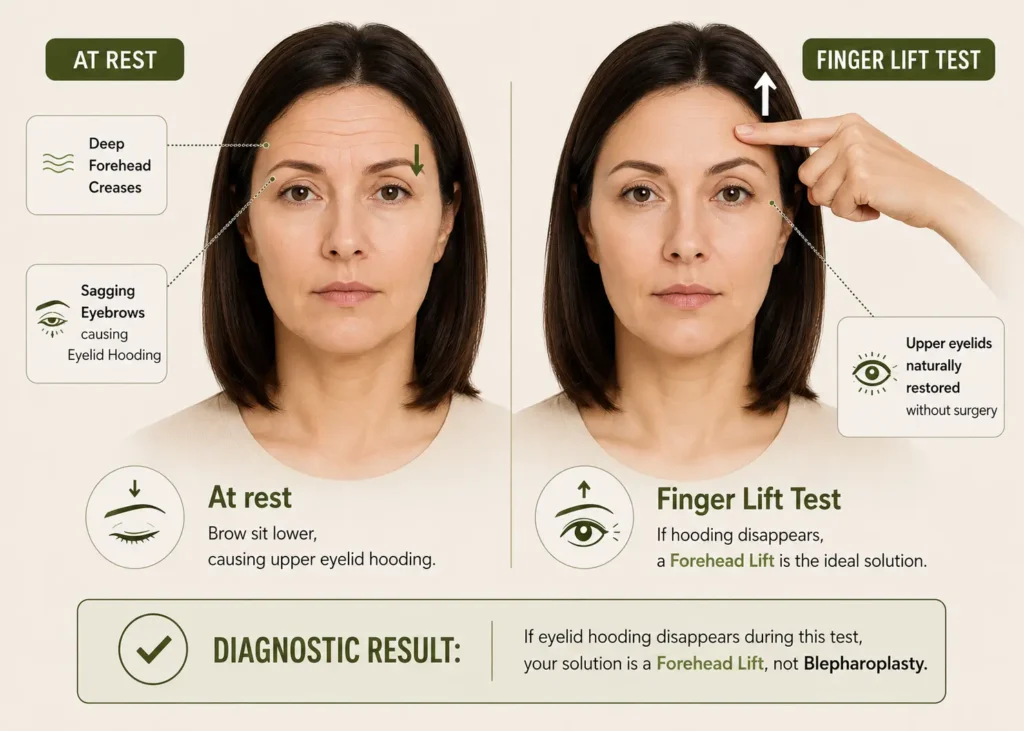
YES | Resolves eyelid hooding naturally by lifting the sagging forehead skin that was pushing down onto the eyelids. |
| Facial Volume Loss
(Hollow temples or deflated brow) |
NO | Alternative: Requires Fat Grafting or Dermal Fillers to restore youthful fullness; skin lifting alone cannot replace lost volume. |
| Dynamic Surface Wrinkles
(Fine lines appearing only when moving) |
NO | Alternative: Best treated with preventative Botox injections to temporarily relax superficial muscle movements. |
| Skin Texture & Pigmentation
(Sun damage, age spots, uneven tone) |
NO | Alternative: Requires skin resurfacing treatments such as Laser therapy, Chemical peels, or Microneedling. |
| Lower Facial Aging
(Sagging jowls, loose neck, marionette lines) |
NO | Alternative: A forehead lift is strictly confined to the upper third of the face. You will need a Facelift or Neck lift for the lower zones. |
Candidacy Note
Forehead lift surgery is most frequently performed on patients between 40 and 60, though it can benefit individuals of any age with inherited heavy brows or stress-related deep furrows. Ideal candidates are non-smokers in good general health with realistic expectations.
The Transformative Benefits of a Forehead Lift
✦ A more rested, approachable expression. Lifting descended brows opens up the eye area and eliminates the habitually stern or exhausted look that gravity creates — regardless of how you actually feel.
✦ Smoothing of deep forehead lines. Horizontal creases and glabellar furrows that creams and injectables can no longer adequately address are significantly improved by repositioning the underlying tissue rather than merely relaxing it.
✦ Improved upper eyelid appearance. Patients who believe they need eyelid surgery are often surprised to learn that a brow lift alone resolves the excess skin “hooding” their eyes, by lifting the source of the problem rather than removing skin from the lid.
✦Long-lasting results. While the natural aging process continues, a surgical forehead lift produces durable improvements — typically 5 to 10 years or longer — that no injectable treatment can replicate.
✦ Combination synergy. When performed alongside a facelift, neck lift, or upper blepharoplasty, a forehead lift contributes to comprehensive facial rejuvenation, restoring balance across all three facial zones simultaneously.
Will a forehead lift make me look younger?
Yes, a forehead lift is highly effective at turning back the facial clock, frequently making patients look 5 to 10 years younger. However, the modern philosophical approach at ABmedi Team Clinic focuses strictly on natural-looking restoration, not radical alteration. The goal is to look like a refreshed, well-rested version of yourself—not tight, surprised, or “wind-tunneled.”
Immediately following the procedure, localized swelling and bruising will temporarily distort your features. Most patients witness their true, beautifully settled results around the 3-month mark, with the final structural healing concluding by month 6. Friends and colleagues will notice you look incredibly refreshed and youthful, but unless you tell them, they won’t be able to pinpoint why.
Frequently Asked Questions
Q1) How long does recovery take after a forehead lift?
Most patients experience swelling and bruising for the first 1–2 weeks. The endoscopic approach typically means less downtime than the coronal technique. Most people return to social activities within 2–3 weeks and feel fully themselves by 6–8 weeks. Temporary scalp numbness or itching is common and resolves over time.
Q2) Will I have visible scars?
All incisions are placed within the hairline or at the natural scalp crease, making them effectively undetectable once healed. The endoscopic technique leaves only small puncture-like incisions. Your surgeon will advise on hair care and scar management during recovery.
Q3) Can a forehead lift be combined with other procedures?
Yes. Combining a forehead lift with a facelift, neck lift, upper eyelid surgery, or skin resurfacing during the same operative session is common and allows for comprehensive, balanced rejuvenation with a single recovery period.
Q4) Is there a non-surgical alternative?
Botulinum toxin injections can provide a mild, temporary brow lift and are a reasonable starting point for younger patients or those exploring their options. However, injectable results are subtle and must be maintained every 3–6 months. For patients with significant brow descent or deep forehead lines, surgery remains the most effective long-term solution.
Q5) How do I know if I need a brow lift or eyelid surgery?
This is one of the most common questions in my consultations. A simple test: place your index fingers just above your eyebrows and gently lift the brow to its ideal position. If the excess skin on your upper eyelids largely disappears, the primary issue is brow ptosis — and a forehead lift, rather than blepharoplasty, may be the right solution.
📞 💬 WhatsApp / Chat: [http://wa.me/84975142666] 🌐 Book online: [+84-975-142-666]
Consultations are available in-clinic and online for international patients. Most patients leave their first appointment knowing exactly what they need — and feeling confident about the path ahead.
