


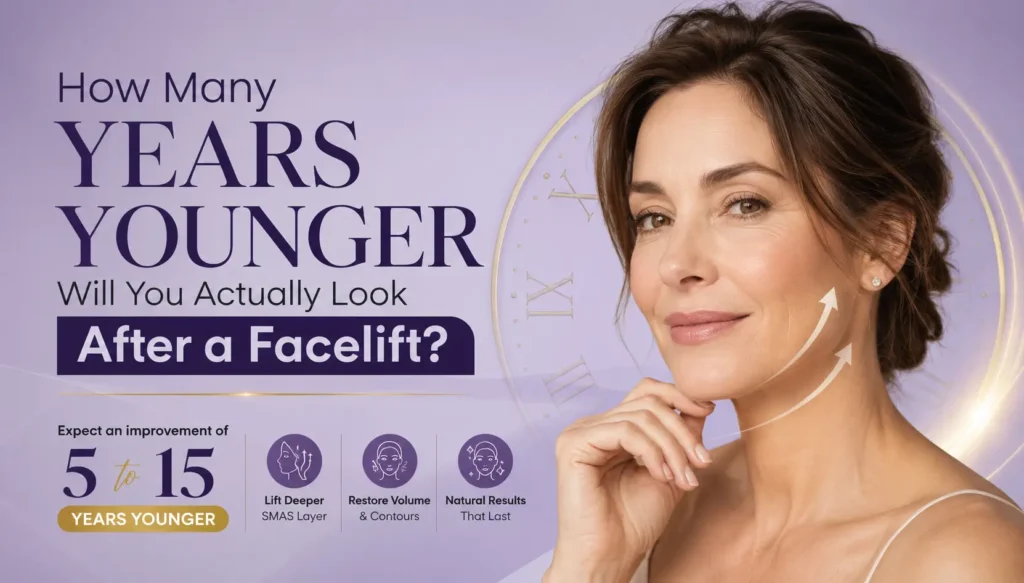
It’s the question almost every patient asks during consultation: “How many years younger will I look?” The honest answer is that it depends — but the research gives us a useful framework, and clinical experience fills in the rest. Most patients can realistically expect to appear somewhere between 5 and 15 years younger, with the majority landing in the 7 to 10 year range. A few factors determine where on that spectrum you’ll fall, and understanding them is the most useful thing you can do before committing to surgery.
What the Research Actually Says
The science on this is more nuanced than most online articles suggest.
- The Clinical Benchmark: A study published in JAMA Facial Plastic Surgery found that comprehensive facial rejuvenation surgery can produce an apparent age reduction of 10 to 12 years.
- The Objective AI Factor: An AI-based study published in Plastic and Reconstructive Surgery used neural networks trained on facial photographs and found an average perceived age reduction of around 4.3 years post-facelift — significantly less than the 6.7-year reduction patients rated for themselves.
- The Isolated Approach Limit: A separate research group found a modest 3-year reduction in a cohort that included less extensive procedures such as eyelid surgery or brow lifts performed in isolation.
The Takeaway: The gap between AI and human perception is telling: patients who have an emotional and financial investment in their outcome tend to perceive more change than objective measurements register. Expect something in the range of 5 to 12 years, with the upper end achievable when multiple procedures are combined, the patient is in their 50s with good skin elasticity, and the surgery addresses deeper tissue layers rather than just the skin surface.
What a Facelift Actually Does to Your Face
Before discussing how much younger you’ll look, it helps to understand what the surgery is physically doing — because that directly determines the quality and longevity of the facelift younger look results.
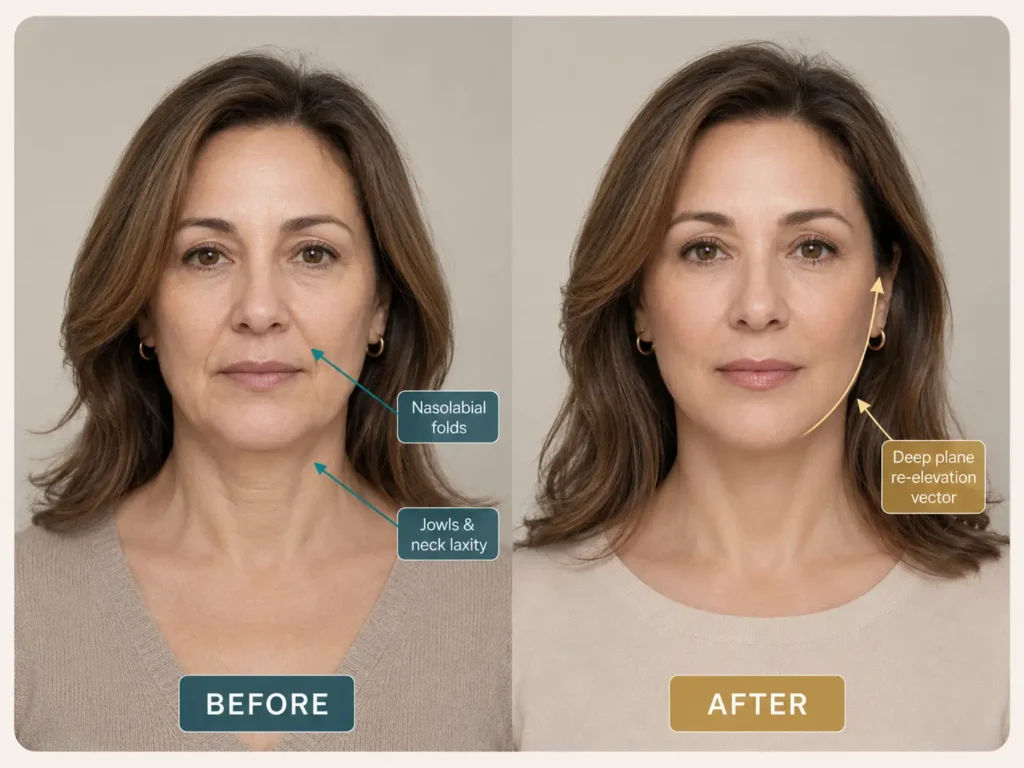
As we age, the face shifts from a heart-shaped structure (fuller in the upper third) to a pear-shaped one, with heaviness descending into the jowls and neck. A modern facelift reverses this by:
- Repositioning the SMAS Layer: The superficial musculoaponeurotic system (the deeper structural tissue beneath the skin) is lifted and anchored, rather than simply pulling the skin tighter.
- Re-elevating Descended Fat: Facial fat pads that have migrated below the jawline are moved back to their youthful, high-cheek positions.
- Eliminating Laxity: Excess, sagging skin is meticulously tailored away to eliminate jowls and deep nasolabial creases.
- Redefining Contours: The jawline and neck are sculpted to create a cleaner, sharply defined profile.
The critical distinction between a natural looking facelift result and an overdone one comes down to where the tension is applied. Older-generation techniques pulled primarily on the skin, producing the telltale “windswept” or “pulled” appearance. Modern techniques at ABmedi Team Clinic anchor the lift in the deeper SMAS layer, allowing the skin to drape naturally over a repositioned foundation — so you look lifted without looking stretched.
Factors That Determine How Young You’ll Look
No two patients age identically, and no two facelifts produce identical results. These are the variables that matter most:
- Your age at the time of surgery Younger patients — those in their 40s and early 50s — typically still have reasonable skin elasticity, which means the skin responds better and settles into a more natural position. The result often looks subtle and seamless. Patients in their 60s and 70s generally show more dramatic visible improvement simply because there is more aging to correct, but the skin’s reduced elasticity can affect how gracefully it drapes after repositioning.
- Skin quality and sun damage history Skin that has been protected from UV exposure retains collagen and structural integrity longer. Heavily sun-damaged skin is thinner, less elastic, and heals less predictably — factors that can limit how natural the result looks and how long it lasts.
- Surgical technique A deep plane facelift — which releases and repositions the deeper retaining ligaments of the face — tends to produce more comprehensive and longer-lasting results than a SMAS-only or skin-tightening approach. This is especially true in the midface and jowl areas, where the deep plane technique delivers genuine structural correction rather than a surface-level adjustment.
- Whether additional procedures are included A facelift alone addresses the lower two-thirds of the face. If the eye area or forehead also shows significant aging — and in most patients in their 50s, it does — the overall result will look more balanced and complete when blepharoplasty, a brow lift, or fat grafting is added. A rejuvenated lower face paired with heavy, tired-looking eyes rarely reads as truly refreshed.
- Lifestyle factors Smoking significantly accelerates skin aging and impairs wound healing. Consistent sun protection, a stable body weight, good nutrition, and a medical-grade skincare routine all contribute to how long results hold — and how natural they look during the healing process.
How Long Does a Facelift Last?
Results are not permanent, but they are durable — and importantly, they age gracefully.
Standard SMAS facelift: results typically hold for 7 to 10 years before visible aging progression becomes noticeable again.
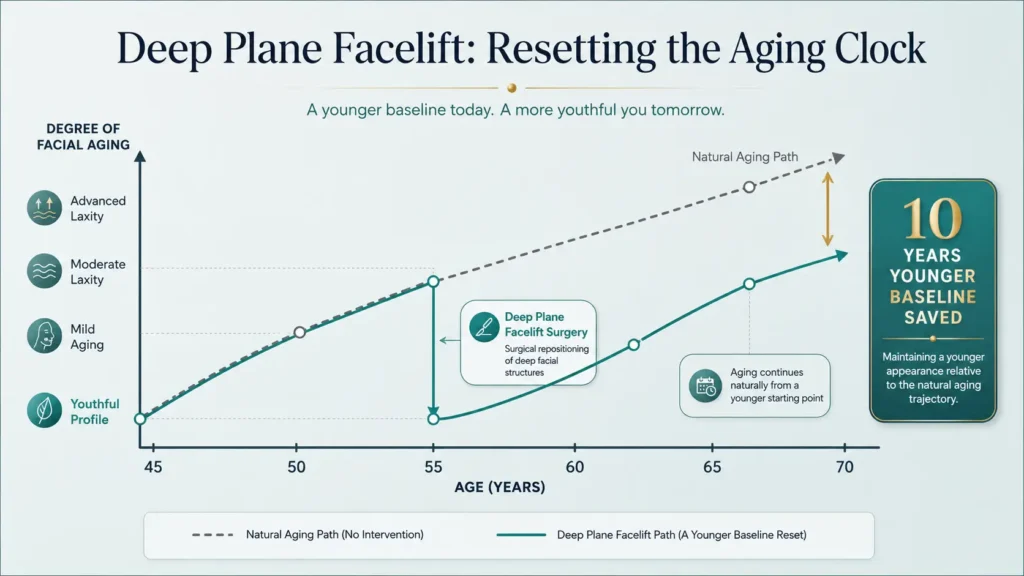
Deep plane facelift: considered the most durable approach, with results lasting 10 to 15 years in most patients. Because it repositions the deeper structural layers rather than relying on skin tension, the face continues to move and express naturally — which is why deep plane results tend to look more authentic over time.
Mini facelift: designed for earlier, milder aging changes, results generally last 5 to 7 years.
An important nuance: “lasting” does not mean the face snaps back to where it was. What actually happens is that the face continues to age from a younger baseline. A patient who looked, say, 68 before surgery and 56 afterward will, ten years later, look around 66 — still meaningfully younger than if they had never had the procedure. Most patients who have a facelift at 55 still look younger than their unoperatd peers a decade later, even without revision surgery.
The Best Age for a Facelift: Does Timing Matter?
There is no single ideal age, but there are age-related patterns worth understanding.
In your 40s: Early intervention is increasingly common, and it has real advantages. Skin elasticity is at its best during this decade, which means the lift holds longer and the result looks more seamless. Mild jowling, early neck laxity, and deepening nasolabial folds are the typical concerns at this stage. A deep plane facelift in the 40s, performed before more extensive tissue descent develops, often produces results that last into the patient’s late 50s or early 60s with minimal further intervention.
In your 50s: This is the window most surgeons identify as the “sweet spot.” The structural changes have become pronounced enough that surgery offers a clear benefit over non-surgical alternatives, but tissue quality is still favorable and healing is reliable. Jowling is more defined, neck laxity is more apparent, and the midface has typically undergone meaningful volume redistribution. Results at this stage tend to be the most transformative in terms of the visible “before and after.”
In your 60s and beyond: Excellent results remain achievable, and many patients in this age group are ideal candidates. The degree of visible change is often dramatic simply because there is more aging to correct. Skin elasticity is reduced, which means healing may take slightly longer, but in experienced hands, the outcome can be just as natural and satisfying.
The key message is this: the right time for a facelift is when the signs of aging have become significant enough that surgery offers a meaningfully better outcome than non-surgical options — and when your health profile makes surgery appropriate. At ABmedi Team Clinic, we assess candidacy individually rather than by age bracket.
What “Natural-Looking” Actually Means
This phrase appears in every facelift conversation, and it deserves a precise definition. A natural-looking facelift is one where:
- The face retains full range of expression — you can smile, frown, and animate without restriction
- No visible signs of excessive skin tension — no pulled hairline, no distorted ear position, no lateral sweep at the corners of the mouth
- Friends notice you look well-rested or ask if you changed your skincare, rather than immediately identifying surgery
- The overall facial proportions remain recognizably yours
The facelift that achieves this is one performed on the deeper structural layers, with restraint — meaning not over-correcting, not removing too much skin, and not applying tension where it creates distortion. A skilled surgeon understands that softness and movement are part of what makes a face look young. Restoring structure underneath allows the skin to follow naturally, which is what produces the genuinely refreshed result patients are looking for.
What a Facelift Cannot Do
Managing expectations is the foundation of a successful cosmetic outcome. To ensure you achieve your ideal aesthetic goals, remember that a traditional facelift:
- Does NOT improve skin texture, fine lines, or sun-induced pigmentation (this requires complementary lasers or chemical peels).
- Does NOT address the upper face or eye area (blepharoplasty or a brow lift must be added).
- Does NOT restore lost skeletal or soft-tissue volume (fat grafting or structural fillers are required).
At ABmedi Team Clinic, the consultation process includes a full-face assessment so patients understand precisely what a facelift will and will not correct, and what complementary procedures, if any, would serve their goals.
How Often Will You Need a Facelift?
Most patients who undergo a well-executed facelift do not return for revision for 10 to 15 years, and many never pursue a second procedure at all. Those who do typically return not because the first result has fully reversed, but because they want to maintain the level of rejuvenation they were happy with. Periodic non-surgical maintenance — injectables, laser treatments, or fat grafting — can extend the visible benefit of facelift surgery and may reduce the likelihood that a second surgical procedure will ever be needed.
Summary of Surgical Techniques and Longevity
| Technique | Typical Longevity | Estimated Age Reduction | Best Suited For |
| Mini Facelift | 5–7 years | 3–5 years younger | Early jawling; mild skin laxity in late 30s/40s |
| Standard SMAS Facelift | 7–10 years | 5–10 years younger | Moderate jowls and midface sagging |
| Deep Plane Facelift | 10–15+ years | 7–15 years younger | Advanced tissue descent; heavy jowls and neck bands |
| Deep Plane + Blepharoplasty | 10–15+ years | 10–15 years younger | Full facial rejuvenation (lower face + tired eyes) |
These are population-level estimates. Individual results depend on the factors discussed above. The best way to understand what is realistically achievable for your face is through a one-on-one consultation with a surgeon experienced in facial anatomy who can evaluate your specific situation directly.
Frequently Asked Questions
Q1) How many years younger do you look with a facelift?
Most patients realistically look about 7 to 10 years younger after a standard facelift. If you combine a deep plane facelift with complementary procedures like eyelid surgery or fat grafting, an apparent age reduction of 10 to 15 years is highly achievable.
Q2) How long after a facelift will I look normal?
Most patients feel “presentable” and comfortable returning to work or social settings within 10 to 14 days, once major bruising fades. However, mild residual stiffness or subtle swelling can take about 3 to 6 weeks to completely resolve, revealing your fluid, natural expressions.
Q3) What happens to your face 10 years after a facelift?
A decade later, your face will continue to age naturally, but you will still look significantly younger than if you had never had the surgery. You basically age from a lower, refreshed baseline—meaning a patient who looks 45 after their procedure will only look around 55 a decade later.
Q4) Do you still age after a facelift?
Yes. A facelift turns back the clock, but it does not stop it from ticking. Your skin and deep tissues will continue to undergo natural chronological aging and volume loss, which is why maintaining a medical-grade skincare routine and healthy lifestyle is vital to prolonging your surgical outcome.
Q5) How to make your face look 20 years younger?
Looking 20 years younger purely through a facelift is generally unrealistic and often leads to an over-tightened, unnatural appearance. To safely achieve maximum, harmonious rejuvenation, surgeons use a multi-layered approach: a deep plane facelift combined with a brow lift, blepharoplasty, and fat transfer to restore lost volume.
Q6) What’s the best age to have a facelift?
The ideal “sweet spot” is typically in your 50s, when structural aging (jowls and neck sagging) is pronounced enough to see dramatic results, yet skin elasticity is still favorable for healing. However, early intervention in your late 40s or restorative lifting in your 60s both yield excellent, long-lasting outcomes.
📞 💬 WhatsApp / Chat: [http://wa.me/84975142666] 🌐 Book online: [+84-975-142-666]
Consultations are available in-clinic and online for international patients. Most patients leave their first appointment knowing exactly what they need — and feeling confident about the path ahead.
