


What a brow lift actually addresses
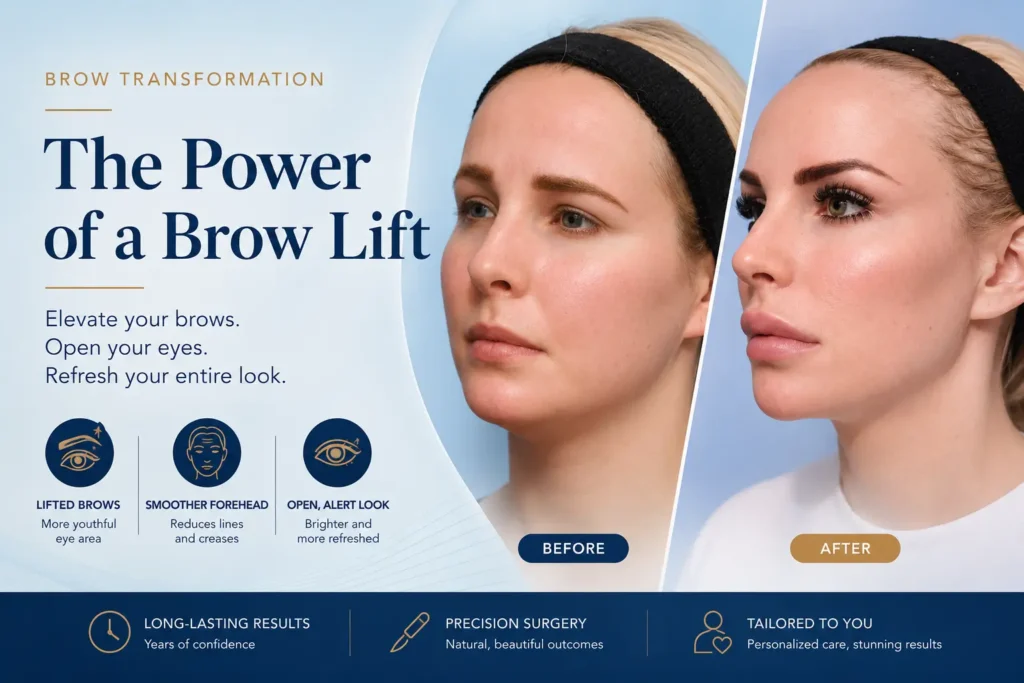
A brow lift — also called a forehead lift — is a surgical procedure that elevates descended eyebrows, smooths forehead creases, and corrects the heavy, hooded appearance that develops over the upper eyelids as the brow drops with age. It is a procedure focused on the upper third of the face, and when done well, the result is a more open, alert, and rested appearance — not a surprised or frozen one.
It is worth separating what this surgery does from what it does not do. A brow lift repositions soft tissue and, depending on the technique, may also weaken or partially disable the muscles responsible for frowning — the corrugators and procerus. It does not remove excess upper eyelid skin directly, though it often resolves what appears to be eyelid excess when that excess is actually caused by a descended brow pressing skin downward (called pseudo-blepharoptosis). Many patients who come to us believing they need eyelid surgery actually need a brow lift, or both.
| The mirror test
Place your palms at the outer edges of your eyes, just above the brows. Gently push the skin upward. If what you see in the mirror looks like the result you want, a brow lift is likely on the right track. If the upper eyelids still look heavy after doing this, you may also need eyelid surgery. This simple self-assessment is one of the first things we do in a consultation at ABmedi team Clinic.
The anatomy behind brow aging
Understanding what actually happens to the brow with age makes every technique decision easier to follow. Several distinct processes contribute simultaneously:
| Lateral brow descent
The outer third of the brow drops earliest and most noticeably — pulled down by gravity, galeal fat pad descent, and weakened fascial support. This creates the tired or sad expression even in well-rested individuals. |
Vertical glabellar lines
Caused by the corrugator supercilii muscle acting repeatedly over decades. These are the “11 lines” between the brows — a direct reflection of how strongly the brow depressors work. |
|
| Horizontal forehead lines
The frontalis muscle is the only muscle that elevates the brow. As the brow descends, the frontalis works harder to compensate, creating deep transverse creases across the forehead. |
Upper eyelid hooding
Brow ptosis pushes skin downward onto the upper eyelid, creating excess that can obstruct vision in advanced cases. This is often misidentified as an eyelid problem when the real driver is the brow position. |
Three anatomical structures must be addressed during any brow lift to achieve lasting elevation: the arcus marginalis (where the brow is tethered at the orbital rim), the conjoint tendon (a fascial condensation in the temporal region), and the zone of adhesion (where the periosteum and galea are fixed together above the temporal fusion line). Releasing these anchoring points is what allows the brow to genuinely move — not just stretch the skin above it.
In addition, three sets of nerves run through this region and must be carefully protected: the supraorbital nerve, the supratrochlear nerve, and the temporal branch of the facial nerve. Injury to the temporal branch is one of the more significant risks of any brow lift — it weakens the frontalis muscle, which can result in brow asymmetry. Understanding this anatomy is what differentiates a careful surgeon from a reckless one.
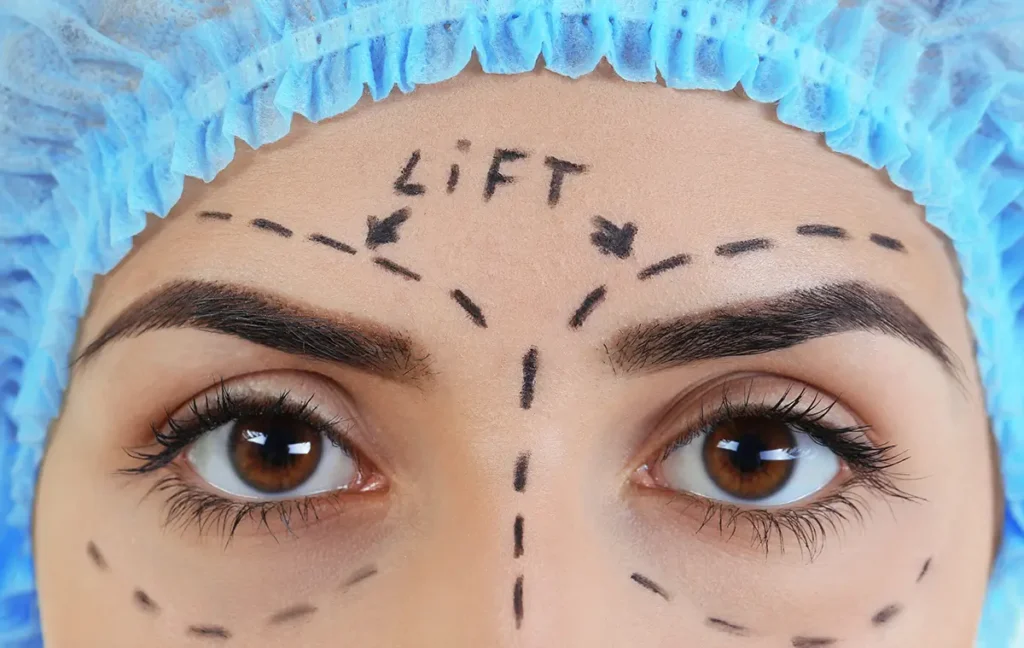
Brow Lift Techniques
Several distinct surgical approaches exist, each with a different incision location, depth of dissection, and range of correction. The right technique is not the newest or least invasive one — it is the one that matches your specific anatomy and goals. Here is an honest breakdown of each.
3.1 Endoscopic brow lift
First described in 1994, the endoscopic technique has become the most commonly performed approach — accounting for more than half of brow lift procedures performed today. Three to five small incisions, each roughly 1.5 cm long, are placed behind the hairline. A small camera is inserted through one incision while instruments work through the others, allowing the surgeon to visualize and release the deeper anchoring structures on a monitor without opening a long scalp incision.
Once the arcus marginalis and conjoint tendon are released, the brow is elevated and secured using fixation devices or sutures anchored to the periosteum. The corrugator and procerus muscles can also be weakened through this approach to address glabellar frown lines.
The endoscopic approach works well for mild to moderate brow ptosis in patients with a normal or low hairline and good skin elasticity. It does not remove skin, which is both its strength (no visible scar) and its limitation (does not address true skin excess or very heavy brows). There is also a small risk of creating a surprised appearance if both medial and lateral brow are elevated too aggressively.
3.2 Temporal (lateral) brow lift
The temporal lift is a targeted approach that addresses only the outer portion of the brow — the part that descends earliest and most in most patients. Incisions are made within the hairline at the temples, and the underlying tissues are lifted and secured in a more lateral vector.
This is a popular choice for patients who are happy with the central and inner brow position but want to correct outer drooping and reduce the heaviness over the upper outer eyelid. Because it does not elevate the medial brow, it avoids the surprised expression that can result from whole-brow elevation. Recovery is faster than a full endoscopic or coronal lift, and incisions are well-hidden.
At ABmedi team Clinic, many of our brow lift patients are ideal candidates for the temporal approach — particularly those in their early 40s with lateral brow descent but otherwise good upper face position.
3.3 Coronal brow lift
The coronal lift is the traditional open approach: a single long incision runs across the top of the scalp from ear to ear, positioned 3–5 cm behind the hairline. The entire forehead flap is lifted forward, deep structures are released and modified, and a strip of scalp tissue is removed before the skin is re-draped and sutured.
This technique offers the most powerful and comprehensive correction — excellent for patients with severe brow ptosis or very deep forehead lines that require direct muscle work. However, it raises the hairline, which makes it unsuitable for patients who already have a high forehead. The zone of scalp numbness behind the incision can be permanent, and there is a small but real risk of visible scarring or hair loss along the incision line. As a result, the coronal lift has largely been replaced by less invasive techniques in most surgical practices.
3.4 Trichophytic (pre-trichial) brow lift
The trichophytic incision is a refinement of the coronal approach designed to solve the hairline elevation problem. Rather than placing the incision behind the hairline, it is positioned just at or within the first few millimeters of the hairline — between the two temporal fusion lines. The incision is beveled at an angle that allows hair follicles to grow through the scar, making it virtually invisible once healed.
Because the incision is placed at the hairline rather than behind it, the hairline does not move upward when the forehead skin is elevated. This makes the trichophytic approach particularly well-suited for patients with a high forehead who want to lower their hairline slightly while also lifting the brows. It offers a powerful, long-lasting lift with a scar that conceals itself well. The trade-off versus the endoscopic approach is a longer incision and a somewhat more involved recovery.
3.5 Subbrow (direct brow) lift
The subbrow lift — also called a direct brow lift — involves making an incision directly along the upper border of the eyebrow hair, removing a precisely calculated ellipse of skin and tissue, and advancing the brow upward to close the defect. The scar sits within or just above the brow itself.
This approach delivers very targeted, predictable brow elevation with minimal dissection and rapid recovery. It is particularly valuable in older patients with thicker brow skin where hiding a scar in the hairline is less relevant, or in situations where brow asymmetry needs correction and millimeter-level precision matters. It is also commonly used in functional brow ptosis repair — where descended brows are obstructing the visual field and insurance coverage may apply. The main drawback is scar visibility, which varies with skin quality and healing but is generally well-tolerated in suitable patients.
3.6 Thread (non-surgical) brow lift
Thread lifts use dissolvable barbed sutures placed beneath the skin to physically pull the brow upward without any surgical incision. They are performed under local anesthesia, recovery is minimal, and results are visible immediately.
The reality, which I am transparent about with every patient who asks: thread lifts for the brow are temporary. Results typically last 12–18 months, and in some cases less. They cannot address skin laxity, muscle banding, or deep forehead lines. They work best as a short-term solution for mild descent in younger patients, or as a bridge procedure before surgery. For patients expecting surgical-quality or surgical-duration results from a thread lift, the disappointment is almost guaranteed.
-
Technique comparison at a glance
| Technique | Best for | Incision | Hairline effect | Longevity | Recovery |
| Endoscopic | Mild–moderate ptosis, normal hairline | 3–5 small scalp cuts (<1.5 cm each) | May rise slightly | ~10 years | 1–2 weeks |
| Temporal | Lateral brow drop only | Small incisions at temples in hairline | Minimal change | 5–8 years | 1 week |
| Coronal | Severe ptosis, low hairline | Ear-to-ear across scalp | Raised | 10–15 years | 3–4 weeks |
| Trichophytic | High forehead, strong correction needed | Along/within hairline edge | Maintained or lowered | 10–15 years | 2–3 weeks |
| Subbrow / direct | Older patients, asymmetry, functional ptosis | Along upper brow border | None | 10+ years | 1–2 weeks |
| Thread lift | Mild descent, temporary solution | No incision | None | 12–18 months | Days |
-
Non-surgical options
Several non-surgical approaches are used to address forehead and brow aging, and they play a legitimate role — particularly in younger patients or those not yet ready for surgery. Here is an honest account of the main options:
- Botulinum toxin (Botox) to the glabella — relaxes the corrugator and procerus muscles, softening vertical frown lines between the brows. It can also be used to selectively weaken brow depressors to allow the frontalis to lift the brow slightly. Results last 3–4 months and require ongoing maintenance.
- Botox to the lateral brow depressors — a targeted injection technique that selectively weakens the lateral orbicularis to allow mild outer brow elevation. Best in patients with very mild descent, typically under age 40. The effect is modest.
- Focused ultrasound (HIFU) — delivers energy to the deep fascial layer to stimulate gradual tissue tightening. Results take two to three months to appear and are modest; repeat sessions are usually needed.
- Radiofrequency microneedling — improves skin quality and triggers some dermal contraction. Useful for texture and early laxity; not a substitute for structural brow elevation.
- Filler in the temples or lateral brow — restoring volume to the temporal hollow can partially support the lateral brow and reduce the appearance of descent. This is a useful adjunct, not a standalone brow lift.
| Clinical perspective
Non-surgical brow treatments are excellent for maintenance and for delaying surgery in appropriate patients. They cannot reposition descended tissue, address brow ptosis of functional significance, or provide surgical-quality structural change. A patient in their 50s with genuine brow descent who has been managing it with repeated Botox and ultrasound treatments for years often reaches a point where surgery provides a far better result at lower cumulative cost. That conversation is worth having early.
-
Who is a good candidate for brow lift surgery?
Candidacy assessment at ABmedi team Clinic involves looking at several factors together rather than any single criterion:
- Brow position — in women, the ideal brow sits at or just above the orbital rim, with an arch that peaks at or slightly lateral to the outer limbus of the eye. In men, the brow typically sits at the rim with less arch. Any brow that has dropped below these positions is a candidate for assessment.
- Degree of ptosis — mild descent may be well-served by a temporal or endoscopic approach. Moderate-to-severe ptosis typically warrants a trichophytic or coronal technique.
- Hairline position — patients with a high forehead or previous hair loss should avoid techniques that elevate the hairline further. The trichophytic approach is designed for this group.
- Skin quality and elasticity — good elasticity yields better, longer-lasting results with any technique. Significant sun damage or very thin skin may influence technique selection.
- Overall health — standard surgical fitness criteria apply. Active smokers are required to quit before surgery.
- Realistic expectations — the goal is natural improvement, not a dramatically different appearance. A brow that looks startled or overly elevated is a failure of surgical judgment, not a success.
| When brow ptosis affects vision
In more advanced cases, a descended brow pushes upper eyelid skin over the lash line, partially obstructing the superior visual field. When this is documented with visual field testing, the procedure may qualify for coverage under some insurance frameworks. At ABmedi team Clinic, we work with patients to assess whether a functional component exists before assuming the procedure is entirely elective.
-
Recovery
Recovery varies significantly between techniques, but the general arc is similar across all of them. Here is a clinically grounded timeline:
Days 1–3
Swelling and bruising around the forehead and eyes are at their most prominent. A compression wrap or bandage is worn. Mild discomfort is typical; most patients manage well with non-prescription pain relief. Keep the head elevated at all times, including during sleep. Thread lift patients are largely past this stage by day two.
Days 4–7
Bruising begins migrating downward and fading. Swelling remains, particularly around the eyes. Temporary scalp numbness and itching as the nerves begin regenerating — this is normal and not a cause for concern. Sutures or staples are typically removed between days 7 and 10.
Week 2
Most patients with endoscopic or temporal procedures are comfortable returning to desk work and light activity. Bruising is mostly resolved, though some residual swelling around the forehead remains. Coronal and trichophytic patients require another week or two before similar milestones are reached.
Weeks 3–6
Sensation gradually returns across the forehead and scalp. The brow continues to settle into its elevated position. Strenuous exercise is typically cleared around week four. Any residual scalp tightness softens progressively.
Months 3–6
Final results are visible as all swelling has resolved and tissues have fully settled. Scars — whether within the hairline or along the brow — continue maturing and fading throughout the first year. Sun protection on any exposed incision areas is essential during this entire period.
-
Frequently asked questions
- Will I look surprised after a brow lift?
Not if the procedure is planned and executed correctly. The surprised appearance results from over-elevation of the medial brow — it is a consequence of poor technique or poor patient selection, not an inherent risk of the surgery. At ABmedi team Clinic, we use anatomical landmarks and intraoperative assessment to ensure elevation is appropriate in both degree and position. For patients concerned about this, the temporal approach specifically avoids medial brow elevation entirely.
- Can a brow lift and eyelid surgery be done together?
Yes — and the combination is very common. When brow ptosis and true upper eyelid skin excess coexist, addressing both in a single procedure produces a more cohesive result than treating them separately. We evaluate the brow and eyelid together during consultation, because the brow position directly affects how much eyelid skin appears excessive. Correcting the brow alone sometimes eliminates the need for eyelid surgery entirely.
- How long do brow lift results last?
Endoscopic and temporal lifts typically last around 8–10 years before noticeable re-descent occurs. Coronal and trichophytic lifts, because they involve skin removal, tend to last 10–15 years. Direct and subbrow lifts are similarly long-lasting. Non-surgical thread lifts last 12–18 months at most. No procedure stops aging permanently — but the structural changes made during surgery are durable, and the end point of aging restarts from an elevated baseline.
- Will the scars be visible?
Hairline incisions (endoscopic, temporal, coronal, trichophytic) are designed to be hidden within or behind the hair and are generally imperceptible once healed. The trichophytic approach is particularly scar-friendly because the beveled incision allows hair to grow directly through the scar line. Direct brow incisions are placed within the brow hair itself and fade substantially over 6–12 months. Scar quality also depends on genetic healing tendency, sun exposure management, and whether the patient smokes.
- What is the best age to consider a brow lift?
There is no specific age threshold — the right time is when the descent is bothering you and the anatomy warrants correction. In practice, patients in their late 30s to 40s with lateral brow descent and good skin quality are often excellent candidates for a temporal or endoscopic lift. Those in their 50s–60s with more advanced changes may require a more comprehensive approach. The anatomical assessment tells us more than the patient’s age alone.
- What is glabellar line reduction and is it part of a brow lift?
Glabellar lines are the vertical furrows between the eyebrows caused by the corrugator supercilii and procerus muscles. Most brow lift techniques — especially endoscopic and coronal approaches — address these muscles directly as part of the procedure, either by weakening, scoring, or partially removing them. This is one of the lasting advantages of surgical brow lifting over repeated Botox: the muscle modification is permanent, and glabellar frown lines are significantly reduced without ongoing injections.
9. A final word from the surgeon
The upper face — brows, forehead, and the area around the eyes — is where expression lives. It is where other people read whether you are tired, angry, focused, or at ease. When age shifts those structures out of their natural position, the mismatch between how you feel and how you read to others can be genuinely frustrating. A well-planned brow lift closes that gap.
What I always tell patients considering this procedure: the technique matters less than the judgment behind it. Every approach described in this article has a rightful place in the right patient. The error — the source of the “over-operated” results you occasionally see — is almost always a mismatch between patient anatomy and technique choice, or between patient expectations and what surgery can honestly deliver.
At ABmedi team Clinic, our consultations are designed to answer the question honestly before any procedure is planned: does your anatomy actually warrant this surgery, which technique fits your specific structure, and are the results you are expecting realistic? If the answer to any of those is unclear, we take the time to work through it. The best outcomes come from that clarity — not from moving quickly to the operating room.
| What to bring to your consultation
Old photographs — from 10 or 15 years ago — are genuinely useful. They help us see the baseline you are comparing yourself to and give us a shared reference point for what a natural, personalized result should look like for your face. They also help distinguish true brow ptosis from other anatomical changes that may need a different approach entirely.
📞 💬 WhatsApp / Chat: [http://wa.me/84975142666] 🌐 Book online: [+84-975-142-666]
Consultations are available in-clinic and online for international patients. Most patients leave their first appointment knowing exactly what they need — and feeling confident about the path ahead.
