


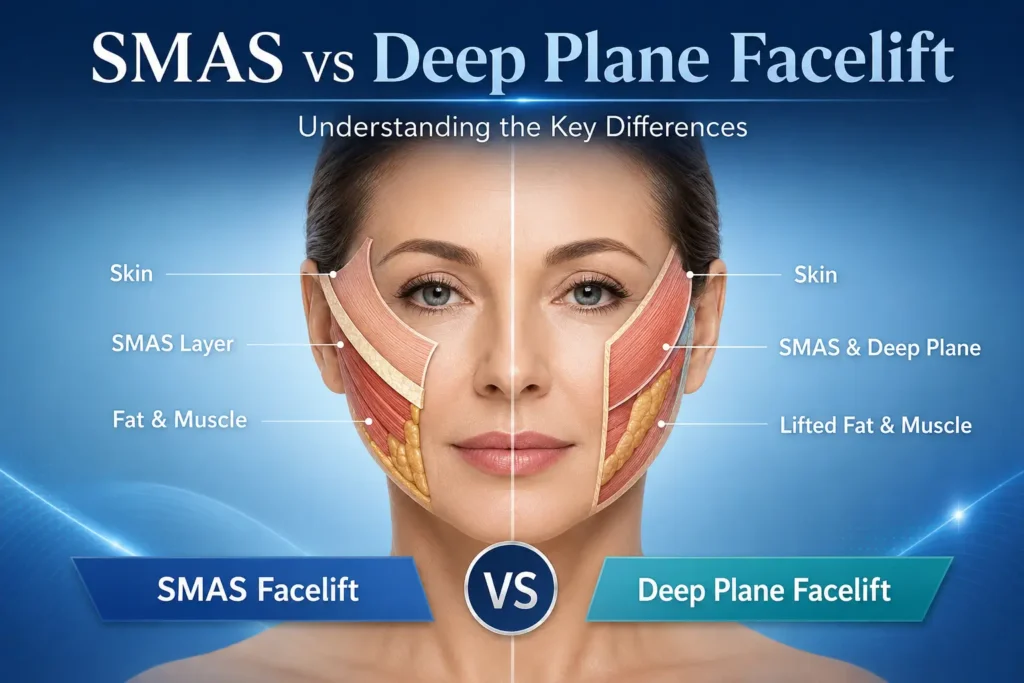
Not every facelift is the same. As a surgeon, the most important conversation I have with patients considering facial rejuvenation is about which technique actually fits their anatomy — not just which name sounds most advanced.
When patients come into our clinic asking about facelifts, two techniques consistently come up: the SMAS facelift and the deep plane facelift. Both are legitimate, well-established approaches to rhytidectomy. But they operate on fundamentally different anatomical principles, produce different results, and suit different patients. Understanding those distinctions is the only honest way to make this decision.
Let me walk you through what actually separates these two procedures — as a surgeon who has performed both.
1. What Is the SMAS?
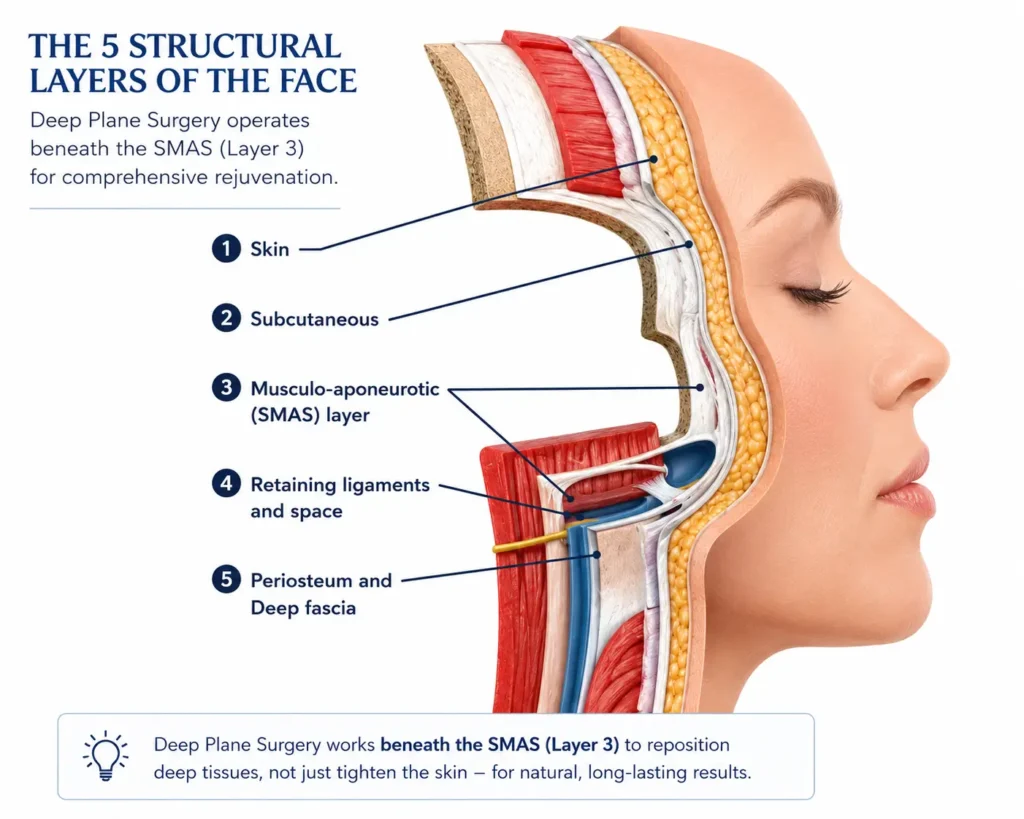
The SMAS — Superficial Musculoaponeurotic System — is a fibromuscular sheet that lies just beneath the skin and above the deeper facial muscles and fat compartments. Think of your face as a layered bed: the skin is the blanket, the SMAS is the mattress. When the mattress sags, pulling the blanket tighter doesn’t restore the form — it just creates surface tension.
Both SMAS and deep plane facelifts engage this layer. The critical difference is how deeply they go, and whether the retaining ligaments — the anchoring fibrous bands that tether soft tissue to the underlying bone — are released or left intact.
2. The SMAS Facelift: A Proven, Targeted Approach
In a SMAS facelift, the surgeon elevates the skin separately from the SMAS layer, then tightens the SMAS itself — either by folding and suturing it (plication) or by removing a measured strip and securing the edges (imbrication). The skin is then re-draped over this restructured foundation.
This technique is a genuine upgrade over skin-only procedures because it addresses structural support rather than surface tension alone. For patients with mild to moderate lower-face laxity, jowling, or early jawline softening, it can produce reliable, gratifying results in the hands of a skilled surgeon.
The limitation is anatomical: because the retaining ligaments are not fully released, the amount of tissue mobilization is constrained. The mid-face — the cheek mound, nasolabial region, and malar fat pad — often remains inadequately addressed. Some tension is inevitably distributed through the skin, which can occasionally produce a slightly pulled appearance in patients with advanced aging.
3. The Deep Plane Facelift: A Structurally Different Operation
The deep plane technique is not simply a “more of the same” version of the SMAS lift. It is a philosophically different operation. Rather than separating skin from SMAS, the surgeon enters the anatomical space beneath the SMAS — the deep plane — and elevates the skin and SMAS together as a single unified composite flap. The blood supply to this combined unit is preserved, which is one reason healing tends to be predictable.
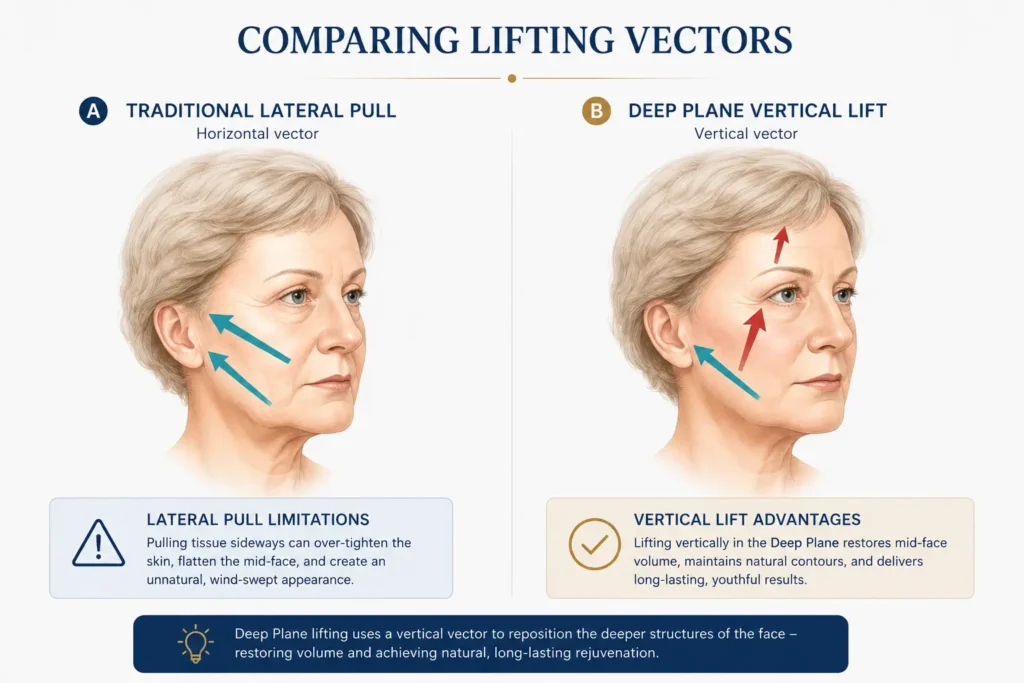
The defining step — and the one that distinguishes genuine deep plane surgery from procedures that merely borrow the name — is the systematic release of the facial retaining ligaments, particularly the zygomatic and masseteric ligaments. Once these structures are released, the entire midface and lower face can be repositioned vertically, against the direction of gravitational descent, without placing any tension on the skin.
This “tension-free” repositioning is why patients who undergo a proper deep plane facelift typically look refreshed rather than operated on. There is no telltale skin pull because the skin is not being used as the primary vehicle of lift. The structural tissues do the work.
In my experience, the deep plane technique is not merely a surgical refinement — it is a fundamentally different philosophy. By releasing the retaining ligaments and repositioning the entire composite flap as a unit, we restore what gravity has displaced rather than simply tightening what remains. That distinction changes both the quality and the longevity of the result.
— AbMedi Team Clinic Surgical Team, Board-Certified Facial Plastic Surgery
4. Side-by-Side Comparison
| Feature | SMAS Facelift | Deep Plane Facelift |
| Tissue Layer | Skin elevated separately; SMAS tightened above deep plane | Skin + SMAS elevated together as a composite flap beneath the SMAS |
| Retaining Ligaments | Generally not released | Systematically released (zygomatic, masseteric) |
| Mid-face Correction | Limited — primarily lower face and jawline | Comprehensive — cheek, nasolabial, jowl, neck |
| Skin Tension | Moderate — some tension distributed through skin | Minimal — tension-free skin closure |
| Naturalness of Result | Good in skilled hands for right candidates | Typically softer, more organic appearance |
| Longevity | Approximately 7–10 years | Approximately 10–15+ years |
| Recovery (Social) | 10–14 days typical | Approximately 10–15+ years |
| Technical Complexity | Advanced | Highly specialized — surgeon experience is critical |
| Best Candidates | Mild–moderate aging; lower face focus | Moderate–advanced aging; comprehensive rejuvenation |
| Patient Satisfaction | 87.8% (meta-analysis, 2024) | 94.4% (meta-analysis, 2024) |
5. Why Deeper Dissection Leads to More Natural Results?
One of the most common misconceptions patients bring to consultation is that a deeper, more extensive procedure must look more “done.” The clinical reality is the opposite. Because the deep plane technique releases the structural anchors that have held displaced soft tissue in place, those tissues can be repositioned to where they naturally belong — higher on the facial skeleton — without surface tethering.
The SMAS facelift, by contrast, requires some skin tension to achieve visible correction because the deep-anchor ligaments remain intact. In younger patients with good skin quality, this tension is manageable and resolves well. In patients with more advanced laxity, it can occasionally produce an overly taut look at the skin surface.
It’s also worth noting a practical reality about recovery: the deep plane actually tends to produce less postoperative bruising than SMAS techniques. The space between skin and SMAS is highly vascular; separating these layers causes bleeding. The deep plane, by contrast, is an avascular anatomical corridor — a naturally occurring gliding space with remarkably few blood vessels. Less vascular disruption means less bruising and often a smoother early recovery.
6. Which Procedure Matches Your Anatomy?
SMAS Facelift May Suit You If…
|
Deep Plane May Suit You If…
|
There is no universally “correct” technique — only the right technique for a specific patient’s anatomy, degree of aging, and goals. At AbMedi Team Clinic, our consultation process includes a thorough anatomical assessment: skin quality, subcutaneous fat distribution, bone structure, degree of ligamentous laxity, and the specific regions of the face that are most affected. The technique follows the anatomy, not the other way around.
7. A Word of Caution: Not All “Deep Plane” Procedures Are Equal
The term “deep plane facelift” has become a popular marketing label — and that creates a real clinical problem. A surgeon can call any procedure a deep plane facelift regardless of whether it involves true sub-SMAS dissection, complete ligament release, and proper composite flap mobilization. The name alone tells you nothing about the actual operation being performed.
What defines a genuine deep plane facelift is technical: entry into the sub-SMAS plane, systematic release of the retaining ligaments, and en-bloc mobilization of the composite flap in a vertical vector. These steps require significant anatomical knowledge and years of dedicated experience. A SMAS facelift performed with precision and skill by an experienced surgeon will almost always produce better results than a so-called deep plane performed by someone with limited experience in the technique.
Before choosing a surgeon, ask to see consistent before-and-after results — not just credentials. Review outcomes across a range of ages and facial types. That evidence matters far more than the procedure name on the website.
8. Recovery: What to Realistically Expect
Days 1–3
Moderate swelling and some bruising are normal. A compression garment supports the tissues. Discomfort is manageable with prescribed analgesics. Rest is the primary activity.
Days 4–7
Bruising begins to transition from deep purple to yellow-green. Sutures in front of the ears are typically removed. Light walking is encouraged to support circulation.
Weeks 2–3
The majority of visible swelling has resolved. Most patients feel comfortable returning to work and social settings. Some residual tissue firmness is normal and expected.
Months 1–3
Final contour continues to refine as residual deep swelling resolves. Sensation in the cheeks and jawline returns progressively. The result begins to look fully natural.
6 Months +
The result is fully mature. Patients enjoy a refreshed, natural appearance with uninhibited facial expression and restored volume — and, for deep plane patients, structural longevity that typically extends well over a decade.
9. Safety, Nerve Preservation, and Scar Management
Facial nerve safety is the most critical consideration in any rhytidectomy. The deep plane technique does involve working in proximity to the facial nerve branches — which is precisely why surgeon experience is non-negotiable. In experienced hands, the risk of permanent facial nerve injury is very low for both procedures, though the deep plane demands a higher standard of anatomical familiarity.
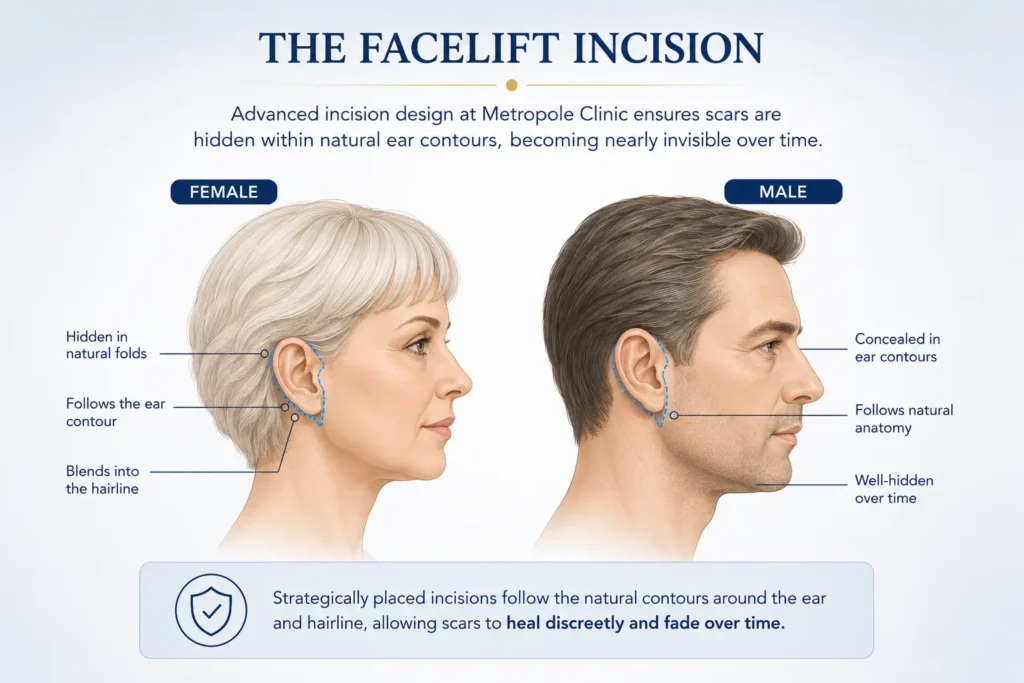
Incisions for both techniques follow the natural contours of the ear — in front of and behind it — and are placed to blend with hairlines and skin folds. When properly planned and closed, scars from either procedure are typically well-hidden and fade significantly over 12 months.
What to Confirm Before Surgery
– Your surgeon should be board-certified with specific facelift subspecialty training
– Ask specifically how many deep plane facelifts the surgeon performs annually — volume and consistency matter
– Verify that the facility holds recognized accreditation for surgical procedures
– Review actual patient photographs across age groups and facial types, not selected highlights
– Understand the revision policy: a confident, experienced surgeon stands behind their outcomes
10. Frequently Asked Questions
- Is the deep plane facelift always better than SMAS?
Not universally. For the right patient — typically someone with mild-to-moderate aging confined to the lower face — a well-executed SMAS lift produces excellent, lasting results. The deep plane becomes the superior choice when mid-face descent, deep nasolabial folds, or comprehensive rejuvenation are the goals.
Does the deep plane facelift take longer to recover from?
Counterintuitively, no — and often the opposite is true. Because the deep plane is an avascular space, there is typically less intraoperative bleeding and less postoperative bruising than with SMAS techniques that separate highly vascular tissue layers. Social downtime for both is generally 10–14 days.
- How long do results last?
SMAS facelift results generally hold for approximately 7–10 years. Deep plane results, due to structural repositioning rather than skin tension, commonly last 10–15 years or longer. Neither technique stops future aging, but both reset the clock meaningfully.
- Can I have a deep plane facelift if I’ve already had a SMAS lift?
Yes, in many cases. Revision facelift surgery is more complex and requires careful assessment of prior scar tissue, remaining tissue quality, and skin elasticity. It is entirely feasible in the right surgical hands, and many patients seek a deep plane procedure as a revision after earlier results have faded.
- Will I look natural afterward?
Both techniques, when performed correctly and for appropriate candidates, produce natural-looking results. The deep plane technique has a structural advantage in this regard — tension-free tissue repositioning means the face moves freely and expressively without the telltale tightness sometimes associated with earlier facelift styles.
📞 💬 WhatsApp / Chat: [http://wa.me/84975142666] 🌐 Book online: [+84-975-142-666]
Consultations are available in-clinic and online for international patients. Most patients leave their first appointment knowing exactly what they need — and feeling confident about the path ahead.
