


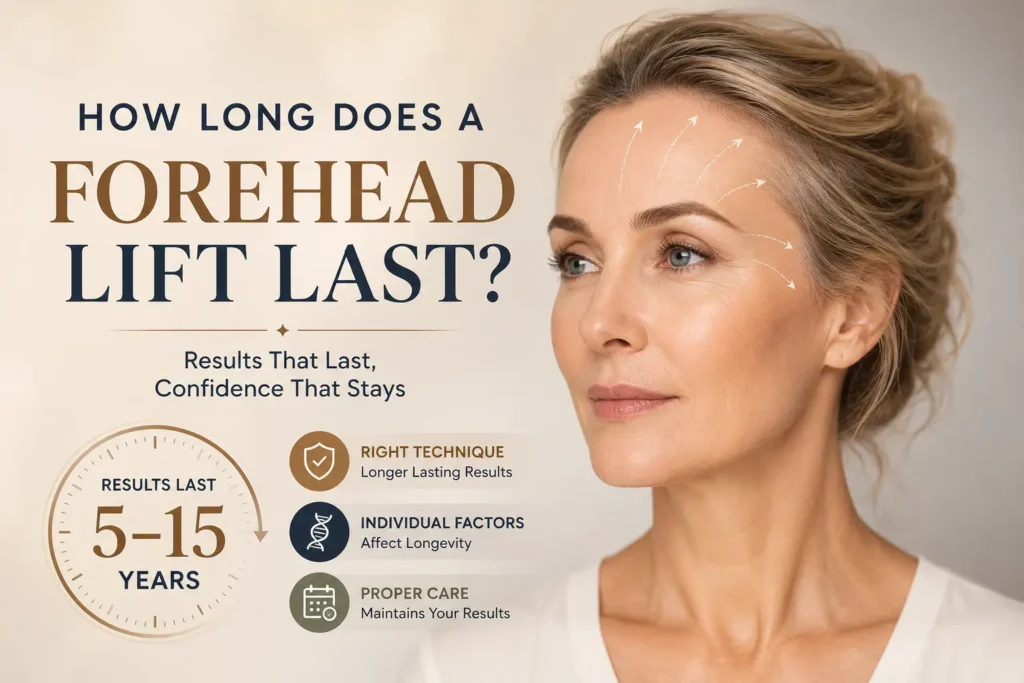
How Many Years Does a Brow Lift Last?
The most straightforward answer: most forehead lifts produce visible, meaningful results for between 5 and 15 years, with the wide range explained almost entirely by two things — the surgical technique used and the individual patient’s biology. This is not a procedure whose benefits fade after a year or two the way injectables do. A well-executed forehead lift re-engineers the structural relationship between your brow, forehead tissue, and the underlying muscle — and that repositioning is durable.
Technique is the single most important variable in how long your results last:
| 5–10 yrs
Endoscopic Brow Lift |
The most commonly performed modern technique. Small hairline incisions, an endoscope for precision tissue repositioning, and internal fixation rather than skin removal. Results are natural and recovery is faster, but the structural hold is somewhat less powerful than open techniques — hence the slightly shorter duration range. |
| 10–15 yrs
Coronal / Open Brow Lift |
The traditional approach involving an incision across the scalp from ear to ear. More invasive and now less frequently performed, but delivers the most powerful and longest-lasting structural correction. Best suited for patients with significant forehead laxity and deep tissue descent. |
| 3–5 yrs
Temporal / Limited Brow Lift |
A conservative option targeting lateral brow descent specifically. Shorter incisions, faster recovery, subtler result. Duration is shorter because only one segment of the brow architecture is addressed. Useful for patients with early aging or those wanting a modest, targeted correction. |

At ABmedi Team Clinic, we select the technique based on the degree of anatomical descent, hairline position, skin quality, and the patient’s recovery preferences — not a one-size-fits-all approach. The technique that lasts longest is the one correctly matched to the individual anatomy in front of us.
Are Forehead Lift Results Permanent?
The procedural changes to your soft tissue architecture are permanent in the sense that the tissue is genuinely repositioned and the structural anchoring holds. However, aging does not pause after surgery — your skin continues to lose collagen, the dermis gradually thins, and gravity maintains its lifelong claim on facial soft tissue. The result is that over the years following surgery, some degree of natural descent will resume.
The crucial distinction that patients often miss: you will always look younger than you would have looked without the surgery. A forehead lift does not return you to zero — it gives you a permanently elevated baseline. A patient who undergoes surgery at 52 and sees gradual descent over the following decade will, at 62, still look meaningfully younger than a 62-year-old who never had the procedure. The aging clock continues, but from a better starting point.
How to Think About It
Imagine a timeline where natural aging would bring your brow to a significantly descended position by age 65. A forehead lift effectively “resets” that timeline to an earlier point — say, your brow position at 40. The aging that follows surgery is the same aging that would have happened anyway, just starting from a younger-looking baseline. You don’t lose the years you gained; you carry them forward.
Will My Forehead Wrinkles Come Back?
Yes — eventually, and to a degree. But with an important qualifier: when forehead wrinkles reappear after a brow lift, they are materially less deep and less numerous than they would have been without the surgery. The structural correction substantially delays the timeline of wrinkle progression; it does not guarantee a wrinkle-free forehead indefinitely.
The mechanism is straightforward. Horizontal forehead lines form from two sources: repetitive frontalis muscle contraction and gradual skin laxity from collagen depletion and sun damage. A forehead lift addresses the structural component — reducing the amount of skin available to crease, repositioning tissue to reduce folding — but it does not stop the frontalis from contracting or permanently reverse the biology of skin aging. Post-operatively, a combination of diligent sun protection, medical-grade skincare, and strategic Botox maintenance (to moderate frontalis activity) is the most effective strategy for keeping results fresh over the long term.
ABmedi Team Clinic Recommendation
We advise all forehead lift patients to begin a structured post-operative maintenance protocol: daily broad-spectrum SPF 50 sunscreen, a retinoid-based evening skincare regimen, and Botox appointments every 4–6 months to limit dynamic line recurrence. Patients who follow this consistently often report that their surgical results look excellent well past the ten-year mark.
The Aesthetic Outcome: Does a Forehead Lift Look Natural?
The single most persistent fear I encounter in consultations — more than recovery concerns, more than cost — is the worry about looking artificial. Patients have seen the overdone results: foreheads that look shrink-wrapped, brows arched so high they belong on a cartoon character, a general expression of perpetual alarm. This is a completely legitimate concern, and I want to address it directly: those outcomes are the product of a specific technical error, not an inherent risk of the procedure itself.
Will I Look Surprised After a Brow Lift?
The “surprised” or “startled” appearance that patients rightfully fear has a precise anatomical cause: over-elevation combined with incorrect vector direction. When a surgeon lifts the brow in a purely vertical plane — pulling upward uniformly across the entire forehead — two problems compound each other. First, the medial (inner) brow rises too high, flattening or reversing the natural arch and creating the alarm-clock look. Second, the forehead skin is placed under excessive tension, producing a tight, immobile appearance that reads as operated-on rather than rested.
The Anatomy of a Natural-Looking Brow Lift: The brow does not age uniformly. The medial (inner) portion of the brow — anchored more firmly by the procerus and corrugator muscles — descends less dramatically than the lateral (outer) tail, which is supported primarily by soft tissue that weakens considerably with age. A technically precise brow lift accounts for this differential descent by lifting the lateral brow more than the medial brow, restoring the natural downward-medial to upward-lateral arch rather than creating an artificial uniform elevation.

At ABmedi Team Clinic, our surgeons plan the elevation vector individually for each patient using pre-operative anatomical mapping, ensuring the lift follows the same spatial trajectory the brow originally aged along — not a generic upward pull that ignores individual brow geometry. The result is a position the face recognises as its own younger self, not a position imposed from the outside.
There is a second, often overlooked cause of unnatural post-operative appearance: placing the fixation point too far superiorly (too high). When the tissue is anchored in the wrong position, the entire brow complex sits unnaturally elevated during rest, and the patient loses the ability to lower the brow naturally, eliminating one of the key elements of relaxed expression. Correct fixation placement — informed by meticulous anatomical assessment — preserves full mobility in all directions. After healing, the patient can raise and lower the brow exactly as before.
The goal of a correctly performed forehead lift is not a dramatically higher brow — it is the restoration of the brow position the patient had in their thirties. That is a subtle, recognisable change that patients’ own circles invariably describe as “you look so well-rested” rather than “did you have surgery?”
Does a Brow Lift Change Eye Shape?
This question reveals a misunderstanding about the anatomy of the periorbital region that is worth clarifying carefully, because the answer directly addresses one of the deepest fears patients carry into consultation — the fear of losing their familiar face.
A forehead lift does not alter the intrinsic structure of the eye itself. The globe, the lid margin, the medial and lateral canthal angles — none of these are touched during the procedure. What a brow lift does is remove the weight that a descended brow has been pressing onto the upper lid. Think of it as releasing a curtain that has been draped across the eyelid platform. When the curtain (the descended brow and its associated skin) is lifted back to its natural height, the eye that was always there — the larger, more open eye of your younger face — is simply revealed again.
Patients often describe the effect as their eyes looking “rounder” or “larger” post-operatively. This is anatomically accurate: the visible aperture of the eye — the amount of the iris that can be seen without the overhanging brow shadow — genuinely increases when the brow is correctly repositioned. But this is restoration, not alteration. The eye structure itself is unchanged. What changes is how much of it is visible.
Clinical Distinction
The occasional patient concern that “the surgery will make my eyes look different” confuses two things: the appearance of the eye (which is affected by what surrounds and overshadows it) and the structure of the eye (which is not). A brow lift changes the former by correcting what was masking it. The fundamental character of the patient’s eyes — the shape, colour, lid crease, and expression — is preserved entirely.
Maximising Your Investment: What Influences the Longevity of Your Lift?
Forehead lift longevity is not a fixed number — it is a range shaped by interacting variables, some surgical, some biological, and some entirely within the patient’s control post-operatively. The table below maps the key factors, their level of impact, and the specific guidance we give every patient at ABmedi Team Clinic to help them protect the years of rejuvenation they have invested in.
| Factor | Impact Level | Mechanism | ABmedi Team Clinic Guidance |
| Surgical Technique | ● High | Coronal lifts reposition more tissue and anchor more deeply than endoscopic or temporal approaches, resulting in longer structural correction. Precision of vector alignment determines how natural and durable the result appears. | We select technique based on the individual’s degree of brow ptosis, hairline position, and skin laxity — not patient age alone. Deeper tissue work when anatomy warrants it; minimal technique when it doesn’t. |
| Genetic Aging Rate | ● High | Collagen degradation rate, intrinsic skin elasticity, and the pace of soft tissue descent are substantially heritable. Patients with a family history of rapid facial aging may see results begin to relax earlier than average. | We conduct a thorough family and personal aging history during consultation to calibrate realistic duration expectations and to plan combination procedures where appropriate. |
| Sun Protection (SPF) | ● High | UV radiation is the single largest extrinsic accelerator of collagen breakdown and skin laxity. Cumulative sun damage directly degrades the dermal architecture that surgical tissue repositioning depends on for long-term stability. | Daily SPF 50 broad-spectrum application is non-negotiable from day 14 post-op onward. We recommend mineral-based sunscreens for patients with sensitive post-surgical skin, and physical sun protection (hats, shade) during peak UV hours. |
| Smoking Status | ● High | Nicotine causes sustained peripheral vasoconstriction, reducing blood flow to the skin and impairing collagen synthesis. Smokers not only have longer and more complicated healing post-operatively — they also lose results faster due to accelerated dermal degradation. | We require smoking cessation a minimum of four weeks before surgery and strongly advise permanent cessation. Patients who resume smoking post-operatively should expect meaningfully shorter result duration. |
| Skincare Routine | ● Moderate | Medical-grade retinoids stimulate new collagen production and improve dermal thickness over time, directly supporting the quality of the tissue in which surgical correction is anchored. Hyaluronic acid and antioxidant serums support the hydration and oxidative defence of the skin barrier. | We establish a prescribed post-operative skincare regimen at the 4-week follow-up appointment: retinol or prescription tretinoin in the evening, vitamin C serum in the morning, and a ceramide-rich moisturiser. Protocol is personalised to skin type. |
| Botox Maintenance | ● Moderate | After a forehead lift, the frontalis muscle remains active and will continue creating dynamic horizontal lines over time. Regular Botox to the frontalis and glabellar complex limits this dynamic creasing, preserving the smooth forehead appearance that surgery established. | We recommend Botox maintenance every 4–6 months beginning 12 weeks post-operatively, once healing is complete. This is not corrective treatment — it is protective maintenance for the surgical result. |
| Diet & Hydration | ● Lower | Nutrient deficiencies — particularly vitamins C, E, and zinc — impair collagen synthesis and skin repair. Chronic dehydration visibly accelerates the appearance of skin laxity. High-sugar diets accelerate glycation, which cross-links and weakens collagen fibres. | A diet rich in antioxidants, lean protein, and omega-3 fatty acids supports optimal skin health. Adequate hydration (minimum 2L daily) helps maintain dermal turgor and overall tissue quality. |
| Weight Fluctuation | ● Lower | Significant weight gain followed by loss — particularly repeated cycles — stretches and permanently weakens the dermis, reducing the skin’s ability to maintain the tightened position established by surgery. | We advise patients to be at or near their target weight before surgery and to maintain a stable weight thereafter. Substantial weight changes after surgery can compromise both the structural result and skin quality. |
The Bottom Line on Protecting Your Results
Of the factors above, sun protection and smoking cessation offer the highest return on effort. A patient who never sunscreens and continues to smoke will likely see their results fade considerably faster than the average range suggests. A patient who is diligent about SPF, follows a retinoid skincare regimen, and keeps up with Botox maintenance often finds that their surgical results hold beautifully well past the ten-year mark — sometimes significantly longer.
The forehead lift is a structural investment. Like any investment, the return it delivers over time is influenced by how well it is managed after the initial commitment. At ABmedi Team Clinic, we treat the post-operative maintenance conversation as an equal part of the consultation, because the surgery and the aftercare together are what produce exceptional long-term outcomes.
Frequently Asked Questions
Q1: Is a forehead lift worth it?
Real Results: Absolutely. If you are frustrated by heavy, low eyebrows that make you look constantly tired, angry, or years older than you actually are, a forehead lift is one of the most rewarding transformations available. It does not just mask the issue; it physically lifts the deep, fallen tissue and smooths out stubborn forehead creases natively.
A Natural, Refreshed Look: Unlike over-injecting the upper face which can leave you with a stiff, “frozen” appearance, a surgical lift restores a naturally alert, open, and youthful look. Patients frequently report that the psychological boost—looking in the mirror and finally seeing a rested, vibrant version of themselves—makes it entirely worth the investment.
Q2: How painful is a forehead lift?
Intra-op & Post-op: The surgical procedure is completely painless as it is performed under expert anesthesia.
Recovery Sensation: During the first few days of recovery, patients describe a sensation of tight, dull aching, mild pressure, and temporary numbness around the incision line rather than acute, sharp pain. This is fully managed with routine post-op care.
Q3: Is a forehead lift permanent?
While it cannot halt the natural aging process, it offers long-term correction. Your structural results will reliably hold for 10 to 15 years before the facial tissues begin to settle naturally over time.
Q4: How expensive is a forehead lift?
ABmedi Team Package: We structure our quotes as an all-inclusive package ranging from $7,000 to $9,500, which leaves zero surprise fees by covering the surgeon’s expertise, anesthesia, accredited facility use, and comprehensive post-op monitoring.
Combo Discounts: When integrated into a comprehensive session (such as combining with an Upper Blepharoplasty or a Facelift), the shared overhead allows us to optimize the total financial investment by 20% to 30%.
Q5: What is the alternative to a forehead lift?
Botox/Dysport: The most common non-surgical alternative is botulinum toxin to temporarily relax the depressor muscles that pull the brow downward, creating a subtle arch.
The Biological Ceiling: However, Botox is strictly a maintenance tool for early, dynamic changes. Once structural brow ptosis has progressed and tissue has truly descended, Botox hits an anatomical ceiling. It cannot lift sagging skin or shorten a lengthened forehead like an endoscopic or surgical lift.
📞 💬 WhatsApp / Chat: [http://wa.me/84975142666] 🌐 Book online: [+84-975-142-666]
Consultations are available in-clinic and online for international patients. Most patients leave their first appointment knowing exactly what they need — and feeling confident about the path ahead.
