


Is It Safe to Get a Facelift in Vietnam?
Is It Safe to Get a Facelift in Vietnam? Yes — but the honest answer has a condition attached to it: safety in Vietnam is not a property of the country, it’s a property of the specific facility and surgeon you choose. Vietnamese law is unambiguous about where a facelift is allowed to happen. Under Circular 41/2011/TT-BYT, procedures like facelifting, breast augmentation, and liposuction may only be performed inside a licensed specialized aesthetic surgery hospital, or within a general hospital that has a dedicated, explicitly licensed aesthetic surgery department. A beauty salon or spa is legally barred from touching a scalpel, no matter what its marketing implies.
That legal framework exists because facelifting under general anesthesia carries genuine surgical risk, and regulators have tightened enforcement in recent years. Law 15/2023/QH15 now allows fines of up to VND 200 million — and criminal prosecution in cases of serious harm — for facilities that mislead patients or operate outside their license. Combined with steadily improving hospital infrastructure and surgeons trained across France, South Korea, and the United States, this is why Vietnam has become one of Asia’s most credible destinations for facial surgery, often at 40–70% below Western pricing, without a corresponding drop in surgical standard — provided you stay inside the licensed system.
The short version
A facelift performed at a Ministry of Health–licensed hospital, by a credentialed surgeon, carries a risk profile comparable to the same procedure in the US, UK, or Australia. The danger isn’t Vietnam — it’s the unlicensed operators who piggyback on Vietnam’s reputation.
Are Vietnamese Plastic Surgeons Board-Certified?
The reputable ones, yes — but “certified” is a word that gets stretched thin in cosmetic surgery marketing everywhere in the world, not just in Vietnam, so it’s worth knowing what a genuine credential actually looks like here.
A properly qualified facelift surgeon in Vietnam will hold a formal Ministry of Health practicing certificate specific to plastic and aesthetic surgery — this is the legal, non-negotiable floor. Above that floor, the strongest candidates typically carry a Master’s degree or a Specialist Degree Level II (Chuyên khoa 2) in plastic surgery from top-tier institutions such as the Vietnam Military Medical University or the University of Medicine and Pharmacy. In the Vietnamese medical system, this rigorous academic and clinical residency path serves as the direct equivalent to Western Board Certification.
Many of these elite surgeons then complete international fellowships in France, South Korea, or the United States, and hold active membership in a recognized professional body such as the Vietnamese Society of Aesthetic Plastic Surgery (VSAPS) or ISAPS.
Here’s the caveat I want to be direct about: in Vietnam, as in most countries, any licensed general physician can legally perform certain cosmetic procedures. A basic medical license is not the same thing as specialized board certification in plastic surgery. This is exactly why the verification step below matters more than any single credential on its own — one document tells you a person is allowed to practice medicine; it doesn’t tell you they’re specifically trained to lift a face.
What Accreditation Should You Look For in a Facelift Clinic? (JCI, Ministry of Health)
Accreditation operates on two levels — the surgeon’s personal credentials, which we just covered, and the facility’s institutional accreditation, which governs everything from sterilization protocol to how quickly a crash cart reaches your bedside. Both need to check out.
| Accreditation | What It Actually Verifies | Is It Mandatory? |
| Ministry of Health License | Legal authorization to perform surgical aesthetic procedures under Circular 41/2011/TT-BYT | Yes — non-negotiable, legally required |
| Specialized Aesthetic Surgery Hospital Status | Confirms the facility (not just a general clinic) is explicitly licensed for surgical cosmetic procedures | Yes — required for facelift-level surgery |
At ABmedi Team Clinic, we hold our Ministry of Health operating license as the baseline, not the headline — because it’s the law, not a marketing achievement. Where I’d encourage you to look harder is at whether a facility’s JCI or equivalent international accreditation is current and verifiable, since that’s what tells you the hospital is measured against a global standard rather than the local minimum.
How to Verify a Surgeon’s Credentials Before You Travel
I tell every prospective patient the same thing: do this verification before you book flights, not after you land. A short video consultation is the easiest place to start, and it’s also where a legitimate clinic will happily hand over documentation without hesitation.
- Ask for official numbers: Request the Ministry of Health practicing certificate number and the hospital’s own operating license number. A reputable facility will display or provide this without being pressed.
- Request a written training history: Look for the specific medical school, residency program, and international fellowships, rather than accepting a vague “internationally trained” claim.
- Cross-check professional societies: Check membership with the Vietnamese Society of Aesthetic Plastic Surgery or ISAPS, and verify it independently through their official online directories.
- Evaluate procedure-specific case logs: Ask to see real patient results specific to facelifting (e.g., Deep Plane or SMAS lifts), not a general breast or body portfolio. Technique-specific experience matters for a procedure this technical.
- Confirm the exact surgical venue: Ensure the surgery will take place inside the licensed hospital itself, not at a separate “partner” spa location you haven’t been able to verify.
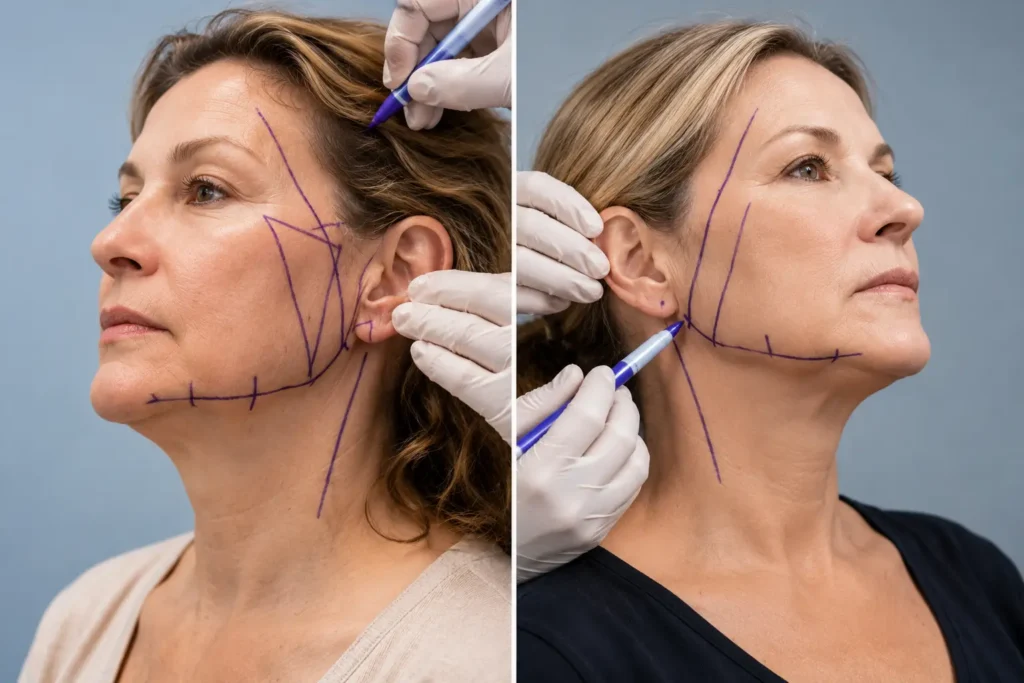
A note on titles: Be cautious of clinics that lean heavily on the word “certified” without naming the certifying body. A genuine credential always has a specific name attached to it — a university, a Ministry, or a recognized international society. If a clinic won’t name one when asked directly, treat that as a signal to keep looking.
What Happens If Complications Arise During Recovery?
No honest surgeon will tell you facelift surgery is risk-free — it isn’t, anywhere in the world. The recognized risks include hematoma, infection, bleeding, contour irregularity, and temporary or, rarely, lasting nerve changes. What determines the outcome isn’t whether a complication can occur, but how quickly and competently it’s managed if it does.
This is where pre-operative screening earns its place, not as paperwork but as protection. Before I’ll accept a patient for surgery, we require blood tests, coagulation and clotting studies, hepatitis and HIV screening, liver and kidney function panels, and a cardiac and pulmonary workup including an ECG. If you’re managing diabetes, hypertension, or cardiovascular disease, those conditions need to be stable before you travel — arriving with an unmanaged condition can mean being deemed unfit for surgery on arrival, which protects you even when it’s disappointing to hear.
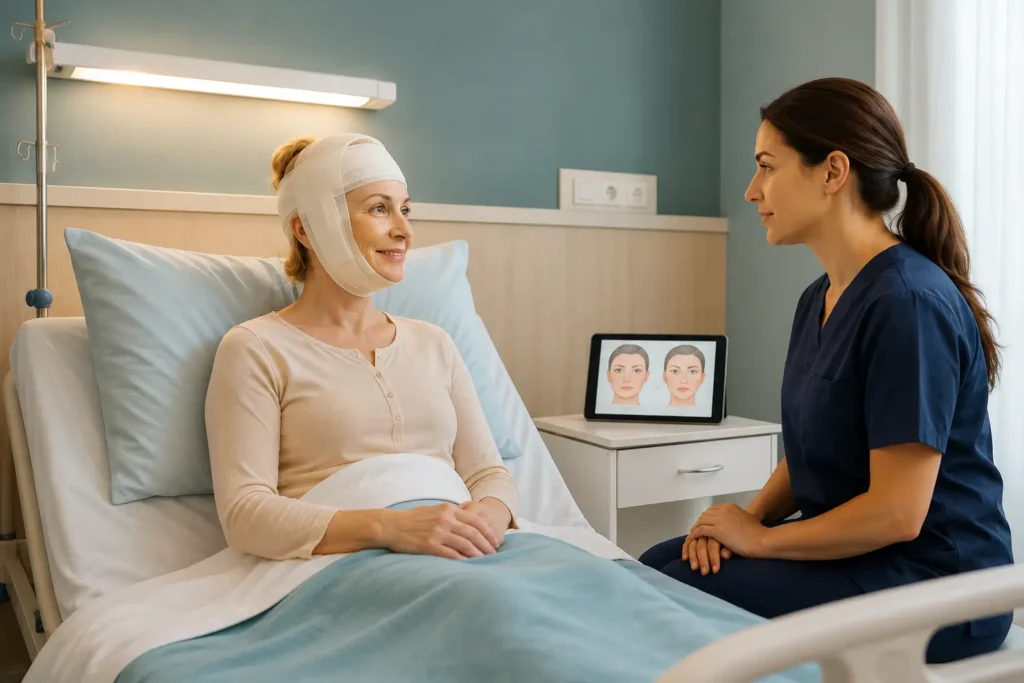
If something does arise during recovery, a reputable clinic keeps the operating surgeon reachable, not a call center. At ABmedi Team Clinic, patients have direct contact with their surgical team through the first days of recovery specifically so early warning signs — unusual swelling, fever, asymmetric bruising — are caught and addressed immediately rather than discovered too late. Early intervention is what keeps a manageable complication from becoming a serious one.
Do Clinics in Vietnam Have Emergency and ICU Backup?
The licensed ones are legally required to. Because facelifting under general anesthesia is classified as a major surgical procedure, Circular 41/2011/TT-BYT requires the performing facility to maintain certified resuscitation and emergency response systems, a qualified anesthesiology team, and the infrastructure to manage a surgical emergency on-site. This is precisely the distinction that separates a licensed aesthetic surgery hospital from an unlicensed studio operating under a “clinic” sign — only the former is legally equipped, and legally permitted, to have you under general anesthesia in the first place.
In practice, that means confirming a facility has on-site intensive or post-anesthesia care capacity, board-certified anesthesiologists administering and monitoring your anesthesia, and blood bank or transfusion access if it’s needed. This is one of the more consequential questions to ask directly during your consultation, because it’s also one of the easiest for a legitimate facility to answer clearly — and one an unlicensed operator will noticeably dodge.
Red Flags: How to Spot an Unlicensed or Unsafe Facility
Most of the botched-surgery cases that make headlines trace back to the same handful of warning signs. If you notice any of these, treat it as a reason to walk away, not negotiate.
01
“Lifetime warranty” or guaranteed results. No ethical surgeon can promise a specific outcome or a lifetime redo — biology doesn’t work that way, and the promise itself is a marketing tactic, not a medical one.
02
Discounts of 50–70% off, or free implants/add-ons. Pricing this aggressive usually means corners are being cut somewhere you can’t see — anesthesia staffing, sterilization, or post-op monitoring.
03
No visible Ministry of Health license number. A licensed hospital has nothing to hide about its registration; reluctance to share it is itself the answer.
04
The procedure happens at a “partner” spa or beauty salon. If the surgery location isn’t the licensed hospital itself, it’s operating outside the law regardless of what the surgeon’s individual credentials look like.
05
Pressure to sign quickly, or contracts with vague post-op fees. Reputable clinics give you time to review terms and disclose costs upfront; hidden charges after surgery are a documented pattern among unlicensed operators.
06
No pre-operative health screening required. Skipping bloodwork and cardiac clearance isn’t a convenience — it’s a sign the facility isn’t taking anesthesia risk seriously.
Frequently Asked Questions (FAQs)
Q1: Is it safe to get a facelift in Vietnam?
Yes, getting a facelift in Vietnam is highly safe, provided the procedure is performed at a specialized aesthetic hospital explicitly licensed by the Ministry of Health. Reputable institutions adhere to strict surgical and anesthesia protocols comparable to Western standards. The key to safety lies entirely in thoroughly verifying your surgeon’s credentials and ensuring the facility has full on-site emergency backup.
Q2: Which country has the best facelift surgeons?
Countries like the United States, South Korea, France, and Thailand are globally recognized for elite facial plastic surgery. However, top-tier plastic surgeons in Vietnam—who are deeply trained through international fellowships in these very nations—now offer identical surgical standards. At ABmedi Team Clinic, our surgeons combine advanced global techniques with deep expertise in Asian facial anatomy to deliver world-class, natural-looking results.
Q3: What happens 10 years after a face lift?
A facelift effectively “turns back the clock,” but it cannot stop time entirely. Ten years after your surgery, your face will still look significantly younger, firmer, and more refreshed than if you had never had the procedure. While natural aging and gradual skin laxity will slowly continue, the structural longevity of a deep-plane or SMAS lift ensures that your underlying facial harmony remains beautifully preserved.
📞 💬 WhatsApp / Chat: [http://wa.me/84975142666] 🌐 Book online: [+84-975-142-666]
Consultations are available in-clinic and online for international patients. Most patients leave their first appointment knowing exactly what they need — and feeling confident about the path ahead.
