


Your face tells people you’re exhausted — even when you feel perfectly fine. A heavy brow, deep-set furrows, and eyes that look perpetually narrowed can age you a decade before your time. Before you decide anything, let’s find out whether a forehead lift is actually the right answer for you.
Who Is a Good Candidate for a Forehead Lift?
This is the question I ask every patient who comes into ABmedi Team Clinic for a consultation — not to gatekeep the procedure, but because a forehead lift is a precision tool, not a universal solution. Getting the answer right means you walk away with results that look natural, not operated.
Candidacy is shaped by four pillars: the physical signs present on your face, your general health, your hairline anatomy, and the realism of your expectations. The table below distills what we assess in the clinic.
| Assessment Factor | ✓ Ideal Candidate | ⚠ Consider Alternatives or Combination |
| Brow Position | Brow has descended below the orbital rim; outer third droops, creating a heavy-lidded appearance | Brow is at normal height — eyelid fullness is due to excess upper-lid skin (blepharoplasty may be more appropriate) |
| Forehead Lines | Deep horizontal creases and persistent frown lines (“11s”) between the brows that remain visible even at rest | Fine surface lines only; injectables (Botox, fillers) are likely sufficient |
| Skin Quality | Moderate skin laxity with reasonable residual elasticity; skin can hold repositioned tissue | Severely sun-damaged or paper-thin skin; may need adjunct skin resurfacing to optimize results |
| General Health | No uncontrolled chronic conditions; clear medical history; no known complications with anesthesia | Active smoker; uncontrolled hypertension or diabetes; bleeding disorders — requires medical clearance or cessation program first |
| Hairline | Normal to low hairline; endoscopic technique hides incisions comfortably within hair-bearing scalp | High forehead or receding hairline; requires technique adjustment (pretrichial incision) or hairline lowering |
| Expectations | Wants refreshed, natural-looking upper face; understands a brow lift improves the forehead and brow — not eyelid shape | Wants dramatic lid reshaping or lower-face rejuvenation; may need blepharoplasty or facelift combination |
| Smoking Status | Non-smoker, or committed to quitting at least 6 weeks before and after surgery | Active smoker — nicotine impairs wound healing and significantly raises complication risk |
Clinical Note from ABmedi Team Clinic
A drooping brow and heavy upper eyelids are frequently confused — even by patients who have researched the topic extensively. During your consultation, our surgeons assess brow position in relation to the orbital rim before recommending any procedure. Operating on the eyelids when the brow is the true source of the problem leads to poor outcomes and unnecessary revision surgery.
Age Factors in Upper Face Rejuvenation
Age matters, but it’s not the deciding variable — anatomy is. That said, the physiological changes that make a forehead lift worthwhile tend to cluster in a predictable window, and understanding where you fall in that window helps frame realistic expectations.
| Age Range | What’s Typically Happening | Most Appropriate Approach |
| 20s–30s | Skin elasticity is high; aging changes are minimal for most. Inherited or injury-related brow drooping may be present. | Surgery only if genetic brow ptosis causes functional or significant aesthetic impairment; injectables handle most concerns |
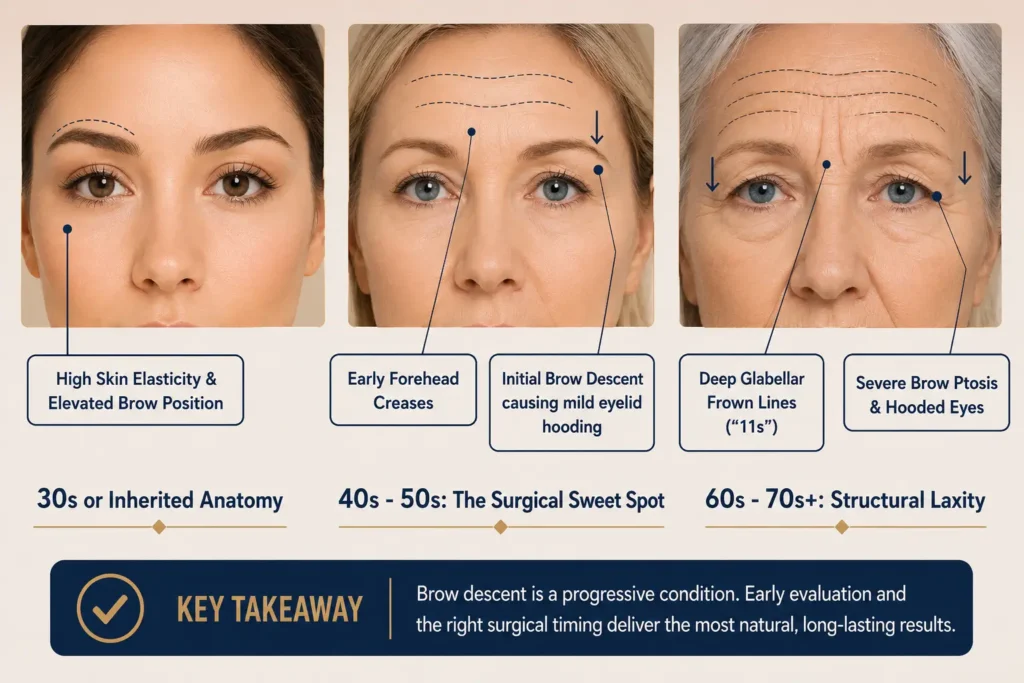
| 40s–50s | Skin elasticity begins to decline; brow starts descending; horizontal lines and “11s” deepen; forehead muscles loosen | Prime window for a forehead lift — tissue still has enough quality to respond well; results are long-lasting |
| 60s | More pronounced brow descent; deeper furrows; some facial volume loss; skin laxity increases | Excellent candidates — forehead lift often combined with facelift or blepharoplasty for comprehensive rejuvenation |
| 70+ | Overall health and skin reserve become primary factors; significant volume loss may accompany structural descent | Case-by-case surgical assessment; combination with fat grafting may enhance outcomes |
To help you easily identify how time and anatomy affect your upper face, explore our clinical aging timeline below, which illustrates facial changes across different generations:
Am I Too Young for a Brow Lift?
Most candidates present in their 40s and 50s, and for good reason — that’s when gravity and repetitive muscle movement finally outpace the skin’s ability to recover. In your 20s or early 30s, a forehead lift is rarely the answer.
The exception is genetics. Some patients inherit naturally heavy or low-set brows that create a permanently stern or fatigued appearance well before middle age. In these cases — and when the condition is confirmed to be structural rather than skin-deep — surgery in the 30s is both appropriate and effective. At ABmedi Team Clinic, we’ve seen patients in this age group achieve significant, confidence-restoring results precisely because the underlying tissue quality supports lasting correction.
If you’re under 40 and have concerns about your brow area, an honest consultation will clarify whether surgery is warranted or whether a Botox brow lift, which temporarily elevates the lateral brow for three to four months, is a better starting point.
Am I Too Old for a Forehead Lift?
There is no universal upper age limit. A healthy 68-year-old will often fare better on the operating table than a 55-year-old who smokes and has uncontrolled blood pressure. What changes with age is not eligibility, but the conversation we have about risk, recovery, and combined procedures.
Patients in their 60s and early 70s frequently seek forehead lifts alongside facelifts or eyelid surgery for more comprehensive upper-face renewal. Provided that cardiovascular health is sound, there are no contraindicated medications, and expectations are well-calibrated, age alone should not discourage you from exploring this option.
What Is the Best Age for a Forehead Lift?
If there is a sweet spot, it tends to fall in the mid-40s to late 50s. Here’s why: the anatomical problem — brow descent, deep furrows, and muscle loosening — has progressed enough to make surgery clearly worthwhile, yet skin quality and tissue resilience are still strong enough to support a natural, durable result. Patients in this window also tend to recover more efficiently.
Surgeon’s Perspective
At ABmedi Team Clinic, we approach every case through the lens of individual anatomy, not calendar age. A patient’s brow position, hairline height, skin quality, and overall health profile matter far more than the number on their ID. The “right age” is when the anatomy warrants it and the patient is in the best health to support a safe, optimal outcome.
Special Anatomical Considerations
Can a Forehead Lift Help Hooded Eyes?
Yes — but with an important distinction that many patients miss.
Hooded eyes occur when the skin beneath the brow sags downward and falls over the upper eyelid, making the eye look smaller, heavier, and perpetually half-closed. In many of these cases, the root cause isn’t the eyelid itself — it’s the brow position. When the brow descends, it pushes excess skin onto the lid, creating the visual impression of too much eyelid skin.
A forehead lift addresses this by elevating the brow back to its anatomically youthful position, which in turn retracts the overhanging skin and opens the eye without touching the eyelid at all. Many patients are genuinely surprised by how much visual improvement they achieve through brow elevation alone.
However, if hooded appearance is primarily due to true upper eyelid excess — skin that belongs to the lid itself rather than the descending brow — blepharoplasty (upper eyelid surgery) is the correct procedure. In moderate-to-severe cases, both procedures may be warranted at the same time.
How we differentiate at ABmedi Team Clinic:
- Our surgeons use the manual brow elevation test during consultation — gently lifting the brow to its ideal position and assessing how much eyelid excess remains
- If the appearance resolves with brow elevation → forehead lift is the primary solution
- If significant lid skin remains after brow correction → upper blepharoplasty is added or prioritized
- This assessment prevents patients from undergoing eyelid surgery when it’s actually their brow doing all the work
Can Men Get a Forehead Lift?
Absolutely — and male patients are increasingly pursuing this procedure. That said, male anatomy introduces specific surgical considerations that require genuine expertise to navigate well.
| Brow Architecture
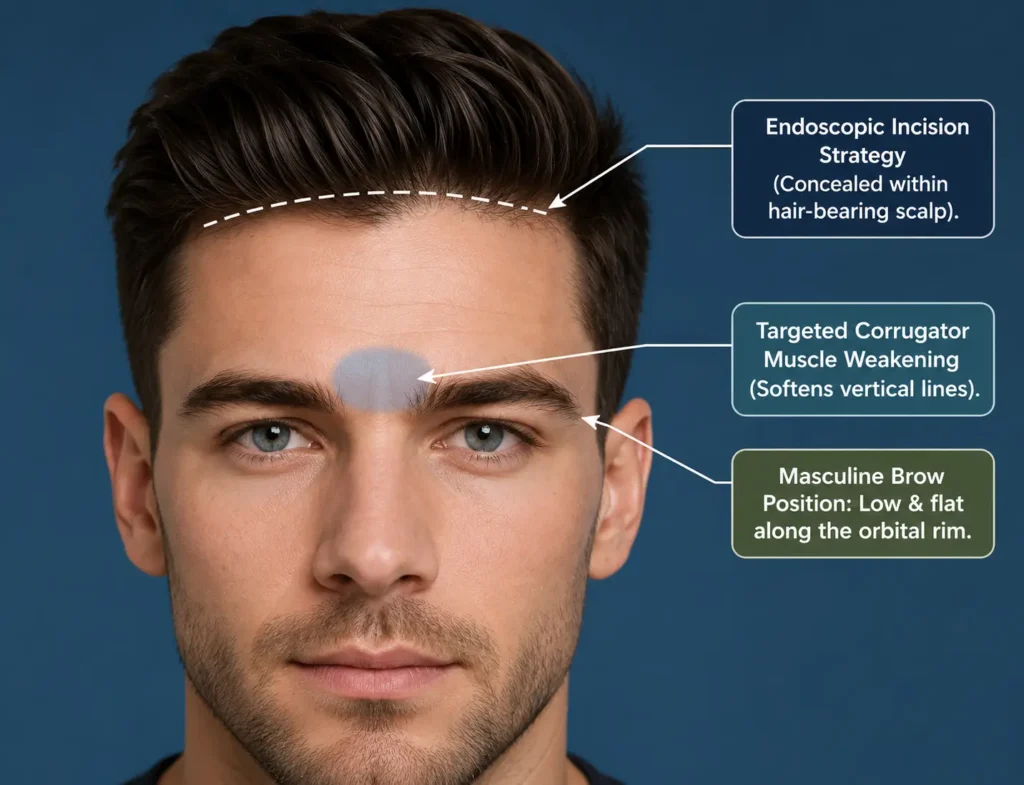
Men’s brows sit at or just below the orbital rim — lower and flatter than women’s. Over-elevation creates a feminized, surprised expression. The goal is a refreshed, alert appearance while preserving that horizontal, masculine brow shape. |
Frontal Bone Structure
Male foreheads typically have more pronounced frontal bossing (brow ridge prominence). Surgical planning must account for this skeletal structure to ensure the repositioned soft tissue sits naturally over the underlying bone. |
|
| Hairline & Incision Strategy
Men with normal hairlines benefit from endoscopic technique, with incisions hidden entirely within the scalp. Patients with thinning hair or male-pattern recession require a modified approach — a coronal incision placed too far back becomes visible; a pretrichial or direct brow incision may offer better scar concealment. |
Direct Brow Lift (Select Cases)
For men with very heavy brows and dense eyebrow hair, a direct incision placed directly above the brow — camouflaged within the brow hair — provides maximum lifting with scars that are virtually invisible. This is a niche technique reserved for appropriate candidates after thorough discussion. |
Male patients at ABmedi Team Clinic also benefit from targeted corrugator muscle weakening during the procedure, which addresses the vertical frown lines between the brows more permanently than repeated Botox injections — reducing long-term maintenance costs. Our surgical planning always prioritizes preserving natural forehead movement so there is no frozen or artificial appearance post-operatively.
A Note on Recovery for Male Patients
Men who opt for endoscopic technique typically return to professional activity within seven to ten days — with bruising and swelling resolving to a level that does not obviously signal recent surgery. For patients concerned about discretion, we work closely on timing and aftercare to make the recovery window as unobtrusive as possible.
Frequently Asked Questions
Q1: Does a forehead lift change the shape of my eyes?
No. A forehead lift repositions the brow and forehead tissue — it does not alter the eyelid or the actual eye shape. If you want to change the contour of your upper lid or address under-eye concerns, those are addressed through separate procedures such as blepharoplasty.
Q2: Can I combine a forehead lift with other procedures?
Yes, and this is quite common. A forehead lift addresses only the upper third of the face. For patients who also have mid-face or lower-face sagging, combining it with a facelift, neck lift, or blepharoplasty achieves more harmonious, complete results — and typically under a single anesthetic.
Q3: Will my results look natural?
In experienced hands, yes. The goal is never to look “lifted” — it’s to look rested and appropriately refreshed. At ABmedi Team Clinic, we calibrate elevation carefully to the individual’s anatomy, avoiding the over-pulled or perpetually surprised appearance associated with outdated techniques.
Q4: What if I just want something non-surgical first?
That’s a valid approach, and often where we start. A Botox brow lift can elevate the lateral brow by a few millimeters and smooth dynamic lines — effects that last three to four months. It’s a useful diagnostic tool: if you love the result, it confirms the anatomy is right for surgical correction. If the change feels insufficient, surgery is likely the better long-term solution.
Q5: How long do results from a surgical forehead lift last?
Results from a surgical forehead lift are long-lasting — typically a decade or more. Unlike injectables, surgery addresses the underlying structural changes directly. You will continue to age naturally after the procedure, but from a significantly improved baseline.
Q6: I have a high hairline — am I still a candidate?
Yes, but technique matters enormously here. Standard incisions placed within the scalp can push a high hairline even higher, which most patients find unacceptable. For patients with an elongated forehead or receding hairline, a pretrichial (hairline) incision is used instead — this actually allows the surgeon to simultaneously shorten the forehead while lifting the brow. The scar, placed precisely at the hairline junction, is typically very well-concealed once healed.
A Closing Word from the Surgeons at ABmedi Team Clinic
Reading through a candidacy guide is a good first step — but it will only take you so far. The real answer to “Is a forehead lift right for me?” lives in the mirror, in your medical history, and in a conversation with a surgeon who can physically assess your brow position, hairline, and skin quality.
What I can tell you from years of practice is this: most patients who come in wondering if they’re “ready” or “old enough” or “too far gone” fall somewhere in a well-defined middle ground where surgery is appropriate, effective, and genuinely life-improving. The ones who don’t qualify for surgery often have excellent non-surgical options — and we’ll tell you clearly which path makes sense for you.
The goal at ABmedi Team Clinic is never to sell you a procedure. It’s to give you the most honest, medically sound recommendation so that whatever you decide, you make it with full confidence.
📞 💬 WhatsApp / Chat: [http://wa.me/84975142666] 🌐 Book online: [+84-975-142-666]
Consultations are available in-clinic and online for international patients. Most patients leave their first appointment knowing exactly what they need — and feeling confident about the path ahead.
