


If you have a naturally slim or lean face and you’re considering a facelift, you’ve likely come across one recurring fear: “Will surgery make me look worse — tighter, more gaunt, more artificial?” It’s a legitimate concern, and one that deserves a direct, medically grounded answer.
The short answer is: in the right hands, with the right technique and the right volumetric plan, a facelift on a thin face can look beautifully natural. But the risks are real, and understanding them is the first step to avoiding them.
Why Thin Faces Are Higher Risk for Unnatural Results
Facial fat is what separates the skin from the underlying muscle. In people with fuller faces, there’s a generous cushion that absorbs tension, smooths transitions, and masks any slight over-correction.
In thin-faced patients, that buffer is minimal. When a surgeon tightens tissue, there’s little subcutaneous fat to soften the result. The skin pulls directly against the muscle, and even modest over-tightening becomes visible — producing that characteristic “done” look: a jawline that seems too sharp, a face that appears stretched rather than refreshed.
This is also why thin patients are the most prone to the so-called wind-swept appearance — where the face looks as though it’s being permanently blown sideways. That look was far more common in older techniques that relied on pulling the skin itself, rather than the deeper structural layers beneath it.
The Core Problem: Horizontal Pulling vs. Vertical Lifting
Traditional facelift techniques — those that dominated surgery in the 1980s and 90s — primarily worked by pulling the skin backward, toward the ears, in a horizontal direction. This is the origin of the “pulled tight” look. The skin moves in the wrong direction relative to how the face actually ages.
Gravity pulls the face downward. A horizontal pull fights that force at the wrong angle, distorting natural contour rather than restoring it.
Modern approaches correct this by working in a vertical lifting vector — moving tissues upward rather than sideways. This replicates the actual reversal of gravitational descent, repositioning fat compartments and soft tissue back toward their original anatomical position. The result is a face that looks younger rather than one that looks operated on.
For thin-faced patients, the choice of lifting vector is not optional — it’s critical. Horizontal tension on a face with little subcutaneous fat leaves no margin for error.
The Best Techniques for Thin Faces
| Feature | Deep Plane Facelift | High-Definition Facelift with SMAS Layering |
| Anatomical Approach | Releases and repositions the deeper structural layers (ligaments, fat pads, and SMAS) as a single composite unit. | Manipulates and tightens the underlying fibrous-muscular (SMAS) layer in multiple distinct planes. |
| Skin Tension Level | Minimal to none. The structural lift is entirely supported by deeper tissues, leaving the skin tension-free. | Low and evenly distributed. Layered tightening ensures no single zone bears excessive load. |
| Lifting Vector | Strictly Vertical Vectors (upward lifting) to reverse gravitational descent. | Oblique or Vertical Vectors tailored to preserve natural contours. |
| Primary Benefit for Thin Faces | Eliminates the “Pulled” look. Restores midface volume and softens nasolabial folds naturally without flattening features. | Maximizes definition. Delivers a sharp, chiseled mandibular line without lateral distortion. |
| Risk of “Wind-Swept” Effect | Virtually zero risk, as the skin surface is never tightly stretched. | Extremely low risk, prevented by gradual, multi-level anchoring rather than an aggressive single pull. |
Deep Plane Facelift
The deep plane approach is widely regarded as the most reliable technique for producing natural, long-lasting results — particularly in patients with minimal facial fat.
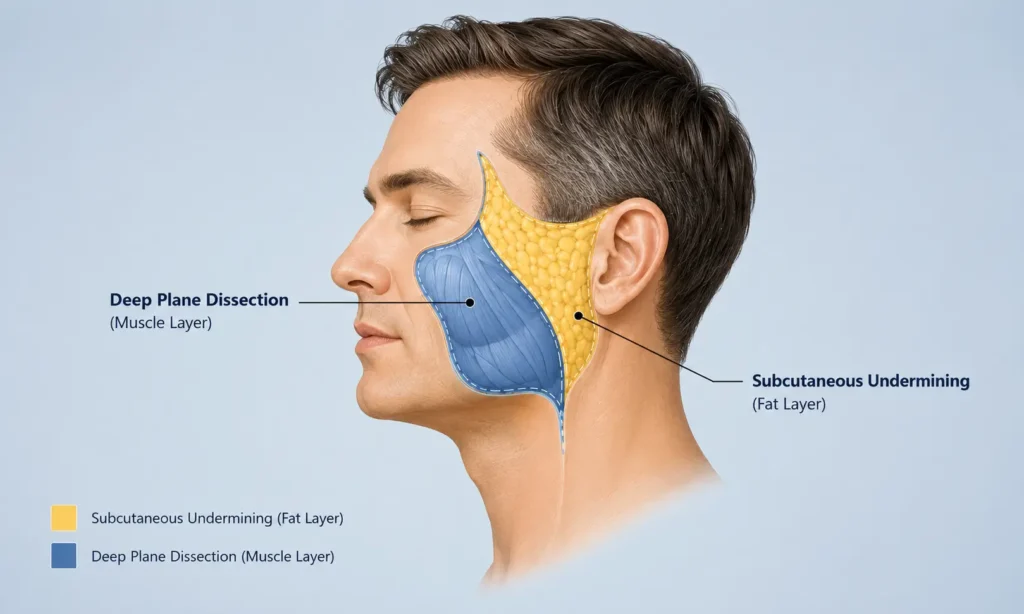
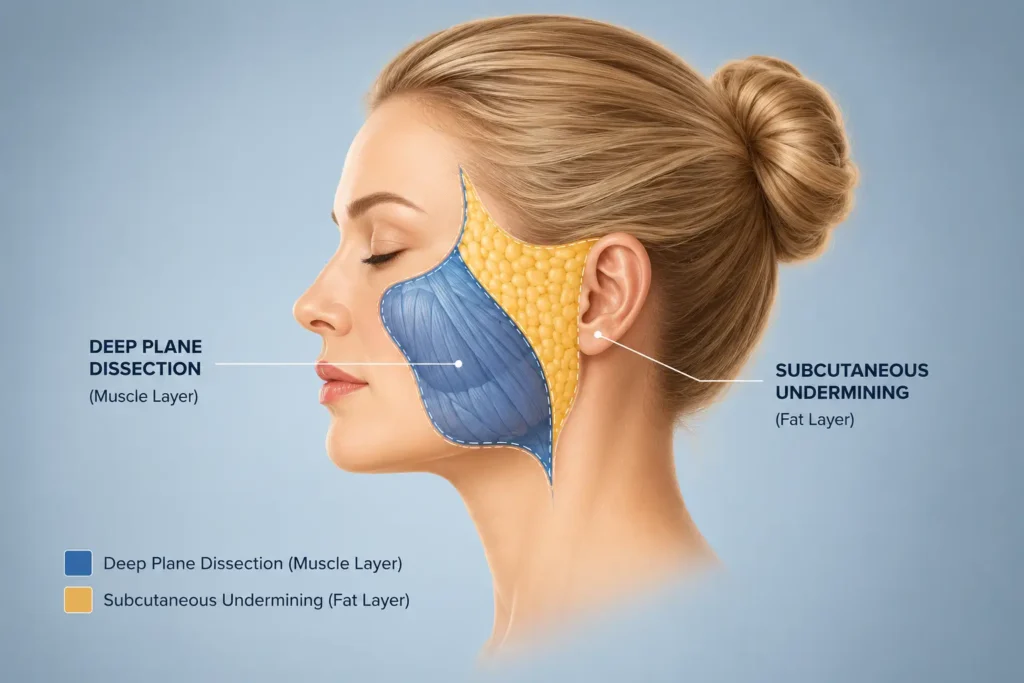
Unlike procedures that work only on the skin or the SMAS (Superficial Musculoaponeurotic System) in isolation, the deep plane technique releases and repositions the deeper structural layers of the face — including ligaments, fat pads, and the SMAS — as a single composite unit. Because the deeper tissues provide the structural lift, there is far less tension required on the skin itself.
This is the key distinction for thin-faced patients: less skin tension means less risk of a pulled, distorted result.
The deep plane approach also addresses the midface more effectively than traditional SMAS-only techniques — lifting sagging cheeks, softening nasolabial folds, and restoring volume to areas that have deflated with age. For patients who are naturally lean, this midface lift is particularly valuable.
High-Definition Facelift with SMAS Layering
A High-Definition Facelift goes beyond basic skin removal. It combines precise SMAS manipulation — tightening the underlying fibrous-muscular layer in multiple planes — with careful repositioning of facial structure to restore definition without distortion.
At ABmedi Team Clinic, this approach involves gradual, layered tightening rather than a single aggressive pull. The SMAS is addressed at multiple levels so that tension is distributed evenly and no single zone bears the full load of the correction.
For thin faces specifically, the direction of the SMAS repositioning matters as much as its degree. An oblique or vertical vector preserves natural contour; an overly lateral (sideways) pull flattens and distorts.
Fat Grafting: The Missing Piece for Thin Faces
A lift alone — no matter how technically refined — addresses laxity and tissue descent. It does not address volume loss, which is a separate and equally important component of facial aging, and one that is far more pronounced in naturally thin faces.
Without restoring volume, a facelift on a depleted face can paradoxically worsen the gaunt appearance. You remove the sag, but you also remove the softness — leaving a tighter, bonier result than before.
Fat grafting paired with a facelift is the standard of care for thin-faced patients. Harvested from the patient’s own body (typically the abdomen or thighs), the fat is processed and re-injected into areas of volumetric loss: the temples, the cheeks, around the eyes, and along the jawline.
This “lift and fill” combination produces what a lift alone cannot:
- Restored cheek fullness and a natural heart-shaped facial contour
- Softer transitions between facial zones
- A youthful plumpness that prevents the hollowed, skeletal look
- Better long-term durability, because volume supports the structural lift
At ABmedi Team Clinic, fat grafting is considered an integral part of facial rejuvenation for patients with thin or lean faces — not an optional add-on.
How to Prevent the “Pulled” Look: What to Look for in a Surgeon
Because thin facial anatomy leaves zero margin for error, avoiding an unnatural outcome depends entirely on your surgical roadmap and the expertise of your provider. To ensure a natural, high-definition result, your evaluation process should focus on these critical criteria:
- Confirmed expertise in deep plane or high SMAS techniques: Ensure the surgeon relies on deep muscle anchoring and ligament release rather than skin stretching. The primary lift must happen in the structural layers, leaving the skin tension-free.
- A dedicated volumetric plan: Volume is the missing link for lean faces. Any surgeon who proposes a facelift for thin anatomy without discussing autologous fat grafting or volume restoration is missing a critical component of your care.
- A tailored approach to incision placement: In thin-faced patients, scar placement must be flawless. Advanced surgeons use a meticulous, tension-free layered closure. As illustrated in the step-by-step technique , incisions must be hidden seamlessly within natural pre-tragal ear creases and vatted precisely along the hairline to preserve hair follicles and avoid displacing the beard line.
- A portfolio of lean-faced patients: Always ask to review actual before-and-after photos of individuals with naturally thin or gaunt anatomy—not just fuller-faced patients where results are more forgiving. Look for a track record of soft, un-pulled outcomes.
Will a Facelift Make My Thin Face Look Even Thinner?
The answer depends entirely on how the surgery is planned. A facelift performed with horizontal skin tension alone will flatten features and make a lean face appear more angular and gaunt—because it tightens without adding back what is missing. This is a real risk with older or less sophisticated techniques.
However, a properly executed deep structural lift combined with autologous fat grafting does the exact opposite. By shifting descended tissue back vertically and actively filling the deflated pockets, patients look less gaunt, softer, and more volumetrically balanced after surgery, not more.
Aging is both a structural problem and a volumetric problem. Addressing only one without the other will always produce an incomplete or compromised result.
What to Look for in a Surgeon
For thin-faced patients considering a facelift, the evaluation process should include:
- Confirmed experience with deep plane or high SMAS techniques — not just marketed claims, but demonstrated results in patients with similar anatomy
- Before-and-after photos from patients with lean or thin faces — not just fuller-faced patients where the results are more forgiving
- A clear volumetric plan — any surgeon who does not discuss fat grafting or volume restoration for a thin-faced patient is missing a critical component of your care
- Discussion of lifting vectors — your surgeon should be able to explain how they will move tissue, in what direction, and why that direction suits your specific anatomy
- No pressure to over-correct — the goal is to look like a younger version of yourself, not a different person
A Clinical Perspective
In our experience at ABmedi Team Clinic, thin-faced patients who have the greatest satisfaction after surgery are those who came in with realistic expectations, received a thorough anatomical assessment, and were treated with a combined approach — structural lifting using vertical vectors, SMAS manipulation appropriate to their tissue depth, and fat grafting to restore facial volume.
The wind-swept look, the pulled-tight look, the gaunt post-operative appearance — these are not inevitable consequences of facelift surgery. They are the consequences of mismatched techniques, inadequate planning, and insufficient respect for the specific challenges that thin facial anatomy presents.
Done correctly, a facelift for a thin face can produce some of the most elegant and natural results in all of facial surgery — because there is very little to hide, and when the balance is right, it shows.
Frequently Asked Questions (FAQs)
Q1: What is the difference between a high SMAS facelift and a standard SMAS facelift for a thin face?
A: A standard SMAS facelift manipulates the lower portion of the facial muscular layer, which works well for full faces but can fail to address the midface adequately. In contrast, a High SMAS facelift releases and lifts the tissue from a much higher point near the cheekbone. For a thin face, this is a game-changer: it repositions dropped cheek fat vertically back to where it belongs, naturally restoring youthful fullness to the midface and avoiding the flat, over-tightened appearance often caused by traditional horizontal pulling.
Q2: What is the “new undetectable facelift” technique, and how does it prevent the “pulled” look?
A: The new undetectable facelift refers to advanced vertical-vector repositioning techniques, such as the Extended Deep Plane or High SMAS facelift. Traditional techniques pulled the skin horizontally toward the ears, creating a telltale “windswept” or “pulled” look that flattens a naturally thin face. The undetectable facelift lifts the deeper muscular framework strictly vertically—opposing gravity. Because the tension is entirely placed on the deep muscles and none on the skin, the results are completely natural, leaving no tight skin or distorted ear cartilage.
Q3: What is the newest facelift technology used to enhance definition in naturally thin faces?
A: The newest approach to high-definition facelifts isn’t just about cutting skin; it is the combination of Deep Plane structural lifting and Micro-fat Grafting (Fat Transfer). Thin faces age by losing volume, making them look gaunt. The latest technology involves harvesting the patient’s own fat, purifying it into micro-droplets, and strategically grafting it into the temples, under-eyes, and cheeks while lifting the deep tissues. This dual-action approach restores the soft, youthful curves of a thin face rather than just tightening it.
Q4: Is there a truly “scarless” facelift technique for patients with minimal sagging?
A: While a surgical facelift will always require minimal incisions, the modern “Scarless” Facelift technique achieves virtually invisible results. Incisions are hidden deep inside the natural contours of the ear (tragal incision) and well within the hairline. For thin faces with early-stage sagging, minimal-incision options like an Endoscopic Midface Lift or a Cinderella Facelift (a customized combination of energy-based lifting and precise injectable contouring) can provide a beautiful high-definition refresh without standard surgical incisions.
Q5: Should a 70-year-old with a thin face get a facelift, or will it make them look too gaunt?
A: A 70-year-old is an excellent candidate for a high-definition facelift, provided they are in good medical health. However, because thin faces lose significant bone and fat density by age 70, a standalone facelift could risk making the face look skeletal or over-pulled. To avoid this, the procedure must be paired with structural volumization (fat grafting or long-lasting biostimulators). This ensures that while the jawline and neck are crisply defined, the midface remains soft, plump, and age-appropriate.
📞 💬 WhatsApp / Chat: [http://wa.me/84975142666] 🌐 Book online: [+84-975-142-666]
Consultations are available in-clinic and online for international patients. Most patients leave their first appointment knowing exactly what they need — and feeling confident about the path ahead.
