


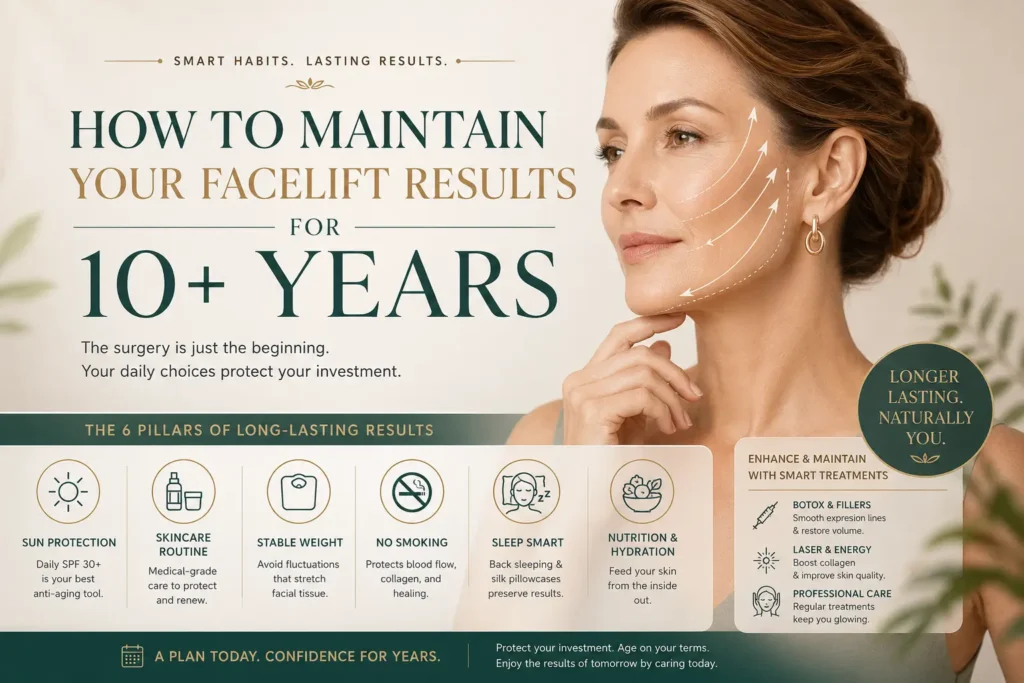
A facelift is one of the most significant investments you can make in your appearance — and one that, with the right habits, can genuinely pay off for a decade or more. But the procedure itself is only half the equation. What you do in the months and years afterward determines whether you still look refreshed at the ten-year mark or find yourself back at square one at five.
This is something I discuss with every patient at ABmedi Team Clinic before and after surgery. A facelift resets the clock — it does not stop it. Understanding what drives longevity, and what quietly erodes it, puts you in a far stronger position to protect your results.
How Long Does a Facelift Actually Last?
The honest answer is: it depends on the technique used and the choices you make afterward.
Traditional SMAS facelifts — which tighten the superficial muscular layer without releasing deeper ligaments — generally provide meaningful improvement for 5 to 10 years. The skin-tension-dependent nature of these procedures means that as tissues relax over time, earlier results can begin to fade.
Deep plane facelifts work differently. By releasing and repositioning the deeper structural layers of the face as a unified composite, rather than relying on surface tension alone, results are more durable — typically 10 to 15 years, and in some cases longer. A 2026 meta-analysis found that patients who underwent structural deep plane procedures waited an average of nearly 11 years before seeking any revision, with some going as long as 30 years. Patient satisfaction at the one-year mark was reported at over 94%, and the majority maintained that satisfaction for more than a decade.
The reason deeper technique lasts longer is mechanical: when the skin doesn’t have to do the structural work of holding the lift in place, it ages more naturally and the correction remains stable longer. The underlying repositioning holds; the skin simply follows.
That said, even the best technique has a ceiling defined by biology, lifestyle, and time. No surgery permanently stops aging — but the right habits can meaningfully extend how long you look like your best self.
What Continues to Age the Face After Surgery
Understanding this matters, because maintenance strategies target each of these processes specifically.
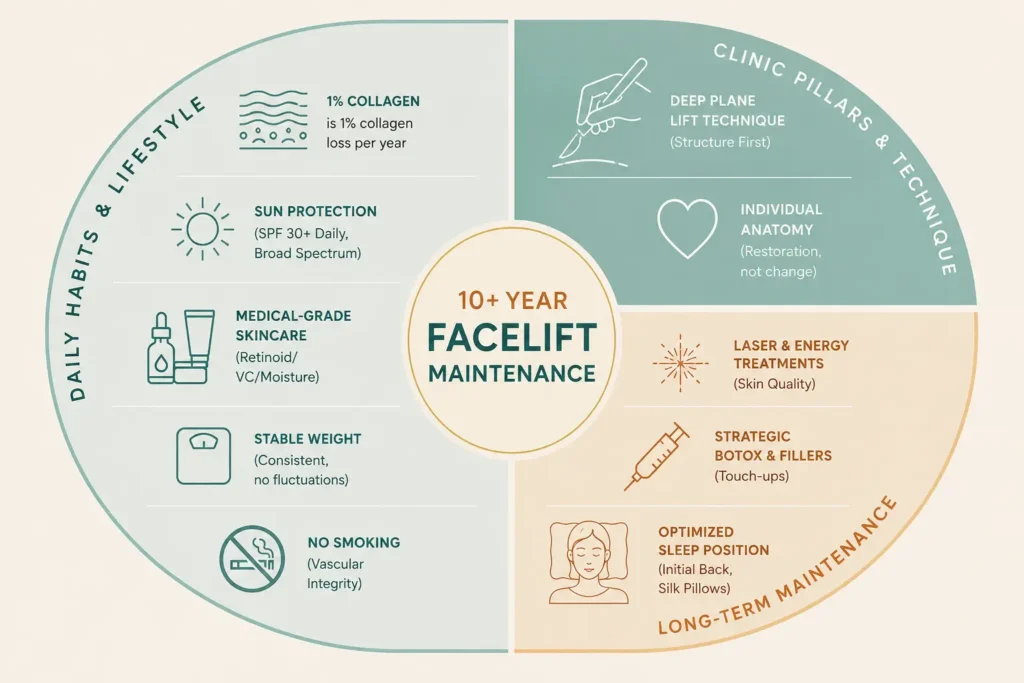
Skin quality deterioration. UV radiation breaks down collagen and elastin continuously. After a facelift, your skin still loses roughly 1% of its collagen per year — more if sun protection is inconsistent.
Ongoing fat compartment descent. Gravity doesn’t retire. Facial fat pads continue to descend slowly over the years, gradually softening the contours your surgery restored.
Bone resorption. This is the factor most patients don’t know about, and it matters more than most people realize. The facial skeleton itself changes with age — the orbital rims widen, the midface bone recedes, and the jawbone loses density. These structural changes eventually affect soft tissue support regardless of how well your facelift was performed. No surgical technique can prevent bone loss, which is one reason that volume restoration — through fat grafting or strategic injectables — remains relevant even years after surgery.
Skin laxity return. Gravity and facial movement work continuously on your skin. How quickly laxity returns depends heavily on skin quality, genetics, and the lifestyle factors covered below.
The Non-Negotiables: What Actually Extends Results
3.1. Sun Protection — The Highest-Leverage Habit
UV exposure is the single most controllable driver of post-facelift aging. It degrades collagen, accelerates pigmentation changes, and thins the skin that your surgery carefully repositioned.
Daily broad-spectrum SPF 30 or higher is essential — not just on sunny days, but year-round, including overcast days when UV still penetrates cloud cover. Wide-brimmed hats add meaningful protection in direct sunlight. Consider that UV also reflects off water, pavement, and sand, meaning side and lower facial exposure is often higher than people assume.
This is not optional maintenance. Patients who are rigorous about sun protection consistently preserve their results longer than those who treat sunscreen as situational.
3.2. A Skincare Routine Built for Post-Surgical Skin
After a facelift, the goal of your skincare routine shifts from correcting damage to preserving the improved baseline you now have. A practical post-facelift regimen includes:
| Step | Product Type | Key Benefit | When to Use | Notes |
| 1 | Gentle cleanser | Removes oxidative debris without stripping the skin barrier | Morning & evening | Avoid active acids or exfoliating formulas in the first 8 weeks |
| 2 | Antioxidant serum (Vitamin C) | Neutralizes UV-induced free radicals before they break down collagen | Every morning | Apply before sunscreen, not instead of it |
| 3 | Medical-grade moisturizer | Maintains elasticity and skin resilience | Morning & evening | Post-surgical skin is more sensitive — choose a fragrance-free, hydrating formula |
| 4 | Broad-spectrum SPF 30+ | Prevents UV-driven collagen loss — the #1 threat to long-term results | Every morning, year-round | Reapply every 2 hours in direct sun |
| 5 | Retinoid (retinol or prescription) | Stimulates collagen production and accelerates cell turnover | Evenings only | Start at 6–8 weeks post-surgery; begin at low concentration and build gradually |
3.3. Stable Weight
Weight fluctuation is one of the most underappreciated threats to facelift longevity. The face is not immune to weight gain and loss cycles — repeated fluctuations stretch and relax the very tissues that your surgery repositioned. Each cycle can progressively blur the jawline definition and cheek contour that the procedure restored.
Maintaining a stable, healthy weight — not necessarily a lower weight, but a consistent one — is among the most effective things you can do to protect your investment. If significant weight loss is planned, ideally this should occur before surgery rather than after.
3.4. No Smoking
The vascular effects of smoking directly undermine facelift longevity. Nicotine constricts small blood vessels, reducing the oxygen supply that skin and deeper tissues depend on for ongoing regeneration. This accelerates collagen breakdown, delays healing, and prematurely ages the skin’s surface and deeper structure.
Patients who smoke age their results faster. We require cessation before surgery for safety reasons, and continued non-smoking afterward meaningfully extends how long results last.
3.5. Sleep Position
During the First 3–4 Weeks (Mandatory): Sleep flat on your back with your head elevated. This is a strict medical requirement to minimize swelling, facilitate fluid drainage, and prevent asymmetric pressure from shifting the healing tissues.
Long-Term Maintenance: Sleeping on your back is ideal to avoid creating mechanical sleep creases on your skin. If you are a chronic side-sleeper, protect your surgical investment with these adjustments:
- Switch to a silk or satin pillowcase: This reduces friction, allowing your facial skin to glide smoothly instead of being compressed and pulled against the fabric.
- Use an anti-wrinkle beauty pillow: The specialized cut-out design cradles your head while preventing your cheeks and jawline from pressing directly into the pillow.
3.6. Nutrition and Hydration
Skin quality after a facelift is substantially influenced by what you feed it from the inside. An antioxidant-rich diet — emphasizing vegetables, fruits, lean proteins, and healthy fats — supports collagen synthesis and mitigates the oxidative stress that accelerates aging.
Specific nutrients with documented skin benefits include vitamin C (essential for collagen production), vitamin A (cell turnover and skin thickness), omega-3 fatty acids (skin barrier function and inflammation control), and adequate protein for tissue repair and maintenance.
Hydration, while often oversimplified, matters: chronically dehydrated skin loses elasticity faster and has less resilience under facial movement. Eight glasses of water daily is a reasonable baseline.
Maintenance Treatments: Extending Results Non-Surgically
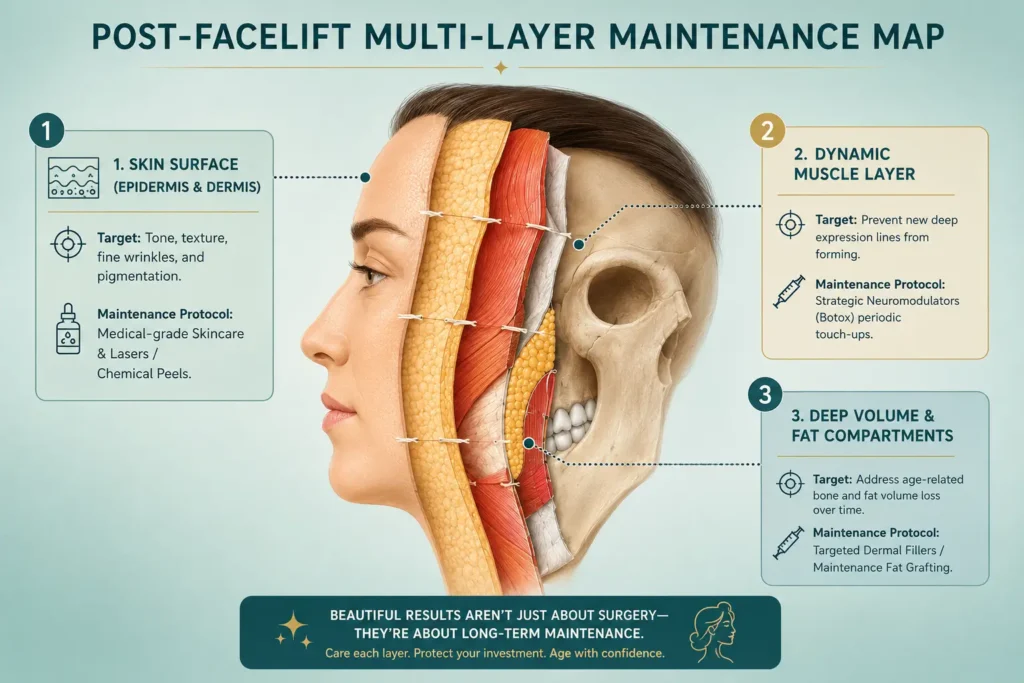
A facelift addresses structural laxity and tissue descent. It does not address surface skin texture, pigmentation, fine lines from muscle movement, or ongoing volume loss. These are the gaps that non-surgical maintenance fills in the years after surgery.
Neuromodulators (Botox and similar). Repetitive muscle contraction is a significant driver of dynamic wrinkles in the upper and mid face. Periodic neuromodulator treatment — typically every three to four months — reduces the mechanical stress that facial expression places on the skin overlying the facelift area, preserving surface smoothness alongside the structural work done surgically.
Dermal fillers or fat grafting maintenance. Volume loss continues after surgery as facial fat pads descend and thin. Strategic injectable filler — or small-volume fat grafting sessions — to the temples, cheeks, tear troughs, and jawline keeps the volumetric balance that is central to a natural-looking result.
Laser and energy-based treatments. Resurfacing procedures, radiofrequency treatments, and similar technologies address skin quality — texture, tone, pigmentation, and surface collagen density — that surgery does not directly improve. Beginning these treatments once the skin has fully healed, and maintaining them periodically, extends the overall quality of the result significantly.
Professional skincare treatments. Regular clinical facials, chemical peels, and medical-grade treatments maintain the skin’s surface condition in ways that home routines alone cannot replicate.
At ABmedi Team Clinic, we build a maintenance plan with each patient at their six-month and one-year post-operative visits — outlining which non-surgical treatments are appropriate for their specific concerns and timeline.
When to Consider a Touch-Up
A well-performed deep plane facelift should not need significant revision for a decade or more. But some patients choose minor interventions earlier — not because the original result has failed, but because they want to maintain a specific standard of appearance as natural aging continues.
Signs that a touch-up conversation is appropriate include the return of noticeable jowling, significant re-descent of the neck contour, or a sense that facial proportions have shifted enough to be bothersome. In most cases, a mini facelift or targeted procedure — rather than a full revision — is sufficient to refresh the original result.
The timing and type of any touch-up should always be discussed with a surgeon who has reviewed your original operative details and current anatomy. There is no universal timeline.
The Factor Nobody Controls: Genetics and Age at Surgery
All of the above can be optimized. But genetics ultimately sets the baseline rate at which your face ages, and your age at the time of surgery influences how long the structural correction holds.
Research consistently shows that patients who undergo deep plane facelift surgery in their 40s to early 60s tend to enjoy the longest-lasting results — younger tissues maintain better tension, heal with more resilience, and the structural correction has a stronger foundation to work from. This doesn’t mean surgery later in life isn’t worthwhile — it often is — but expectations for durability should be calibrated accordingly.
Genetics also determines where you sag first, your skin’s collagen density, and how you scar. These cannot be changed, but understanding them helps set realistic expectations for the ten-year trajectory.
A Clinical Summary
At ABmedi Team Clinic, we consistently see the best long-term outcomes in patients who approach post-facelift care as an ongoing commitment rather than a one-time event. The surgery creates the foundation. What you do for the following decade determines the building.
The core principles are straightforward even if they require sustained effort: protect from UV every single day, maintain stable weight, don’t smoke, build a retinoid-based skincare routine, and schedule periodic non-surgical maintenance with your surgical team.
Patients who do these things reliably — and who had their structural lift performed correctly in the first place — are the ones we see at their ten-year follow-up still looking like a younger, refreshed version of themselves. That is the goal, and it is entirely achievable.
Frequently Asked Questions (FAQs)
Q1: What happens to your face 10 years after a facelift?
A: A facelift effectively “turns back the clock,” but it cannot stop time entirely. Ten years after your procedure, your face will still look significantly younger and more refreshed than it would have without the surgery. While natural aging will gradually resume—resulting in mild skin laxity or minor volume loss—the structural improvements made to your deeper facial layers (the SMAS layer) remain a permanent baseline, keeping severe sagging at bay.
Q2: How do you maintain facelift results for over a decade?
A: Longevity is achieved through a combination of daily protection and targeted maintenance. To preserve your results for 10+ years, implement these non-negotiable habits:
- Medical-Grade Sun Protection: Apply broad-spectrum SPF 50+ daily to prevent UV rays from breaking down your newly tightened collagen.
- Advanced Skincare: Incorporate medical-grade retinoids, antioxidants (Vitamin C), and hyaluronic acid to maintain skin density and elasticity.
- Non-Surgical Touch-Ups: Support your surgical framework with periodic, non-invasive treatments such as Botox for dynamic wrinkles, dermal fillers for volume maintenance, or energy-based therapies (like Ultherapy) to boost surface collagen.
- Healthy Lifestyle: Avoid smoking and maintain a stable weight, as significant fluctuations can stretch out the surgical modifications.
Q3: Do you need a facelift every 10 years?
A: No, a repeat facelift every decade is rarely necessary, especially if your initial surgery utilized advanced techniques like the Deep Plane Facelift. Because deep plane techniques reposition the underlying muscle and fat layers rather than just pulling the skin, the structural foundation lasts much longer. Most patients only ever need one comprehensive facelift in their lifetime, utilizing minor, non-surgical touch-ups to manage subsequent aging signs.
Q4: Does skin age faster after a facelift?
A: Absolutely not. This is a common misconception. Your skin does not age faster; in fact, by removing redundant, stretched-out skin and lifting the underlying tissue, the face is better positioned to age more gracefully. The natural aging process simply continues from your new, younger baseline.
Q5: How many years younger do you look with a facelift, and can it take 20 years off your face?
A: On average, a standard facelift makes patients look 7 to 10 years younger. However, achieving a dramatic “15 to 20 years younger” transformation is entirely possible when you combine a deep plane facelift with complementary procedures, such as upper/lower blepharoplasty (eyelid surgery) and fat transfer. This combined approach addresses all three main signs of aging simultaneously: sagging, dynamic wrinkling, and volume loss—delivering a comprehensive, natural-looking clock-turn without the “over-pulled” look.
📞 💬 WhatsApp / Chat: [http://wa.me/84975142666] 🌐 Book online: [+84-975-142-666]
Consultations are available in-clinic and online for international patients. Most patients leave their first appointment knowing exactly what they need — and feeling confident about the path ahead.
