


The word “facelift” no longer means just one thing. When patients come to us asking whether they need a facelift, the first question I ask is: which kind? Because the answer changes everything – the recovery, the cost, the result, and whether the procedure actually addresses what’s bothering them.
Over the past decade, the conversation around facial rejuvenation has evolved significantly. The rise of injectable treatments has given patients a genuine choice: restore a more youthful appearance through a carefully planned combination of dermal fillers (the “liquid facelift”), or address structural facial changes through traditional surgery (rhytidectomy). Neither is universally better. Each solves a different problem.
Here is an honest, clinically grounded breakdown of both approaches.
What Is a Liquid Facelift?
A liquid facelift is not a single product injected in a single visit. It is a treatment plan – typically involving multiple dermal filler products with varying viscosities placed at different depths across several facial zones – designed to restore the volume and structural support that diminishes with age.
As we age, the fat compartments of the face gradually deflate and descend. The cheekbones lose prominence. The temples hollow. The under-eye area develops that tired, sunken look. The jawline softens as tissue migrates downward and the underlying bone structure slowly resorbs. Contrary to popular belief, many of these changes aren’t caused by skin stretching – they’re caused by volume loss from within.
At ABmedi Team Clinic, we address this by placing hyaluronic acid or calcium hydroxylapatite-based fillers into specific anatomical compartments – cheeks, temples, jawline, tear troughs, and sometimes the lips or chin – to recreate the scaffold that supports a youthful facial contour. The result lifts and supports overlying tissue from the inside, without a single incision.
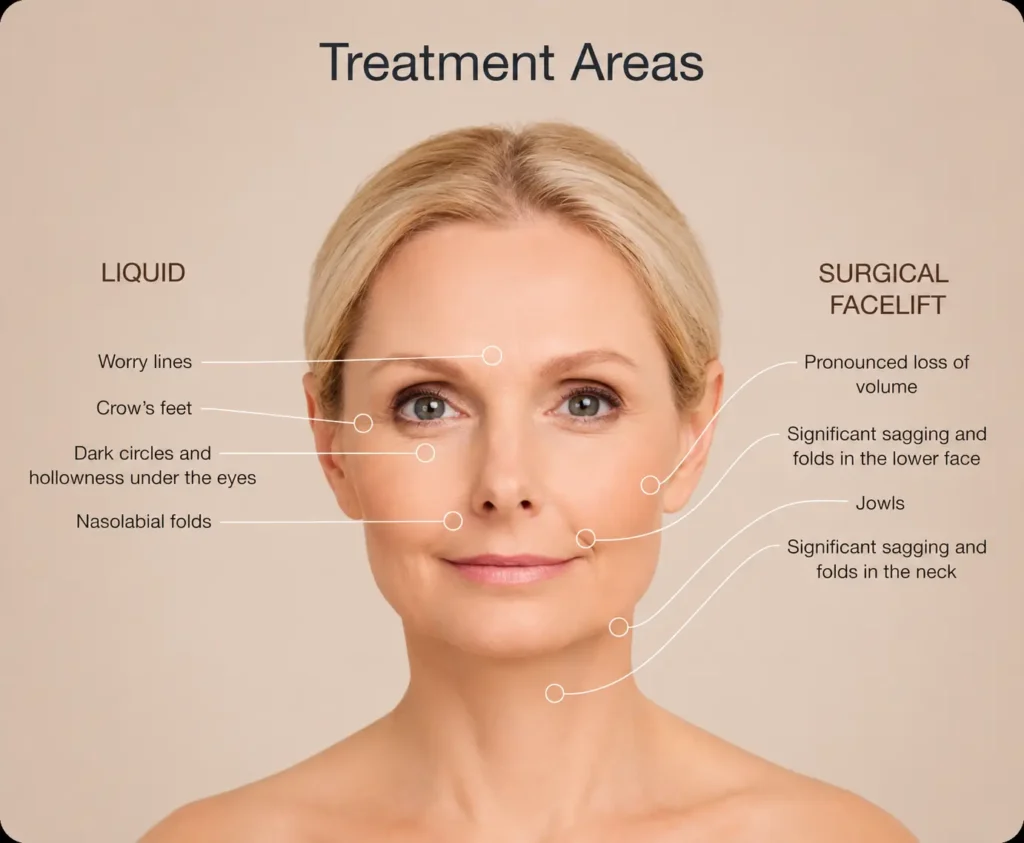
In many cases, we combine fillers with neuromodulator injections (anti-wrinkle treatments) for a more comprehensive outcome. A well-executed liquid facelift can look genuinely refreshed – not “done.”
Key facts about the liquid facelift:
- Procedure time: typically 45-90 minutes
- No general anaesthesia required
- Results visible almost immediately (final result assessed at 2 weeks)
- Structural fillers last 12–24 months; superficial fillers may need refreshing at 9-12 months
- Minimal downtime – most patients resume normal activities the same day or next day
- Results are adjustable and reversible (hyaluronic acid fillers can be dissolved)
What Is a Surgical Facelift (Rhytidectomy)?
A traditional facelift – medically known as a rhytidectomy – addresses facial ageing from a fundamentally different angle. Where fillers restore lost volume, surgery repositions and tightens existing tissue.
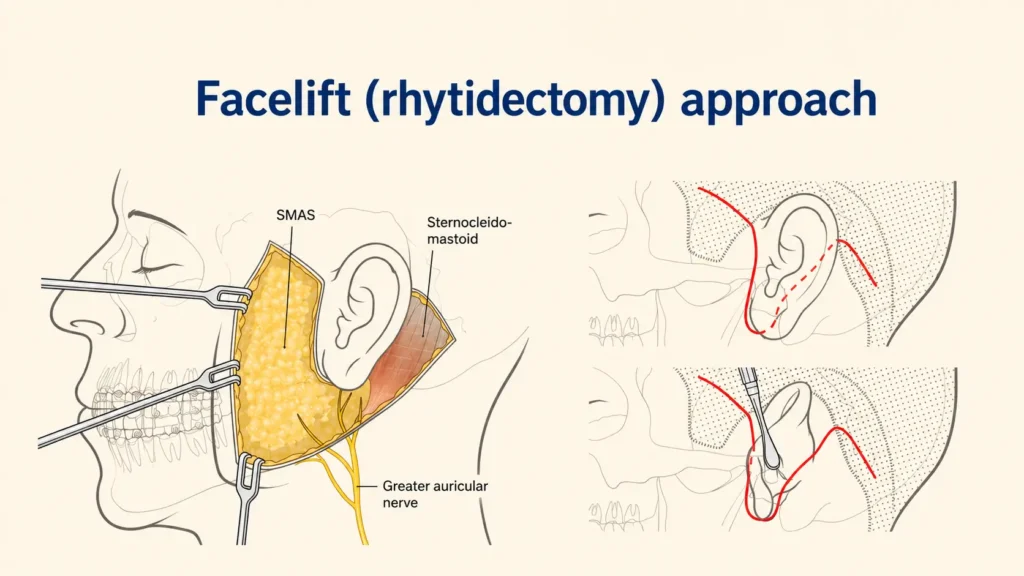
The procedure involves discreet incisions along the hairline and around the ears, through which a surgeon lifts and repositions the underlying soft tissue layers (including the SMAS – the muscular fascia beneath the skin), removes excess skin, and closes everything in a way designed to look natural, not pulled. In a deep plane facelift, the surgeon works beneath the muscle layer itself, releasing deeper ligaments for a more comprehensive and longer-lasting correction.
Surgery is the most effective tool available for patients with significant skin laxity, pronounced jowling, loss of jawline definition, and neck changes – the structural shifts that occur in the later decades of facial ageing. No amount of filler can replicate what surgery achieves when there is true excess skin and tissue descent.
However, surgery does not address volume. A patient who has a facelift without simultaneously managing their volume loss may emerge looking tighter but not necessarily younger – because the hollowing that accompanies age-related deflation remains visible.
Key facts about surgical facelift:
- Performed under general or local anaesthesia with sedation
- Recovery: 2-3 weeks before returning to most activities; full healing 3-6 months
- Results are more dramatic and durable – typically lasting 7-10 years
- Results are fixed; adjustments require further intervention
- Carries standard surgical risks: anaesthetic reaction, scarring, infection, swelling, nerve sensitivity changes
The Core Difference: Volume Loss vs. Skin Laxity
One of the most important insights in contemporary aesthetic medicine is this: the visible signs of facial ageing are driven primarily by volume loss, not skin laxity alone.
Early-to-mid ageing (typically the 30s through mid-50s) is largely a volume story. Fine lines, hollowed cheeks, early jowling, and a tired appearance are predominantly caused by the deflation and descent of the facial fat compartments, not by irreversible skin stretching. In these cases, restoring the scaffold through carefully placed fillers can achieve a result that surgery simply cannot replicate – because there is no excess skin to remove.
Late ageing (typically from the late 50s onward, though this varies significantly) introduces a laxity problem on top of the volume problem. The skin has genuinely stretched. Jowls have formed. The neck has changed. At this stage, surgery becomes the appropriate primary intervention – and fillers remain valuable as a complement, not a replacement.
This is why age-based rules (“you need surgery once you hit 50”) are not clinically useful. The correct question is: what is driving this patient’s visible ageing, and which intervention addresses that most precisely?
Side-by-Side Comparison
| Liquid Facelift | Surgical Facelift | |
| Procedure type | Non-surgical (injectable) | Surgical (incisions) |
| Anaesthesia | None / topical numbing | General or IV sedation |
| Downtime | Minimal (1-2 days) | 2-3 weeks |
| Results visible | Immediately | Several weeks post-op |
| Duration of results | 9-24 months | 7-10 years |
| Reversibility | Yes (HA fillers) | No |
| Best for | Volume loss, early-mid ageing | Significant laxity, jowls, neck |
| Ideal age range | Typically 30s-50s | Typically 50s-70s+ |
| Cost (initial) | Lower | Higher upfront |
| Long-term cost | Ongoing maintenance | Longer intervals between treatments |
A note from ABmedi Team Clinic: The two approaches are sometimes used together. We frequently work alongside surgical colleagues to provide complementary filler treatment before or after a facelift procedure – addressing the volume component that surgery alone does not resolve.
Who Is the Right Candidate for Each?
| Assessment Criteria | Liquid Facelift | Surgical Facelift |
| Typical age range | 30s – early 50s | 50s – 70s and beyond |
| Degree of ageing | Mild to moderate | Moderate to advanced |
| Primary concern | Volume loss in cheeks, temples, under-eyes | Significant skin laxity, jowling, neck changes |
| Excess skin | None or minimal | True excess skin present |
| Jawline | Softened due to volume descent | Poorly defined due to tissue and skin laxity |
| Neck area | No significant changes yet | Loose skin, excess fat requiring surgical correction |
| Downtime tolerance | Cannot or prefers not to take extended time off | Prepared to recover for 2–3 weeks |
| Reversibility preference | Wants the option to adjust or reverse | Accepts a fixed, long-lasting result |
| Treatment history | New to or early in injectable treatments | Has already maximised results from fillers |
| Mindset | Not yet ready for – or does not want – surgery | Ready for comprehensive surgical intervention |
Recovery and Realistic Expectations
One of the most common errors patients make is choosing between these procedures based on fear of recovery rather than clinical appropriateness. That fear is understandable, but it can lead to under-treating – pursuing injectables when surgery is what’s genuinely needed, then being disappointed with the result.
Equally, choosing surgery when volume restoration alone would achieve what the patient is looking for means accepting surgical risk unnecessarily.
The right decision starts with an honest assessment. At ABmedi Team Clinic, we offer consultations specifically designed to clarify which approach – or which combination – genuinely addresses the changes a patient wants to correct, rather than defaulting to whichever option they came in asking about.
FAQ
Q1: Is a liquid facelift better than a surgical facelift?
A: Neither option is universally “better,” as the ideal choice depends heavily on your specific degree of facial aging, anatomy, and recovery goals:
- A Liquid Facelift (using dermal fillers, Botox, and biostimulators) is superior for younger patients (typically in their 30s to 40s) experiencing early volume loss and minor wrinkles. It requires zero downtime and offers immediate results, but it cannot lift severely sagging skin.
- A Surgical Facelift is far superior for moderate-to-severe tissue laxity, deep jowls, and structural dropping. While it involves a surgical recovery window, the scale of transformation is profound, and the results are long-lasting rather than temporary.
Q2: What is a Cinderella Facelift, and how does it fit into non-surgical options?
A: A Cinderella Facelift is a specialized, premium non-surgical protocol that takes the concept of a liquid facelift a step further. Instead of just masking wrinkles with standard fillers, a Cinderella Facelift combines energy-based skin tightening devices (such as Ultherapy or Thermage) with targeted micro-injections of biostimulators and Botox. This dual-action approach first tightens the surface skin collagen fibers and then instantly airbrushes away shadow lines, creating an ultra-refreshed, youthful glow without a single surgical incision.
Q3: Is age 50 too old for a mini facelift, and when should you pivot to a full surgery?
A: Age 50 is definitely not too old for a Mini Facelift; in fact, it is often the perfect sweet spot for patients who have taken excellent care of their skin. A mini facelift focuses primarily on refreshing the lower face and jawline. However, if a 50-year-old patient exhibits significant skin laxity extending down into the neck (such as a “turkey neck” or severe plastysmal bands), a mini facelift or a liquid facelift will fall short. At that stage, pivoting to a comprehensive Deep Plane Facelift and Neck Lift is necessary to achieve a harmonious, natural look.
Q4: What is clinically considered the most effective facelift procedure available?
A: Clinically, the Deep Plane Facelift is recognized worldwide as the gold standard and most effective facelift procedure. Unlike traditional surgeries or non-surgical liquid lifts that merely pull the skin or inflate the surface tissue, a deep plane facelift goes beneath the muscular layer (the SMAS framework). The surgeon fully releases the naturally retained ligaments and vertically repositions the entire dropped muscular structure. This addresses the absolute root cause of facial sagging, delivering the most natural-looking, high-definition, and durable transformation possible.
Q5: What is the safest type of facelift, and why do plastic surgeons often advise against PDO threads?
A: The “safest” type of facelift is one that minimizes tension on the skin and preserves deep vascularity—which is why advanced Deep Plane techniques performed by a board-certified plastic surgeon are remarkably safe and yield fewer complications like the “pulled” look. On the other hand, many top plastic surgeons advise against PDO thread lifts as a long-term alternative because threads only provide a temporary, mechanical hook that can break down quickly. Furthermore, PDO threads can induce intense subcutaneous scarring and internal fibrosis, which often compromises the tissue quality and complicates the field if the patient decides to get a proper surgical facelift later in life.
📞 💬 WhatsApp / Chat: [http://wa.me/84975142666] 🌐 Book online: [+84-975-142-666]
Consultations are available in-clinic and online for international patients. Most patients leave their first appointment knowing exactly what they need — and feeling confident about the path ahead.
