


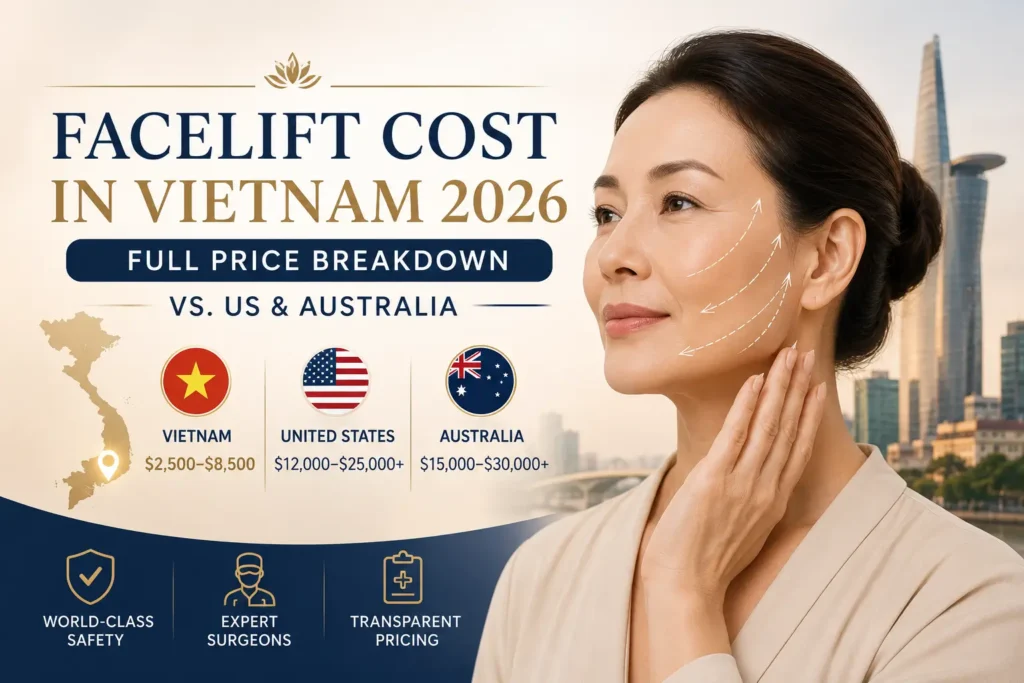
How Much Does a Facelift Cost in Vietnam in 2026?
Across licensed hospitals in Hanoi and Ho Chi Minh City, a surgical facelift in 2026 generally falls into these bands, depending on technique and how much correction is needed:
| $500–$1,200
Non-surgical / thread lift |
$2,500–$5,000
Mini or endoscopic facelift |
$4,000–$8,500
Full SMAS or comprehensive facelift |
$8,000–$15,000
Deep plane facelift (advanced technique) |
There’s no single “facelift price” because the term covers procedures with very different scope — a thread lift and a deep plane facelift both get called a facelift in casual conversation, but they’re not remotely the same operation, time in the operating room, or surgical skill. At ABmedi Team Clinic, we quote based on your actual anatomy and the technique that suits it, not a one-size number pulled from a price list.
Why Is a Facelift So Much Cheaper in Vietnam Than the US, Australia, or Canada?
The honest answer has nothing to do with cutting corners on the actual surgery—it comes down to structural economic differences that exist regardless of where the operating table sits.
- Lower Labor and Overhead Costs: Surgeon compensation, nursing staff salaries, and clinical real estate all cost a fraction of what they do in Sydney, Toronto, or Los Angeles. This structural gap flows directly into your quote as savings.
- Reduced Malpractice and Compliance Costs: Western medical markets carry extraordinarily high liability insurance premiums. Surgeons must factor these massive overhead expenses into every single patient fee.
- Localized Facility Expenses: Hospital operational fees reflect local construction, utility, and maintenance costs rather than the premium real estate pricing of a Manhattan or Beverly Hills surgical suite.
- Currency and Cost-of-Living Variances: A fee that comfortably supports a world-class, fully equipped surgical practice in Hanoi would be considered significantly under-market in most Western metropolitan areas.
None of this touches surgical skill. The surgeons performing these procedures in Vietnam’s licensed hospitals often trained in the very same countries where facelifts cost three to five times more—many hold elite fellowships from France, the United States, or South Korea. You are not paying less because the expertise is lower; you are paying less because the cost structure surrounding that expertise is completely different.
What’s Included in a Facelift Package Price?
A transparent quote—regardless of where you get it—should fully itemize these medical and logistical components. Ask for each one by name before you compare two numbers side by side:
- Surgeon’s Fee: Covers personalized surgical planning, the operation itself, and all scheduled post-operative follow-up visits.
- Anesthesia & Anesthesiologist’s Fee: Standard full facelifts require general anesthesia, which must be administered and continuously monitored by a board-certified anesthesiologist.
- Hospital Facility Fee: Covers operating theatre time, specialized nursing support, sterile high-grade equipment, and any required overnight hospital stays.
- Pre-Operative Health Assessments: Essential safety screenings including comprehensive bloodwork, coagulation studies, an ECG, and other clinical tests confirming you are medically fit for anesthesia.
- Post-Operative Medical Care: Includes professional dressing changes, suture removal, and scheduled check-ins during your recovery window in-country.
- International Concierge Services: At ABmedi Team Clinic, our comprehensive international packages extend beyond the operating room. We include private airport transfers, a dedicated 1-1 medical translator, and all post-op prescription medications so you experience zero logistical stress.
Hidden Fees to Watch For When Booking Facelift Surgery Abroad
Most disputes over facelift pricing don’t come from the headline number — they come from what wasn’t mentioned until the invoice arrived. Watch for these specifically:
01
Consultation fees not credited toward surgery. Some clinics charge a separate consultation fee that isn’t deducted from your final bill even if you proceed.
02
Anesthesia and facility fees billed separately. A quote that only reflects the surgeon’s portion can look deceptively low until these are added.
03
Extended-stay costs from a slower-than-expected recovery. Hotel, transport, and companion expenses add up quickly if healing takes longer than the standard 10–14 day window.
04
Add-on procedures priced individually. Combining a facelift with eyelid surgery, a brow lift, or fat grafting is common, but each add-on should have its own clearly disclosed line item.
05
Card payment surcharges. A roughly 3% fee for credit card payment is standard practice in Vietnam — not a scam, but worth budgeting for if you’re not paying by bank transfer or cash.
06
Document translation and medical record fees for cross-border continuity of care, which some clinics include and others charge separately.
None of these are automatically red flags on their own — most are standard and disclosed by reputable clinics. The problem is when they’re not disclosed until after you’ve already committed. Ask for a full written cost breakdown before booking flights, not after.
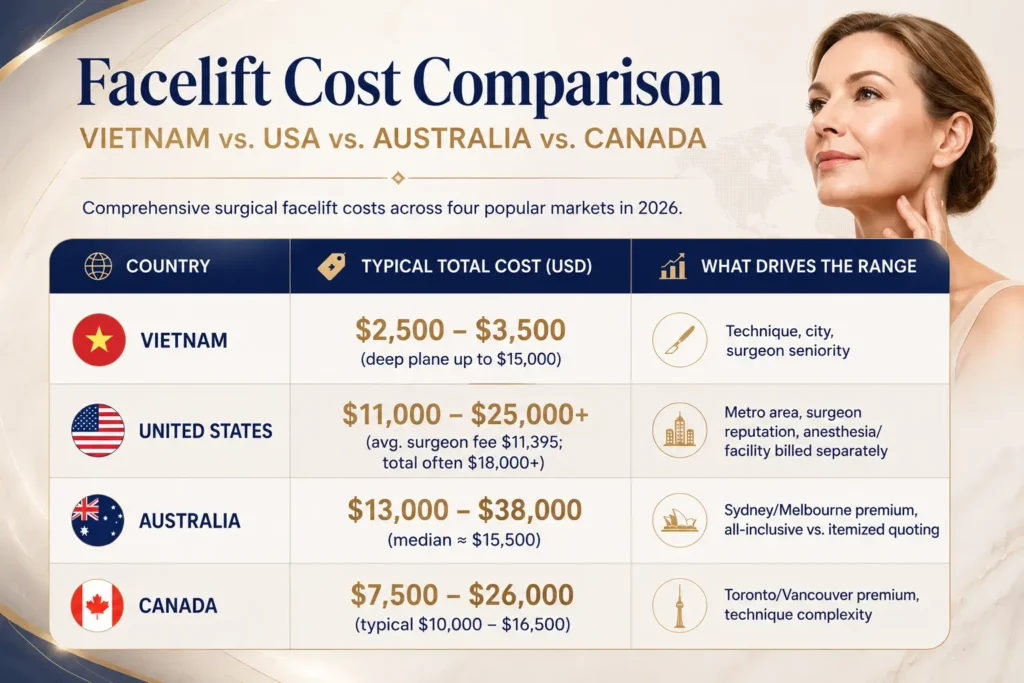
Facelift Cost Comparison: Vietnam vs. USA vs. Australia vs. Canada
Here’s how a comprehensive surgical facelift compares across the four markets patients ask me about most, using 2026 national averages and typical ranges.
| Country | Typical Total Cost (USD) | What Drives the Range |
| Vietnam | $2,500 – $3,500 | Technique, city, surgeon seniority |
| United States | $11,000 – $25,000+ (avg. surgeon fee $11,395; total often $18,000+) | Metro area, surgeon reputation, anesthesia/facility billed separately |
| Australia | $13,000 – $38,000 (median ≈ $15,500) | Sydney/Melbourne premium, all-inclusive vs. itemized quoting |
| Canada | $7,500 – $26,000 (typical $10,000 – $16,500) | Toronto/Vancouver premium, technique complexity |
Even at the high end of Vietnam’s pricing, a deep plane facelift still lands well below the US or Australian average for the same technique — patients commonly report savings in the 40–70% range once every fee is accounted for on both sides.
Is a Low-Cost Facelift in Vietnam Too Good to Be True?
Not inherently — but the price alone can’t tell you that. The structural cost differences above are real and well-documented, which means a $4,000–$6,000 facelift at a licensed Vietnamese hospital is a genuinely fair market price, not a discount that implies something’s missing.
Where I’d start asking harder questions is at the extremes. A quote that undercuts even the low end of the licensed market — say, a full surgical facelift advertised well under $2,000 with vague inclusions — usually means something is being trimmed that you can’t see in a brochure: anesthesiologist qualifications, sterilization protocol, or post-operative monitoring. The same logic applies to “lifetime warranty” claims or steep last-minute discounts; no legitimate surgical outcome can be guaranteed, and no reputable clinic needs to pressure you into deciding fast.
The test I recommend
Ask for an itemized breakdown and compare it against the ranges above. If the number is unusually low and the clinic can’t explain what’s included, that combination — not the price by itself — is the actual warning sign.
Does Travel Insurance Cover Facelift Complications Abroad?
This is the part of the budget conversation most patients skip, and it shouldn’t be skipped. Standard travel insurance almost never covers complications from a planned cosmetic procedure. These policies are built around unforeseen illness or accidents during a trip — a facelift you booked in advance is, by definition, not unforeseen, so insurers typically exclude it explicitly in the policy wording.
The same gap exists on the home-country side: private health insurance in the US, UK, Australia, or Canada almost universally excludes cosmetic surgery and anything traced back to it, even if the complication itself looks like a new medical event. If you developed an infection after a facelift abroad, most domestic insurers will trace the cause back to an excluded elective procedure and decline the claim.
What actually closes this gap is a dedicated medical tourism insurance policy, purchased separately and specifically for this trip. These typically cost 1–5% of your total procedure cost and can cover:
- Emergency medical expenses if a complication arises during or shortly after your procedure
- Extended accommodation and daily living costs if recovery takes longer than planned
- Medical evacuation or repatriation in serious cases
- In some policies, corrective or revision surgery tied directly to a documented complication, even discovered after you’ve returned home
Read the policy wording closely before you buy — most plans still exclude dissatisfaction with cosmetic results (as opposed to a genuine medical complication), and some require you to return to the original clinic for any corrective work. Buy this coverage as soon as your surgery date is confirmed, not the week before you fly.
| ABmedi Team Clinic — Plastic & Aesthetic Surgery, Hanoi | A Final Word from the Surgeon
Patients rarely regret paying a fair price for real expertise. What they regret is not knowing what a number actually included until it was too late to ask. My advice is the same one I’d give a family member: get every quote itemized, compare technique to technique rather than headline to headline, and budget for medical tourism insurance as part of the trip — not an afterthought. |
Frequently Asked Questions (FAQs)
Q1: What is the cheapest country to get a facelift?
Countries like Turkey, Mexico, Thailand, and Vietnam offer some of the lowest facelift costs globally, with prices often 40% to 70% lower than in Western nations. In Vietnam, lower operational costs and living expenses allow fully licensed aesthetic surgery hospitals to offer world-class treatment without compromising clinical safety or surgical standards.
Q2: Is Vietnam good for face lifts?
Yes, Vietnam is an excellent destination for facial rejuvenation. The combination of internationally trained plastic surgeons, modern hospital infrastructure, and highly competitive pricing makes it a top choice for medical tourists. To ensure a successful outcome, patients must choose a specialized aesthetic hospital licensed explicitly by the Ministry of Health, such as ABmedi Team Clinic.
Q3: What is the cheapest state for a facelift?
Within the United States, states with lower cost-of-living metrics—such as Oklahoma, Ohio, or Texas—generally offer more affordable facelift options compared to high-demand metropolitan areas like New York or California. However, even the lowest US rates remain significantly higher than traveling abroad to an accredited international clinic.
Q4: Which country is best for a deep plane facelift?
The United States is historically the pioneer of advanced deep plane techniques. However, top-tier plastic surgeons in South Korea and Vietnam now deliver identical clinical mastery. At ABmedi Team Clinic, our surgical team utilizes specialized deep plane approaches that lift the deeper muscle layers rather than just stretching the skin, creating natural, long-lasting results tailored to Asian and international facial anatomy.
Q5: Which type of facelift lasts the longest?
The Deep Plane Facelift and the traditional SMAS Facelift are the longest-lasting options, typically maintaining their results for 10 to 15 years. By lifting and securing the deep muscle and tissue layers rather than just tightening the superficial skin, these techniques provide superior structural longevity compared to mini-lifts or thread lifts.
