


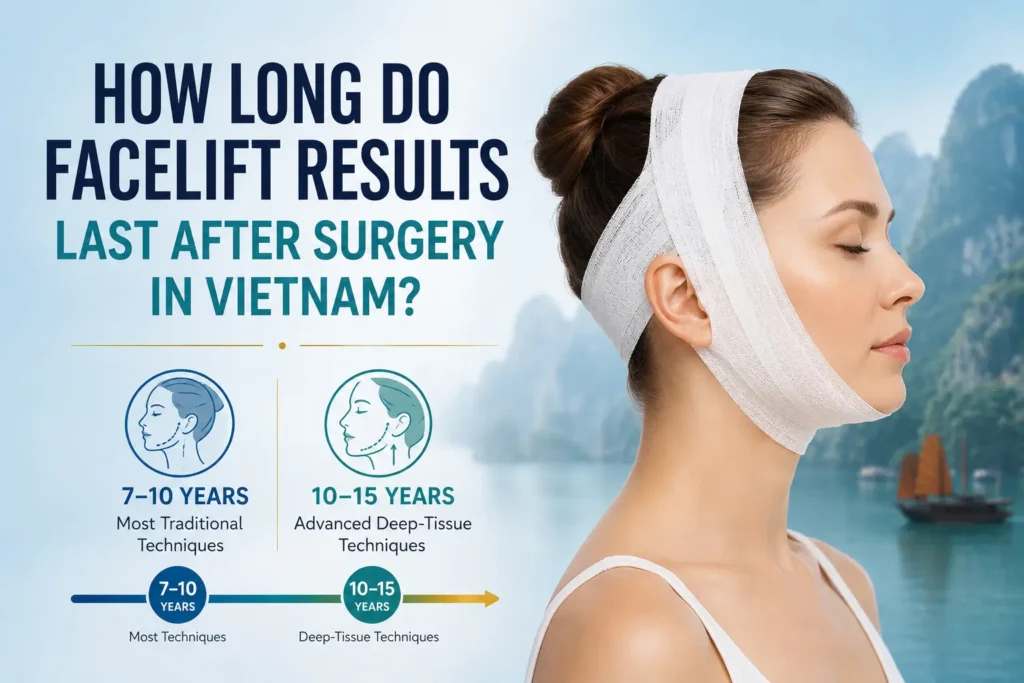
Patients ask me this question in almost every consultation, and I understand why. A facelift is a serious investment of time, trust, and money, and you deserve a straight answer before you book a flight. So here it is, in plain terms: most well-executed facelifts hold their improvement for 7 to 10 years, with some deep-tissue techniques lasting into the 10-to-15-year range. What determines where you land on that spectrum has less to do with geography and far more to do with technique, skin biology, and how you live afterward. Let’s walk through what that actually means for someone considering surgery here in Vietnam.
How Long Do Facelift Results Last?
Most patients keep a visibly younger, firmer face for 7 to 10 years, and advanced deep-tissue techniques extend that durability to 15 years. No facelift stops the clock permanently — it resets it.
I say this to every patient at ABmedi Team Clinic because it’s the honest baseline, not a marketing number. A well-known long-term study that photographed and scored facelift patients over five and a half years found that jowl correction largely held up, while the neck angle showed more relapse over time — a reminder that different areas of the face age at different rates, even after surgery. That’s clinical evidence, not guesswork, and it shapes how I plan each procedure.
Skin-Only Lifts vs. Deep-Plane & SMAS Techniques
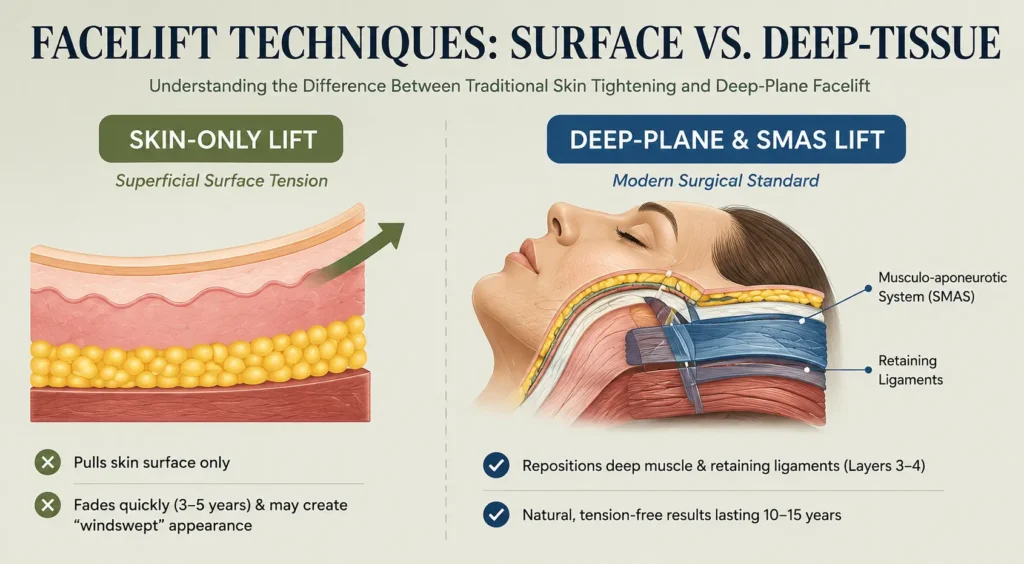
The surgical technique matters enormously here. Surface-level lifts that mainly tighten skin tend to fade faster, sometimes within five to seven years, because skin alone isn’t built to bear structural tension indefinitely.
Deeper techniques — where I reposition the SMAS layer (the Superficial Musculoaponeurotic System, which is the muscular and connective tissue beneath the skin) and, in some cases, work at the deep-plane level — redistribute descended fat pads and tighten the muscular foundation rather than pulling skin taut. Working in these anatomical planes requires a high degree of surgical precision to navigate around facial nerve branches safely, but the reward is immense: because the tension rests entirely on strong muscle fascia rather than delicate skin, the result ages far more gracefully and lasts significantly longer (often in that 10-to-15-year window).
What “Resetting the Clock” Means Long-Term
One more honest point: your face will keep aging after surgery. What a facelift does is lower your visual “starting line,” so a decade later, you generally still look 7 to 10 years younger than you would have without it — even though gravity, sun, and time never fully stop moving.
Will a Facelift in Vietnam Look Natural, Not Overdone?
Yes, when performed correctly — a facelift should never announce itself. The goal I work toward is a rested, refreshed version of you, not a tighter, unfamiliar face.
I understand the anxiety behind this question. International patients have seen photos online of the “windswept” look — skin pulled so tight the ears sit oddly, the smile looks strained, the expression seems frozen. That result comes from over-tightening skin without addressing the deeper structures underneath it, and it’s technique failure, not an inevitable outcome of facelift surgery itself.
Avoiding the “Windswept” Look Through Structural Support
The medical tourism landscape in Vietnam has genuinely shifted over the past few years. Industry reporting on international patients travelling here for facial rejuvenation notes a clear move away from chasing one dramatic feature and toward balanced, natural-looking outcomes tailored to each patient’s own bone structure and skin. That shift matters because it means the surgical culture is increasingly built around subtlety rather than transformation for its own sake.
Combining Facelift with Micro-Fat Grafting for Natural Volume
At ABmedi Team Clinic, natural results come from three specific decisions during planning:
- Working on deeper tissue layers, so the lift comes from repositioned muscle and fat rather than stretched skin.
- Respecting your existing facial proportions instead of imposing a generic template.
- Combining procedures conservatively when needed — for example, a facelift addresses sagging tissue but doesn’t restore volume lost from hollow temples or mid-face deflation. Where appropriate, I may recommend micro-fat grafting alongside a lift rather than over-tightening skin to compensate for volume loss. The objective is always the most appropriate intervention, not the most procedures.
Do Vietnamese Surgeons Understand Western Facial Aesthetics?
Experienced surgeons here work with both Western and Asian facial anatomy regularly, and many trained or practiced internationally. Understanding your specific bone structure, skin thickness, and aging pattern is a matter of surgical experience, not nationality.
This is a fair question to ask before travelling for any procedure, and I’d ask it myself in your position.
Anatomic Nuances: Western vs. Asian Facial Aging
Facial anatomy differs distinctly across ethnic groups:
- Western Facial Anatomy: Typically features a higher, more prominent bone framework (cheekbones and brow ridges) combined with thinner dermis layer. Western facial aging often manifests as earlier fine wrinkling, volume loss in the mid-face, and noticeable skin laxity along the jawline.
- Asian Facial Anatomy: Tends to have a broader, flatter skeletal structure with a thicker dermis and stronger deep fat pads, leading to lower-face heaviness rather than early fine wrinkling.
Because skin thickness, fat distribution, and how the SMAS layer behaves under tension aren’t identical across populations, a surgeon must adjust their surgical vector (the angle at which tissue is lifted). Lifting a Western face requires a more vertical release to preserve high cheekbone contours without adding unnatural width to the mid-face.
Factors That Affect How Long Your Results Last
Your results depend on four things working together: surgical technique, your skin quality, your age at surgery, and how you care for your skin afterward. No single factor controls the outcome on its own.
| Factor | What it means for you |
| Surgical technique | Deeper, structural techniques that reposition the SMAS layer — and, where indicated, work at the deep-plane level — outlast surface-tightening approaches. This is the single biggest lever on longevity, and it’s about the surgeon’s skill, not just the procedure name. |
| Skin quality and genetics | Thicker, more elastic skin holds a surgical result longer than thin, sun-damaged, or genetically fragile skin. Largely outside your control, but I assess it honestly at consultation so we can set realistic expectations together. |
| Age at surgery | Patients operated on in their late 40s to mid-50s often see results last longer, simply because there’s less accumulated tissue laxity to correct and the skin retains more elasticity. |
| Lifestyle after surgery | Sun exposure breaks down collagen and accelerates skin aging. Smoking impairs blood flow to healing tissue. Significant weight loss or gain can alter facial volume and change how the result looks, even years later. |
| Post-operative skincare | A consistent skincare routine, sun protection, and, when appropriate, complementary non-surgical treatments (skin resurfacing, targeted volume maintenance) all help preserve the surgical foundation for longer. |
None of these factors work in isolation — a strong technique on poorly protected skin, or excellent skincare on a weak surgical foundation, both fall short of what’s possible.
Before-and-After Expectations: What’s Realistic?
A facelift should make you look like a well-rested, younger version of yourself — not a different person, and not permanently “fixed.” Expect meaningful, visible improvement in jawline definition, jowls, and mid-face sagging, alongside continued natural aging afterward.
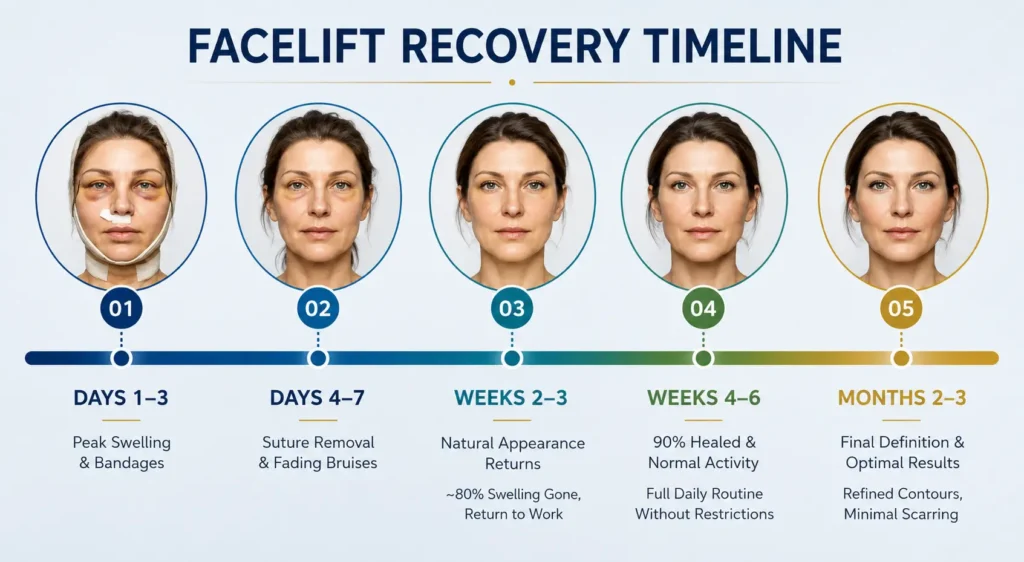
Here’s what I tell patients honestly during planning:
| Timeframe | What to expect |
| Weeks 1–6 | Swelling and bruising fade, but the face may still look slightly tight or asymmetric. This is normal healing, not the final result. |
| 3–6 months | The face relaxes into its natural post-surgical shape — roughly when we can properly evaluate the outcome together. |
| 6 months–2 years | You’re seeing the full benefit of the surgery at its best. |
| Year 3 onward | Natural aging resumes from this new, improved baseline. You’re not “back to where you started” — you’re aging forward from a younger starting point. |
A facelift does not correct everything on the face. It repositions sagging skin and tissue; it does not restore volume lost from the temples or cheeks, and it does not change skin texture, pigmentation, or fine lines on its own. If those are part of your concerns, I’ll usually discuss combining the lift with fat grafting or a non-surgical skin treatment, rather than trying to solve every issue through tension alone — because that’s exactly the kind of over-correction that leads to an unnatural result.
If you’re weighing a facelift in Vietnam, the most useful thing you can do before travelling is ask direct questions about technique, request to see long-term results — not just three-month photos — and make sure your surgeon is willing to say “no” to a request that would compromise a natural outcome. That willingness to set honest boundaries is, in my experience, the clearest sign of a surgeon who is planning for how you’ll look in ten years, not just in your six-month photo.
Frequently Asked Questions (FAQ)
Q1. Is Vietnam good for face lifts?
Yes, Vietnam has become a highly respected destination for facelifts, combining board-certified plastic surgeons, modern JCI-accredited surgical facilities, and substantial cost savings.
Many leading plastic surgeons in Vietnam, including our team at ABmedi Team Clinic, have received advanced clinical training in France, the United States, South Korea, and Japan. International patients benefit from world-class structural techniques (such as Deep-Plane and SMAS lifts) at approximately 50% to 70% less than the cost in Western countries, without compromising on medical safety or natural-looking outcomes.
Q2. What’s the worst day after a facelift?
Days 2 and 3 post-surgery are typically considered the most challenging part of the recovery process.
During this 48-to-72-hour window, post-operative swelling and facial bruising peak as part of the body’s natural inflammatory response. While severe pain is rare and well-managed with prescribed medication, patients often experience tightness, mild discomfort, and fatigue. By Day 4 or 5, swelling begins to subside noticeably, and daily comfort improves rapidly.
Q3. What happens 10 years after a face lift?
Ten years after a facelift, your face continues to age naturally, but you will still look significantly younger than if you had never had the procedure.
A surgical facelift “resets” your visual age clock rather than stopping time. After a decade, soft tissues gradually experience natural gravity and collagen loss, but the underlying structural support created during surgery remains. You will age forward from a refreshed baseline, maintaining better jawline definition and mid-face structure than your unoperated peers.
Q4. What is the hardest cosmetic surgery to recover from?
Major body contouring procedures — particularly circumferential tummy tucks (Abdominoplasty) and lower body lifts — are generally considered the most demanding to recover from.
These procedures involve extensive tissue tightening, muscle repair, and mobility restrictions during early healing. In comparison, while a facelift requires careful post-operative attention to facial swelling and resting posture, it is typically far less physically painful and allows for a faster return to light daily activities.
Q5. What is the most regretted cosmetic surgery?
Statistically, cosmetic procedures performed by unqualified providers or driven by fleeting trends carry the highest dissatisfaction rates.
Regret rarely stems from a specific procedure type; instead, it arises from over-correction (such as over-tightened skin or excessive fillers), realistic expectations not being set during consultation, or choosing low-cost clinics that compromise on safety. At ABmedi Team Clinic, we prevent post-surgical regret by maintaining strict clinical boundaries, prioritizing subtle, natural structural rejuvenation, and turning down procedures that would alter a patient’s authentic facial identity.
📞 💬 WhatsApp / Chat: [http://wa.me/84975142666] 🌐 Book online: [+84-975-142-666]
Consultations are available in-clinic and online for international patients. Most patients leave their first appointment knowing exactly what they need — and feeling confident about the path ahead.
