


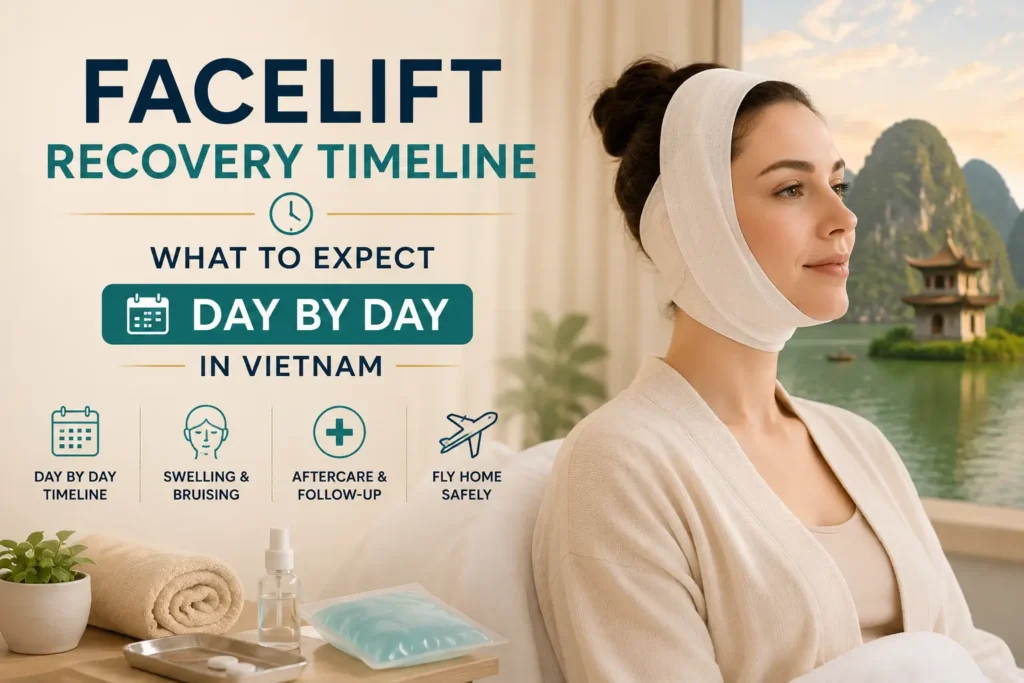
Every patient asks me some version of the same question the day before surgery: “Okay, but what will I actually look like on day 3? Day 10? When I land back home?” It’s a fair question, and it deserves a straight answer rather than a vague “everyone heals differently.”
So here it is: a realistic, day-by-day recovery map built from what I see in my own patients week after week, plus the specific logistics that matter when you’re traveling from the US, Australia, or Canada for surgery rather than recovering five minutes from your own bed.
Facelift Recovery Timeline: Day by Day
Recovery isn’t linear, and it doesn’t move at the same pace for everyone — your age, skin quality, and the specific technique used (deep plane, SMAS, or mini facelift) all shift the curve slightly. But almost every patient passes through the same recognizable stages.
| Day 0–1 | Surgery Day & The First 24 Hours
You’ll wake up groggy, with a compression dressing around your face and neck. This first day is about rest and monitoring, not activity — you’ll feel unsteady, and you should have someone with you rather than being alone in a hotel room. Mild pain is normal and managed with medication; sharp, escalating pain is not, and I want to hear about it immediately. |
| Day 2–3 | Peak Swelling
This is the point where patients often feel most discouraged, because the mirror looks worse, not better. That’s expected — swelling and bruising typically peak between days two and three as the body sends fluid and immune cells to the surgical site to begin repair. If your reflection looks more dramatic than day one, that’s your body doing exactly what it’s supposed to. |
| Day 4–6 | Turning the Corner
Most patients no longer need prescription pain medication by this point, and swelling visibly begins to recede. Moving around the room, sitting up for meals, and short walks in the hallway start to feel manageable rather than exhausting. |
| Day 7 | First Follow-Up & Suture Removal
We typically see patients in clinic around this mark to remove non-dissolvable sutures and check incision healing. Daily improvement usually becomes noticeable from here onward, and this is generally the earliest point we clear patients for short car rides or errands with a companion. |
| Day 8–14 | Bruising Fades, Confidence Returns
Week two is when most patients notice a real jump in both appearance and comfort — swelling drops off faster and bruising continues to clear. Bruises typically shift color as they heal, moving from purple to green to yellow-brown before disappearing entirely. Many patients feel comfortable in public with light makeup by the end of this window, and this is generally when we discuss the earliest safe date to fly home. |
| Day 15–30 | The “Ugly Duckling” Stretch Wraps Up
Most visible bruising is gone and residual swelling continues to fade in the background. Some patients notice lingering puffiness along the jaw or under the chin that isn’t obvious to anyone but them. Numbness around the ears or incision lines is common and not a cause for concern — nerve sensation returns gradually over the following weeks. |
| Month 2–3 | Results Settle In
This is typically when the jawline definition and overall contour you were hoping for really come into focus, as the deeper tissue layers finish settling into their new position. |
A note from the surgical team: No two faces heal at exactly the same pace. Age, skin elasticity, whether you smoke, and how closely you follow post-op instructions all move this timeline in either direction. Treat the above as a map, not a guarantee.

How Much Downtime Do You Need After a Facelift?
“Downtime” means different things depending on what you’re returning to. Here’s how I break it down for patients planning their trip around work, family, and social commitments.
| Activity | Typical Timing |
| Remote / desk work | Day 10–14 |
| Comfortable in public with makeup | Day 10–14 |
| Social events, dinners out | 2–3 weeks |
| Light exercise, walking | 2–3 weeks (surgeon clearance) |
| Swimming, strenuous exercise, gym | 4–6 weeks |
| Full, final results visible | Several months as tissue settles |
A useful rule of thumb: mini facelifts, being less invasive, tend to track toward the faster end of every one of these windows, while a full deep plane facelift — which repositions deeper muscle and tissue layers — sits toward the slower end because there’s simply more internal remodeling happening beneath the surface.
When Can You Fly Home After Surgery?
This is the question that matters most if you’ve traveled to Hanoi specifically for this procedure, and it deserves more nuance than a single number.
Cabin pressure on a commercial flight is equivalent to sitting at roughly 6,000–8,000 feet of altitude. That pressure change, combined with low cabin humidity and hours of sitting still, can push more fluid into facial tissue and worsen swelling — and prolonged immobility also raises clotting risk during exactly the window when your body’s clotting factors are already elevated from surgery.
Why timing matters: The period of highest blood clot risk after any surgery generally falls between days five and fourteen, which is also often when patients feel well enough to want to travel. This is precisely the mismatch we plan around.
Short-Haul Flights (Under ~4 Hours)
Most patients are cleared for a short regional flight around the 7–10 day mark, provided swelling has visibly improved and there’s no sign of complication at the incision sites. We build this into your recovery schedule if your itinerary includes an internal connection.
Long-Haul International Flights
For the long flight back to the US, Australia, or Canada, we generally recommend waiting a minimum of 2 weeks, and many surgeons — myself included, depending on how your individual healing is progressing — prefer closer to 3–4 weeks before a 12+ hour flight. This isn’t overcaution; it reflects the reality that longer flights mean longer immobility, more cumulative pressure exposure, and less access to your surgical team if something feels off mid-air.
Practical tips for the flight home:
- Book an aisle seat and get up to walk every 2–3 hours
- Stay well hydrated and skip alcohol and excess salt before boarding
- Wear your compression garment if your surgeon has cleared you to travel in it
- Keep your written aftercare plan and clinic contact details in your carry-on
- Consider compression stockings for the flight to support circulation
Because most international patients need to remain in Hanoi for at least one to two weeks for in-person follow-up before flying, we build this directly into your treatment plan when you first book your surgery date — it shouldn’t come as a surprise the week before your flight.
Managing Aftercare Once You’re Back in the US, Australia, or Canada
Going home doesn’t mean your recovery is finished — it means the second half of it happens without us physically in the room, which is why we send every international patient home with a detailed, dated aftercare plan before they board their flight.
Before You Leave Hanoi
- A written recovery timeline covering what’s normal through week 6
- Photos of your incisions at the point of discharge, for comparison later
- A prescription or written medication plan your local pharmacy can honor
- Direct contact details for reaching your surgical team by message or video call
Once You’re Home
We ask patients to schedule a local check-in with a general practitioner or plastic surgeon in their home country around week 2–3, purely as a second set of eyes — not because we expect a problem, but because having someone nearby who can physically examine you gives real peace of mind. We remain reachable by video call throughout your recovery for anything that comes up, from a question about scar care to a photo you want us to look at.
What to arrange before you fly home: a quiet first few days with help around the house, a sleeping setup with your head elevated, soft foods on hand, and — if possible — a local doctor’s contact already saved in your phone, just in case.
Warning Signs of Complications After a Facelift
The vast majority of recoveries proceed exactly as expected. But knowing the difference between “normal, if uncomfortable” and “call your surgeon now” matters even more when you’re thousands of miles from the clinic that operated on you. Contact your surgical team immediately — don’t wait for your next scheduled check-in — if you notice any of the following:
- Sudden, one-sided swelling or a firm, rapidly growing lump under the skin
- Active bleeding that soaks through your dressing
- Fever above 100.4°F (38°C), or chills
- Pain that intensifies rather than improves, or isn’t controlled by medication
- Foul-smelling drainage or pus from an incision
- Sudden weakness on one side of the face, or an uneven smile
- Shortness of breath, chest pain, or calf swelling after a flight (possible clot warning signs)
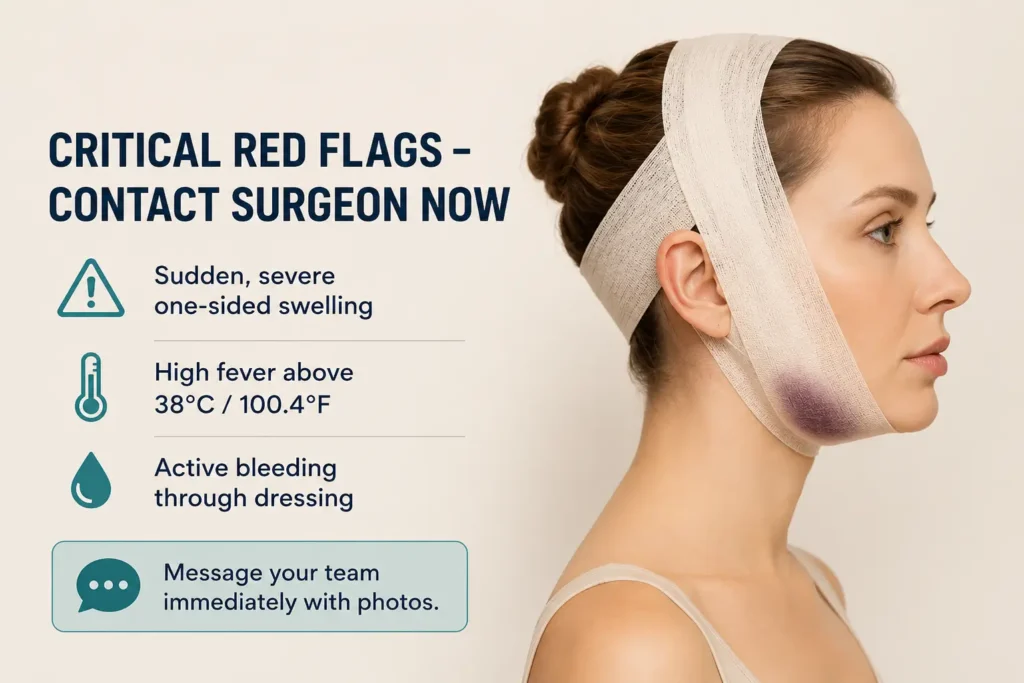
If you’re traveling when this happens: don’t try to self-diagnose over a symptom-checker.
Message your surgical team immediately with photos, and seek in-person emergency care in whatever country you’re in if symptoms are severe — a firm lump with rapidly worsening one-sided swelling in particular needs same-day evaluation.
Long-Term Recovery: What Happens After Week 4?
By the one-month mark, most of the dramatic, visible healing is behind you — but the deeper story is still being written. Scar tissue continues to mature and soften for several more months, incision lines gradually fade from pink to a color close to your natural skin tone, and any lingering numbness around the ears or jaw continues to resolve as nerve endings reconnect.
Full, settled results — the jawline definition and contour you actually came for — typically take three to six months to fully reveal themselves, with subtle refinement continuing for up to a year as deeper tissue layers finish settling. Patients are often surprised by this; the two-week version of your results is a preview, not the final picture.
What we watch for in long-term follow-ups: symmetry as swelling fully resolves, scar maturation and color, and whether any residual firmness along the incision lines is softening on schedule. This is why we keep in touch well past the point most patients consider themselves “recovered.”
Frequently Asked Questions (FAQ)
Q1. Is Vietnam good for face lifts?
Answer: Yes, Vietnam is an excellent choice for a facelift. The country combines internationally trained plastic surgeons, state-of-the-art medical facilities licensed by the Ministry of Health, and highly competitive pricing. Medical tourists can save up to 60-70% compared to Western countries while receiving world-class care and personalized post-operative recovery services in major hubs like Ho Chi Minh City and Hanoi.
Q2. How long does it take for your face to look normal after a facelift?
Answer: Most patients can expect their face to look relatively “normal” and presentable in public within 2 to 3 weeks after surgery, as the majority of visible bruising and major swelling subsides. However, minor residual swelling, stiffness around the incisions, and subtle asymmetries are completely natural. The final, fully settled, and refined results typically reveal themselves between 3 to 6 months post-op.
Q3. How long do I have to sleep sitting up after a facelift?
Answer: You should sleep with your head elevated at a 30 to 45-degree angle (using a wedge pillow or 2-3 standard pillows) for at least 1 to 2 weeks after a facelift. Keeping your head above your heart is crucial during this initial phase to minimize post-op swelling, reduce fluid retention, accelerate the healing process, and prevent accidental pressure on the fresh incisions.
Q4. How will I look 3 weeks after a facelift?
Answer: At the 3-week mark, you will already see a noticeably refreshed and younger facial contour. Most of the intense bruising will have faded to a faint yellowish tint, easily concealed with light makeup. While some tightness, mild swelling, and numbness around the ears are still completely normal, you will look well enough to return to work, socialize comfortably, and engage in light daily activities without looking like you just had surgery.
Q5. What are the worst days of recovery after a facelift?
Answer: The first 48 to 72 hours (Days 1 to 3) are typically the most uncomfortable and challenging days of facelift recovery. During this peak period, swelling and bruising reach their maximum, and patients often experience a tight, throbbing sensation alongside mild discomfort. Fortunately, this peaks around day 3 and begins to improve significantly by day 4 or 5, with pain being easily manageable through prescribed medications.
📞 💬 WhatsApp / Chat: [http://wa.me/84975142666] 🌐 Book online: [+84-975-142-666]
Consultations are available in-clinic and online for international patients. Most patients leave their first appointment knowing exactly what they need — and feeling confident about the path ahead.
