


Do I Need a Brow Lift or Eyelid Surgery?
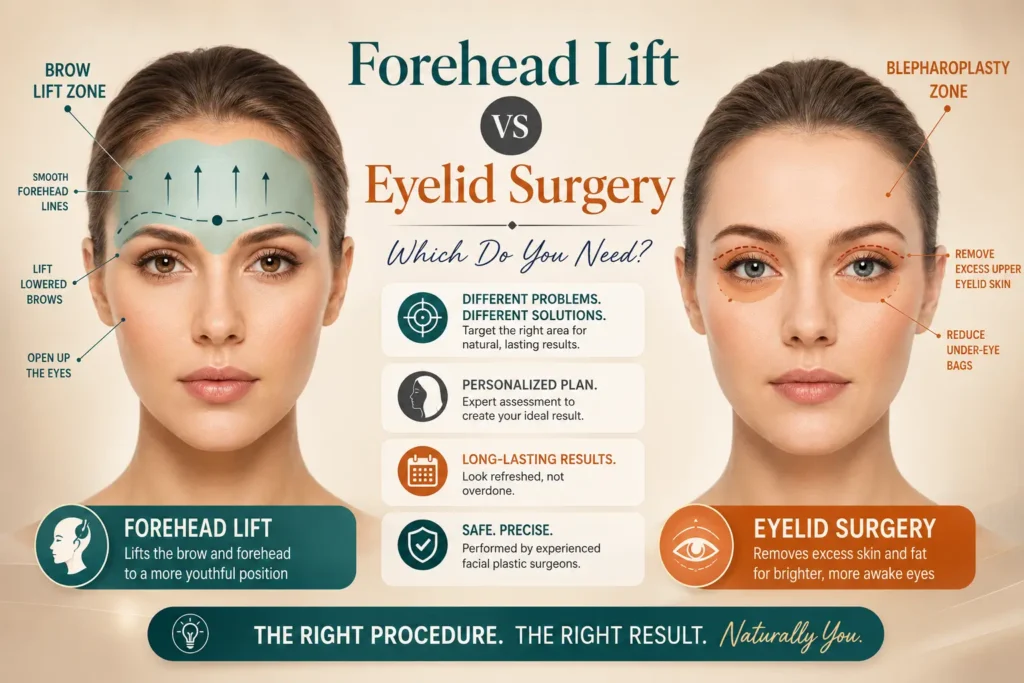
When patients arrive at ABmedi Team Clinic frustrated by eyes that look persistently tired or heavy, I ask them one question before anything else: where, precisely, is the weight coming from? The answer determines everything — because a forehead lift and blepharoplasty are anatomically distinct operations that solve distinct problems, even though both improve the eye area.
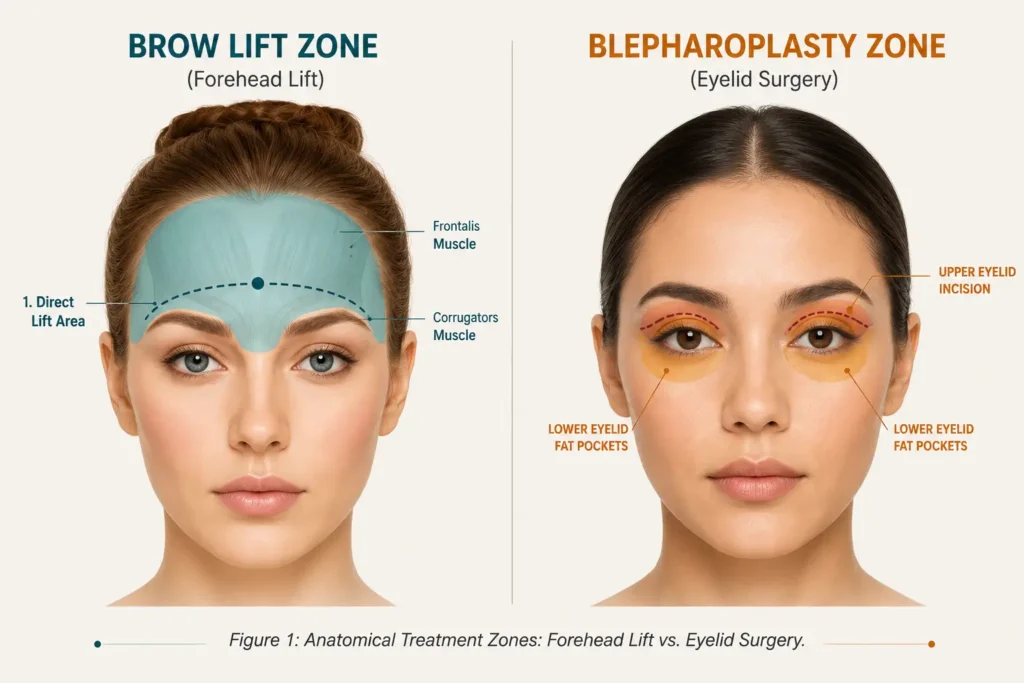
A brow lift (forehead lift) works above the eyes. Through incisions concealed at or behind the hairline, the underlying soft tissue and musculature of the forehead are elevated and repositioned. The visible result is a higher, more arched brow position, smoother horizontal forehead creases, and softer glabellar frown lines between the brows. Importantly, the lifting effect on the upper eyelid is indirect — when a descended brow is restored to its youthful height, the excess skin it was casting over the upper lid simply lifts away with it.
Blepharoplasty (eyelid surgery), by contrast, acts directly on the eyelid. In upper lid surgery, a carefully measured strip of redundant skin — and sometimes excess fat — is removed through a fine incision placed along the natural eyelid crease. The crease is re-established, the lid platform opened, and the eye immediately appears more awake. Lower lid blepharoplasty addresses under-eye bags and loose skin below the lashes. Neither upper nor lower blepharoplasty changes brow position at all.
Clinical Anatomy Note
The eyebrow has a well-defined ideal position: in women, the head of the brow should sit roughly at the orbital rim, arching gently to a peak above the lateral limbus before tapering downward. In men, the brow sits closer to the rim with less arch. When the brow descends below this ideal — a condition called brow ptosis — it physically presses extra skin onto the upper lid. Removing that lid skin without first correcting the brow ptosis often produces a tight, unnatural result and leaves the underlying problem unaddressed.
The key clinical distinction is this: a brow lift corrects position; blepharoplasty corrects tissue volume. Some patients need one. Many need both.
| At-Home Self-Test
The Manual Brow Elevation Test — Do This Before Your Consultation
If lifting the brow dramatically reduces upper lid heaviness — the excess skin largely disappears and your lid platform opens up — the primary problem is brow ptosis. A forehead lift alone may resolve the issue, or you may need a modest blepharoplasty alongside it. If lifting the brow makes little difference to the amount of skin sitting on the lid — the lid itself remains heavy regardless — the problem is intrinsic eyelid skin laxity or excess fat. Blepharoplasty is the correct primary intervention. If both occur simultaneously — the brow is clearly low AND there is residual lid skin even after elevation — a combined procedure will produce the most complete result. |
Who Is an Ideal Candidate for Each?
You are likely a brow lift candidate if: your brow position sits at or below the orbital rim, you find yourself unconsciously elevating your brows to see clearly or to look alert, you have deep horizontal forehead furrows caused by constant frontalis muscle overcompensation, or you have previously undergone upper blepharoplasty but are noticing renewed heaviness as the descended brow continues its downward drift.
You are likely a blepharoplasty candidate if: your brow sits at an acceptable height yet upper lid skin folds over the lash line, you have under-eye bags that no amount of sleep will resolve, or you experience functional visual obstruction from the upper lid tissue itself — not from the brow.
Important Consideration
Performing an upper blepharoplasty on a patient who primarily needs a brow lift is one of the more common errors in facial surgery planning. Removing too much upper lid skin in the presence of significant brow ptosis can leave a patient with lagophthalmos — an inability to fully close the eye — and a result that looks unnatural. The tissue simply wasn’t where the problem was.
Upper Face Dilemmas: Forehead Lift vs Botox vs Facelift
Once you’ve established that the forehead and brow region needs attention, the next question is which modality — injection, surgery, or a broader facial procedure — is actually appropriate for your degree of change. These three options are not interchangeable; they operate on fundamentally different biological mechanisms and deliver fundamentally different outcomes.
| Brow Lift vs Botox — Surgical Realignment vs Temporary Relaxation |
| Botox has genuinely transformed how we manage the upper face over the past two decades. By selectively relaxing the depressor muscles that pull the brow downward — primarily the orbicularis oculi and corrugator — small doses of botulinum toxin allow the frontalis muscle to elevate the tail of the brow with less resistance. The result is a subtle arch and a smoother forehead, typically achieved in a 15-minute office visit with no recovery period and an onset of effect within five to seven days.
That said, Botox has hard limits that are purely anatomical. It cannot restore soft tissue that has descended due to gravitational change and ligamentous laxity. It cannot shorten a lengthened forehead. It does not address the deep structural repositioning that brow ptosis requires once it has progressed beyond a certain threshold. When the brow has dropped significantly, injecting the depressors simply amplifies whatever residual elevator function remains — and that ceiling is limited. The honest clinical distinction is this: Botox is a maintenance tool for early or moderate dynamic brow changes; surgical brow lifting is a structural solution for anatomical descent. The two are not competing options — they are sequential stages of the same journey. Many of my patients at AbMedi Team Clinic begin with Botox in their thirties, achieve excellent results for years, and transition to a forehead lift in their mid-to-late forties when the structural change finally outpaces what an injection can accomplish. Practical Decision Point If your brow responds well to Botox — meaning it lifts noticeably after treatment — you are likely in the early-to-moderate phase of brow descent and are an excellent candidate for continued injectable management. If your brow no longer responds meaningfully to Botox, or if you require an increasing dose to achieve the same effect, the underlying structural change has progressed and surgery warrants serious consideration. |
| Brow Lift vs Facelift — Upper Third vs Mid-and-Lower Face Rejuvenation |
| A brow lift and a facelift address entirely different anatomical zones, and confusing the two — or expecting one to do the work of the other — leads to significant dissatisfaction. The face is conventionally divided into thirds: the upper third (forehead to brow), the middle third (brow to nasal base), and the lower third (upper lip to chin). A forehead lift operates exclusively in the upper third. A facelift — even the most comprehensive rhytidectomy — operates primarily in the mid and lower thirds, improving jawling, nasolabial fold depth, mid-face descent, and neck laxity.
No facelift will correct a descended brow. The anatomical vectors of a facelift pull tissue in a posterior and superior direction along the lower and mid face; this movement does not transmit meaningful force upward into the forehead. Conversely, a brow lift will do nothing for a heavy jaw, prominent jowls, or a lax neck. The two procedures target non-overlapping regions of the face — which is precisely why they are so frequently combined. The decision between them hinges on the geography of your aging. If the heaviness you see in photographs is concentrated at the brow, forehead, and upper periorbital region, a forehead lift addresses the source. If the aging you are concerned about sits at the cheek, jaw, and neck, a facelift is the appropriate intervention. A significant proportion of patients in their late forties and fifties exhibit meaningful aging in both zones, which is the clinical rationale for combining the procedures — a topic explored in detail in the combination section below. |
The Power of Combination: Can These Procedures Be Done Together?
Combining facial procedures during a single anesthetic episode is not simply a matter of convenience — it is often the most anatomically logical and medically sound approach to comprehensive rejuvenation. Here is why, in practical terms.

Can a Forehead Lift and Upper Blepharoplasty Be Combined?
Yes — and in many cases, they should be. When brow ptosis and eyelid skin redundancy coexist (which is extremely common in patients over 45), addressing only one of these problems produces a result that looks incomplete or unbalanced. Elevating the brow without removing residual lid skin can leave a patient with a high brow and still-heavy upper lids. Removing lid skin without correcting the brow creates a tight lid that will re-accumulate excess tissue as the descended brow continues pressing downward.
Why the Combination Works Better Than Either Alone
From an anatomical standpoint, the brow lift is performed first in the sequence. Once the brow is elevated to its correct position and secured, we can make a precise assessment of how much upper lid skin genuinely remains in excess. This sequencing prevents over-resection of the lid — a critical safety principle — because the brow lift itself removes a portion of the apparent lid fullness by re-establishing the correct soft tissue relationship. The blepharoplasty then addresses only what is truly redundant at the lid level, delivering a natural, proportionate result.
Single-downtime advantage: Patients who choose to have both procedures simultaneously undergo one anesthetic, one sterile operating field preparation, one recovery period, and one set of post-operative restrictions. Separating these procedures into two surgical episodes — whether for financial reasons or scheduling convenience — means doubling every one of those elements. The combined recovery after simultaneous brow lift and upper blepharoplasty typically runs 10 to 14 days to social presentability, no longer than either procedure performed alone.
Cost efficiency: Facility and anesthesia fees are shared across both procedures rather than incurred twice, making the combined approach meaningfully more economical than two separate operations.
Can a Forehead Lift and Facelift Be Done Together?
Absolutely — and for patients whose aging involves both the upper third and the mid-to-lower face simultaneously, combining these procedures delivers a result that no single operation can replicate. The face ages as a whole, not in isolated segments. A patient who lifts only the brow while ignoring significant jowling or mid-face descent will have a forehead that looks refreshed framed by a lower face that still reads as older. The incongruity is immediately visible and often undermines the impact of the surgery.
From a surgical standpoint, a combined forehead lift and facelift is routinely performed in a single session of approximately three to four hours. The procedures use different anatomical planes and entirely different incision sites — the forehead lift works at or behind the hairline, the facelift through incisions around the ear — so the two are performed in sequence without technical conflict. Recovery is approximately two to three weeks, comparable to a standalone facelift, because the facial skin has a finite healing bandwidth regardless of the number of zones addressed.
Comprehensive Rejuvenation Logic
Think of the face as a landscape that has shifted at every elevation. Addressing only one altitude — the forehead or the jawline — while leaving other areas untouched creates a topographical imbalance that trained eyes will notice and, more importantly, that the patient will notice in their own reflection. When the goal is a genuinely rested, naturally younger appearance rather than a surgically segmented one, comprehensive same-session correction is almost always the superior strategy.
At AbMedi Team Clinic, the combination of forehead lift, upper blepharoplasty, and facelift — performed together in appropriately selected patients — represents the most complete single-session facial rejuvenation we offer. Patients typically achieve five to twelve years of visible age reversal across the entire face in a single recovery period.
Frequently Asked Questions
Q1: Is a face lift better than eyelid surgery?
Neither procedure is “better” than the other; they are designed to address entirely different anatomical regions of facial aging. A facelift (rhytidectomy) primarily targets the lower two-thirds of the face, effectively tightening sagging jowls, smoothing deep nasolabial folds, and restoring a sharp jawline. Conversely, eyelid surgery (blepharoplasty) focuses exclusively on the periorbital area to eliminate under-eye bags and heavy, hooded upper eyelids. Because aging rarely happens in isolation, these two procedures are frequently combined in a single surgical session to achieve a completely balanced, harmonious rejuvenation while optimizing facility and anesthesia fees.
Q2: How do I know if I need a brow lift or a blepharoplasty?
A simple clinical diagnostic method you can try at home is the “Brow Lift Test.” Look in the mirror and use your fingers to physically lift your eyebrows upward to their natural, youthful position above the brow ridge.
- If lifting your brow automatically corrects the sagging skin over your upper eyelids, your primary anatomical concern is a dropped brow line, making you an ideal candidate for a forehead/brow lift.
- If your upper eyelid skin still remains heavy, wrinkled, and hooded even when your eyebrow is held in its proper position, the issue is structural skin excess on the eyelid itself, meaning a blepharoplasty is required.
- Note: Many patients present with a combination of both conditions and achieve the best aesthetic result through a dual, combined procedure.
Q3: What is the ideal age for blepharoplasty?
While there is no single “perfect” age, the vast majority of patients undergoing blepharoplasty are 35 years of age or older, which is when the natural degradation of collagen typically causes noticeable eyelid laxity, sagging, and fat prolapse (under-eye bags). However, younger patients in their 20s or early 30s frequently seek lower blepharoplasty if they possess a genetic predisposition to chronic, prominent under-eye bags that do not respond to topical treatments or lifestyle adjustments.
Q4: Will I regret blepharoplasty?
Statistically, blepharoplasty has one of the highest patient satisfaction rates and lowest regret rates in the entire field of plastic surgery. According to multi-year patient-reported outcome data, the vast majority of individuals report an immediate boost in self-confidence, noting that they look “refreshed and well-rested” rather than “operated on.” Regret is exceptionally rare and is almost exclusively associated with choosing a non-board-certified operator, which can lead to complications such as asymmetry, over-resection of skin (lagophthalmos, or inability to close the eyes fully), or an unnatural hollowed look.
Q5: What is the most regretted plastic surgery?
Globally, rhinoplasty (nose surgery) historically carries some of the highest revision and patient dissatisfaction rates in cosmetic surgery. This is primarily due to the immense architectural complexity of the nose, its prominent position in the exact center of the face, and the intricate balance required between aesthetic appearance and respiratory function. Additionally, over-aggressive, low-cost procedures or non-surgical “liquid nose jobs” performed by unqualified injectors frequently result in vascular complications or unnatural cosmetic distortion, leading to high rates of patient regret and expensive revision surgeries.
📞 💬 WhatsApp / Chat: [http://wa.me/84975142666] 🌐 Book online: [+84-975-142-666]
Consultations are available in-clinic and online for international patients. Most patients leave their first appointment knowing exactly what they need — and feeling confident about the path ahead.
