



In twenty-plus years of doing this work, I’ve noticed that patients rarely arrive asking “should I get a facelift?” By the time they sit down across from me, they’ve already decided. What they actually need answered is which facelift, performed how, under what anesthesia, and for how long they’ll be on my table. Those four questions are the backbone of this article, and I’m going to answer them the way I would in a real consultation room at ABmedi Clinic — plainly, with the trade-offs left in, not smoothed over.
What’s the Difference Between a Deep Plane and Traditional Facelift?
The short answer: it comes down to which layer of tissue the surgeon actually moves, and whether the skin travels with that layer or gets pulled separately from it.
A traditional facelift — sometimes called a SMAS facelift, named for the superficial musculoaponeurotic system that sits under your skin — works by separating the skin from that muscular layer, then tightening each one on its own. The surgeon lifts the SMAS, secures it, and then re-drapes and trims the skin over the top. It’s a well-established approach that’s been refined for decades, and for the right patient it produces a genuinely refreshed result, particularly around the jawline and lower face.
A deep plane facelift takes a different route. Instead of separating skin from SMAS, I release the retaining ligaments that anchor the deeper facial structures to the underlying bone, then lift the skin and SMAS together, as one unit, along with the deeper fat compartments of the midface. Because nothing is being pulled independently, there’s far less tension sitting on the skin itself.
Why this matters clinically
Tension on skin is what creates that “wind-tunnel” or overly stretched look patients dread. Moving the SMAS and skin as a single unit lets me reposition volume — especially in the cheeks and nasolabial folds — rather than just stretching skin over a face that hasn’t actually changed shape underneath.
| Factor | Traditional (SMAS) Facelift | Deep Plane Facelift |
| Layer treated | Skin and SMAS lifted separately | Skin, SMAS, and ligaments released and lifted as one unit |
| Midface volume | Limited correction | Restores cheek and midface volume directly |
| Skin tension | Higher — skin bears more of the lifting force | Lower — deeper structures carry the lift |
| Best suited for | Mild to moderate laxity, jawline and neck focus | Moderate to advanced aging, midface descent, deep folds |
| Technical demand | Established, widely performed | Requires advanced anatomical training near the facial nerve |
| Typical longevity | Around 7–10 years | Often 10–15 years, largely due to structural repositioning |
Neither technique is objectively superior — I want to be direct about that, because a lot of marketing online implies otherwise. A patient in her mid-40s with early jowling and good skin quality may do beautifully with a well-executed traditional lift. A patient in her late 50s with significant midface descent and deep nasolabial folds is usually better served by the deep plane approach. The right answer depends on your anatomy, not on which technique sounds more advanced in a blog post.
Mini Facelift vs. Full Facelift: Which Is Right for You?
This is one of the most common points of confusion I see, because “mini” sounds like a lighter version of the same thing — and in some ways it is, but the differences run deeper than incision length.
What a Mini Facelift Actually Treats
A mini facelift uses shorter incisions, usually tucked around the ear, and addresses early laxity concentrated in the lower face and upper neck — think early jowling, a softening jawline, and the first signs of “prejuvenation” candidates want to get ahead of. Less tissue is undermined, the operation is shorter, and recovery is typically measured in about a week to ten days rather than several weeks.
What a Full Facelift Actually Treats
A full facelift addresses the lower two-thirds of the face and neck comprehensively — midface, jowls, jawline, and neck banding — through longer incisions and more extensive dissection of deeper tissue. It’s a bigger operation with a longer recovery, but it corrects far more advanced aging than a mini facelift is designed to touch. Note that neither procedure treats the forehead or brow area on its own — that requires a separate brow lift, which can be combined during the same surgical session if you want.
| 30–50
Typical age range for mini facelift candidates |
7–10
Days of downtime, mini facelift |
2–4
Weeks of downtime, full facelift |
Here’s the honest caveat: age is a guideline, not a rule. I’ve recommended mini facelifts to patients in their 60s with excellent skin elasticity and isolated jawline concerns, and I’ve recommended full facelifts to patients in their late 30s dealing with more advanced laxity than their age would suggest. Your candidacy comes down to what I see on a physical exam, not a birthday.
Quick answer
Choose a mini facelift if your concerns are limited to early jowling and jawline softening with good skin elasticity. Choose a full facelift if you have midface descent, deep folds, and neck laxity that a smaller procedure won’t meaningfully correct.
What Techniques Do Vietnamese Surgeons Use for Facelifts?
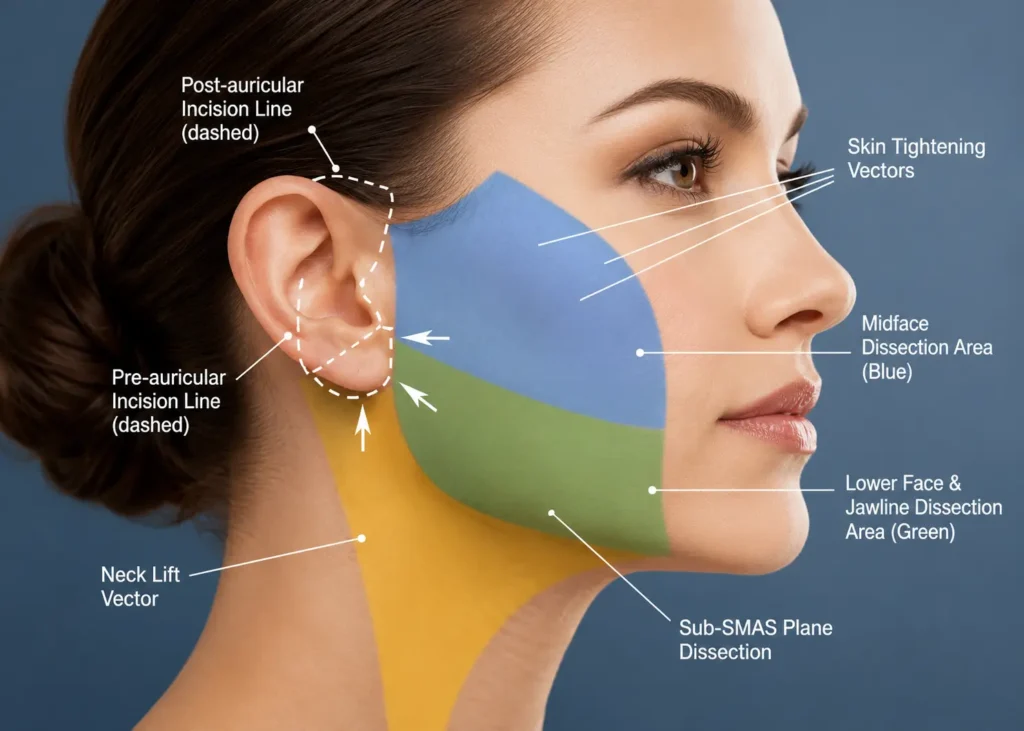
This question comes up constantly from international patients researching facelift surgery in Vietnam, usually with an unspoken worry underneath it: will I be getting an outdated technique because I’m having this done abroad? It’s a fair question, and the honest answer is that Vietnam’s leading facial plastic surgery centers, including our team at ABmedi Clinic, train in and perform the same core techniques used at reputable practices in the US, Australia, and the UK — deep plane dissection, SMAS plication and imbrication, extended SMAS techniques, and endoscopic approaches for appropriate candidates.
What differs isn’t the surgical vocabulary — it’s often the surgeon-to-patient ratio and the amount of hands-on time a senior surgeon personally spends per case, since high-volume medical tourism practices have built their entire model around facial anatomy expertise. At ABmedi Clinic, every deep plane and SMAS facelift is performed directly by a senior surgeon from incision to closure — not handed off to a junior associate partway through, which is unfortunately not universal even in higher-cost markets.
Technique selection follows the same clinical logic anywhere in the world: skin quality, degree of ligament laxity, prior surgical history, and the specific areas of concern determine whether SMAS plication, extended SMAS, or deep plane dissection is the right tool. What should matter to you as a patient isn’t the country on the passport stamp — it’s whether the surgeon operating on you has performed the specific technique hundreds of times and can show you consistent, natural-looking outcomes.
What to verify before you book
Ask directly: which technique will be used, who performs the entire procedure, how many of this specific technique the surgeon has done, and whether before-and-after photos reflect that surgeon’s own cases rather than stock imagery. Any reputable practice, including ours, should answer without hesitation.
How Long Does Facelift Surgery Take?
Operating time depends almost entirely on which procedure you’re having and whether it’s combined with anything else. Here’s roughly how it breaks down in practice:
| Procedure | Typical Duration |
| Mini facelift alone | 1–2 hours |
| Traditional (SMAS) facelift | 3–4 hours |
| Deep plane facelift | 4–6 hours |
| Deep plane facelift + neck lift | 5–7 hours |
| Full facial rejuvenation (facelift + brow lift + eyelid surgery + fat grafting) | 6+ hours |
Deep plane technique takes longer than a traditional lift for a straightforward reason: releasing the retaining ligaments and working beneath the SMAS near the facial nerve demands a slower, more meticulous dissection. I would rather a case run an extra ninety minutes than rush past tissue that sits close to nerve branches. If a surgeon quotes you an unusually short time for a deep plane procedure, that’s worth asking more questions about, not celebrating.
Combined procedures — facelift with a neck lift, or facelift with blepharoplasty — add time but are often more efficient and safer overall than spacing them into separate surgeries months apart, since you’re only going through anesthesia and recovery once.
What Type of Anesthesia Is Used?
Patients often assume there’s one standard answer here, but anesthesia choice genuinely depends on the scope of surgery, your health history, and — to a real degree — surgeon and anesthesiologist preference.
General Anesthesia
You’re fully asleep and unaware throughout the procedure, typically with airway support. This is the standard choice for deep plane facelifts and any longer, more extensive combined procedure, largely because it allows the surgical team to work without interruption over several hours and keeps facial muscles completely relaxed during deep dissection.
IV Sedation (“Twilight” Anesthesia)
You remain able to breathe on your own, you’re deeply relaxed and typically have no memory of the procedure afterward, but you’re not intubated. This is commonly used for mini facelifts and shorter SMAS procedures. Recovery from sedation tends to be quicker than general anesthesia, with less grogginess and lower rates of post-operative nausea.
Local Anesthesia with Sedation
Some surgeons perform facelifts, including select deep plane cases, using local anesthetic injections combined with light sedation, keeping the patient conscious but comfortable. Advocates point to a lower rate of hematoma and reduced cardiac and pulmonary risk since general anesthesia is avoided entirely. It requires a longer, more patient surgical pace and isn’t the right fit for every case or every patient’s anxiety tolerance.
How we decide at ABmedi Clinic
Your anesthesia plan is set during your pre-operative consultation and medical screening, based on procedure length, your cardiovascular health, and any prior anesthesia history — not on a one-size-fits-all clinic policy. A board-certified anesthesiologist is present for every case, regardless of technique.
What actually determines your safety isn’t which category of anesthesia you choose — it’s the qualifications of the person administering it and whether your procedure is performed in an accredited surgical facility with proper monitoring. That’s a question worth asking of any clinic, anywhere in the world.
Endoscopic vs. Open Technique: Pros and Cons
The endoscopic approach uses a small camera inserted through minimal incisions, usually hidden in the hairline, allowing the surgeon to visualize and reposition deeper tissue without the longer incisions an open technique requires. The open technique — which includes both traditional SMAS and deep plane facelifts as typically performed — uses continuous incisions from the temple around the ear, giving direct visual and manual access to a wider surgical field.
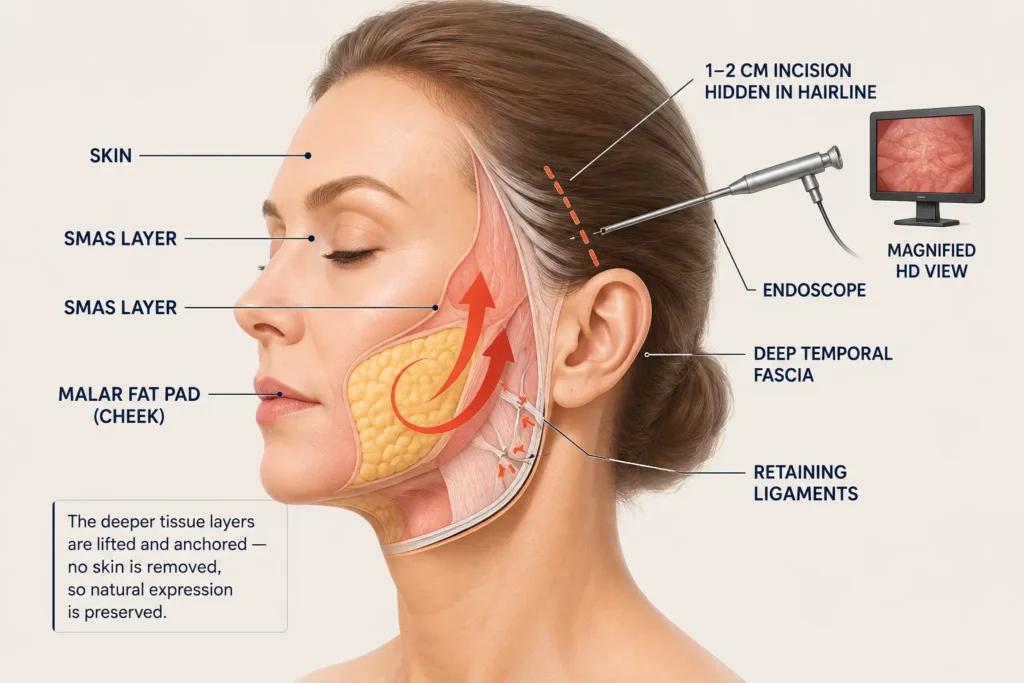
| Endoscopic Technique | Open Technique | |
| Incisions | Small, hidden in hairline | Longer, along temple, ear, and hairline |
| Scarring | Minimal, less visible | Well-concealed but longer |
| Best for | Early to moderate aging, upper and midface | Moderate to advanced laxity, full facial correction |
| Correction depth | Cannot address significant tissue descent or excess skin removal | Allows extensive tissue repositioning and skin excision |
| Recovery | Generally shorter, less swelling | Longer, more swelling proportional to dissection |
| Typical duration of results | Shorter-lived, as underlying skin laxity isn’t removed | Longer-lived, especially with deep plane technique |
Quick answer
Endoscopic technique favors smaller scars and faster recovery but is limited to early-stage aging. Open technique — including deep plane — handles more advanced laxity and delivers longer-lasting correction, at the cost of a longer incision and recovery period.
Where endoscopic technique shines: patients in their 40s with early brow, cheek, or midface descent who don’t yet need — or want — excess skin removed. It’s a genuinely elegant, minimally invasive option for the right stage of aging.
Where it falls short: significant skin excess and advanced ligament laxity simply cannot be corrected through small incisions and camera guidance alone. I’ve had patients who tried an endoscopic approach elsewhere too early in the aging process and ended up needing an open procedure a few years later than if they’d simply had the right operation the first time. Matching technique to your actual anatomy, rather than to which procedure sounds least invasive, is what prevents that kind of repeat surgery.
Frequently Asked Questions
Q1: Is a deep plane facelift more painful than a traditional facelift?
Not meaningfully. Pain levels between the two techniques are comparable and are generally well controlled with prescribed medication in the first few days. Most patients describe tightness and pressure rather than sharp pain, regardless of which technique was used.
Q2: Can I request local anesthesia for a deep plane facelift?
It’s technically possible in select cases, but most surgeons, including our team, recommend general anesthesia for deep plane surgery given the length of the procedure and the precision required near the facial nerve. We’ll discuss what’s medically appropriate for your specific case during consultation.
Q3: Do Vietnamese surgeons use the same facelift techniques as US or Australian surgeons?
Yes. Deep plane, SMAS, and endoscopic techniques are internationally standardized approaches. What varies between practices anywhere in the world is surgeon experience, case volume, and whether a senior surgeon performs the entire procedure personally.
Q4: Can endoscopic and open techniques be combined in one surgery?
Yes, in some cases. For example, an endoscopic brow lift can be combined with an open deep plane facelift during the same surgical session if your anatomy calls for correction in both regions.
Q5: How soon after consultation can surgery be scheduled?
Once your medical screening and pre-operative clearance are complete, most patients can be scheduled within a few weeks, though international patients often plan around travel logistics and recovery time in Vietnam before flying home.
📞 💬 WhatsApp / Chat: [http://wa.me/84975142666] 🌐 Book online: [+84-975-142-666]
Consultations are available in-clinic and online for international patients. Most patients leave their first appointment knowing exactly what they need — and feeling confident about the path ahead.
