


The Question Every Patient Asks First
“Which facelift do I actually need?”
If I had a dollar for every time I heard this during a consultation, I’d likely have enough to open a new wing at Abmedi Clinic. It is the most common question—and honestly, the most reasonable one. The internet presents a confusing menu: mini, full, SMAS, deep plane, thread lifts. Most articles treat them as interchangeable.
They are not.
The right procedure depends on where you are aging, how deeply those changes have occurred in your facial structure, and how much recovery time you can realistically commit to. At Abmedi Clinic, my job is to match the anatomy in front of me to the technique best suited to correct it – not to sell a brand name or a trend.
This guide explains every major option clearly, without jargon, in the order most patients work through them.
Why the Face Ages the Way It Does
Before jumping to solutions, it is worth spending a minute on what is actually happening beneath the surface – because this changes everything about which procedure makes sense.
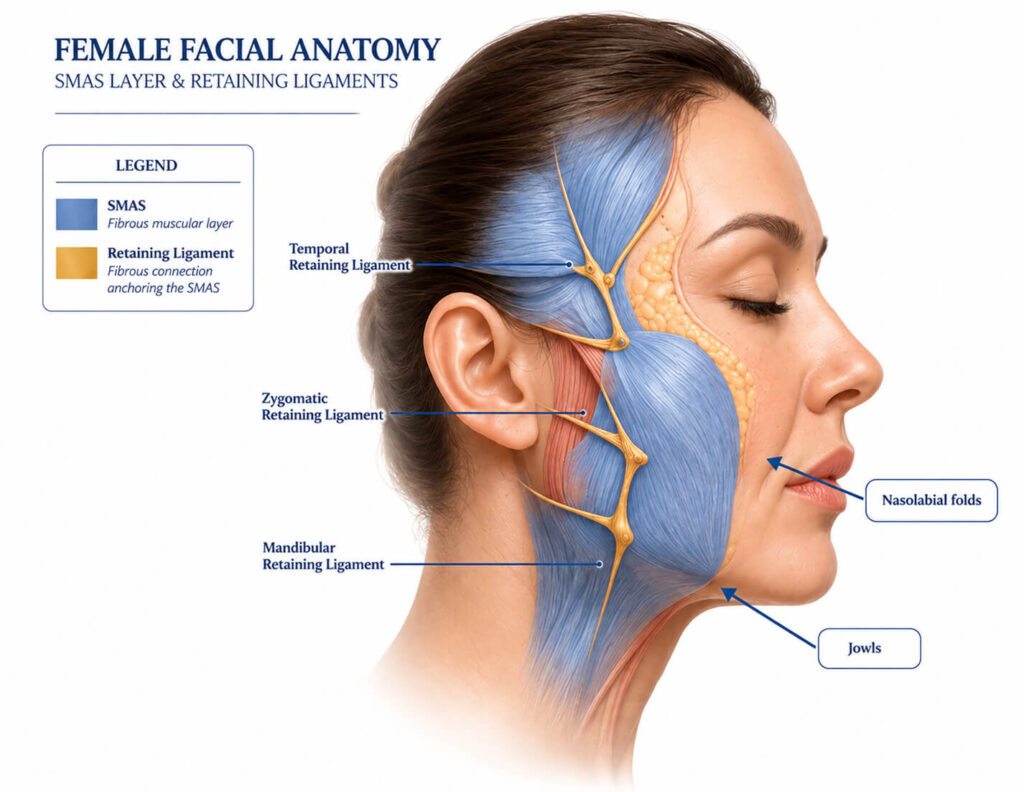
Your face has a fibrous muscular layer called the SMAS (Superficial Musculoaponeurotic System). It sits below the skin, above the deeper muscles, and is held in place by several retaining ligaments anchored to the underlying bone. As we age, collagen and elastin diminish, those ligaments gradually stretch, and the entire SMAS layer – along with the fat pads resting on top of it – descends.
What you see externally is the result: cheeks that flatten, nasolabial folds that deepen, jowls forming along the jawline, and the neck losing its clean angle. These changes are structural, not just cosmetic.
This is why older facelift techniques that only tightened the skin looked pulled and unnatural – they never addressed what was actually happening underneath. Modern facial surgery works on the SMAS and deeper layers, which is why today’s results look so much more genuine.
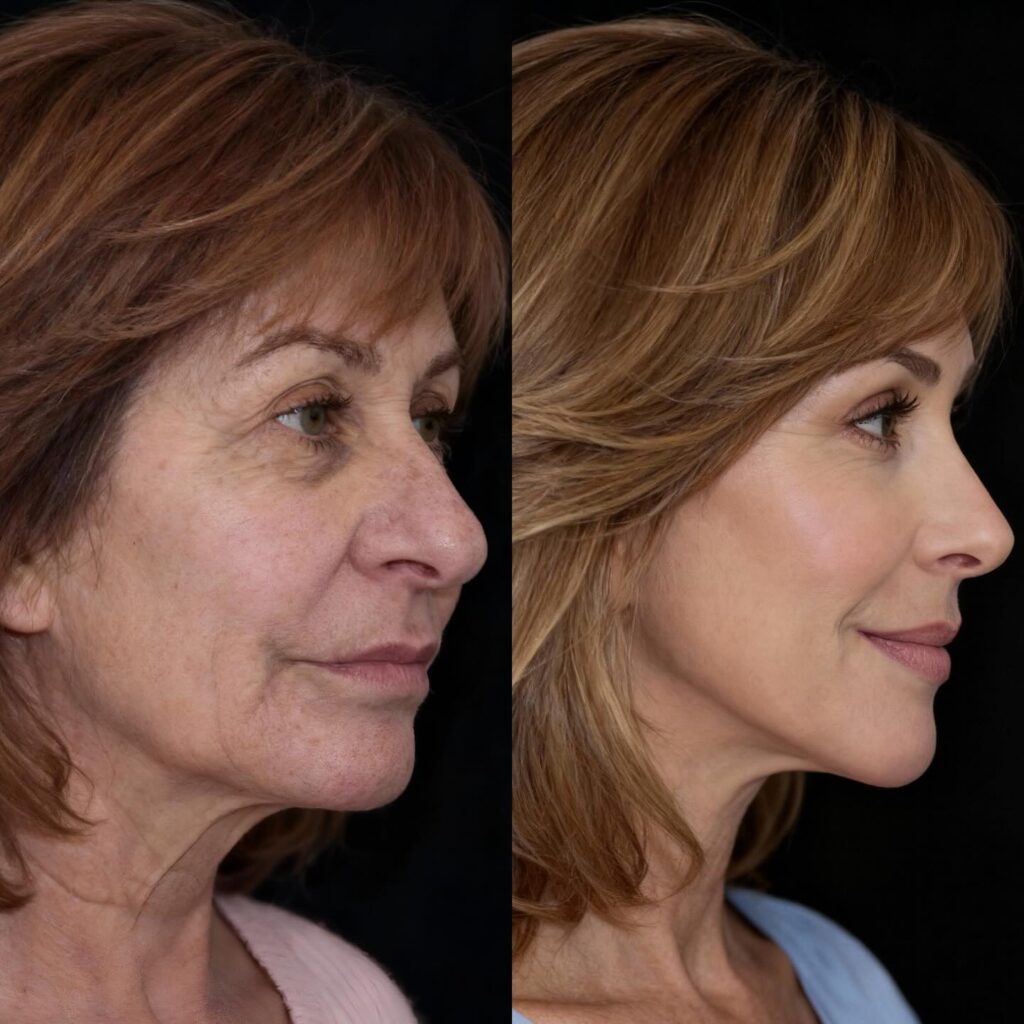
The Six Main Options at a Glance
| Procedure | Depth | Primary Targets | Longevity | Downtime | Best Age Range |
| Thread Lift | Subcutaneous | Cheeks, jowls, neck, folds | 12–24 months | 2–3 days | 35–45 |
| Mini Facelift | Skin + superficial SMAS | Lower face, early jowls | 2–5 years | ~1 week | 38–52 |
| Mid-Facelift | Mid-face soft tissue | Cheeks, nasolabial folds | 5–7 years | 10–14 days | 40–55 |
| SMAS Facelift | SMAS repositioning | Lower face, jawline, neck | 7–10 years | 1–2 weeks | 45–65 |
| Deep Plane Facelift | Below SMAS + ligament release | Full face, midface, neck | 10–15+ years | 2 weeks | 48–72 |
| Neck Lift | Platysma + skin | Neck, jawline, chin area | 7–10 years | 1–2 weeks | 40–70+ |
Thread Lift
A thread lift is a non-surgical option that uses thin, dissolvable sutures – typically made from PDO (polydioxanone) or PLLA material – inserted beneath the skin via a small cannula. Barbed threads physically lift and anchor sagging tissue; smooth threads stimulate the body’s own collagen production in the surrounding area. You get an immediate, visible improvement, and the collagen remodeling continues for several months as the threads dissolve naturally.
Thread lifts work well for early jowling, mild cheek sagging, softening of nasolabial folds, and minor neck laxity. Results last 12 to 24 months. The downtime is minimal – most patients feel comfortable returning to normal activities within a few days, with only minor bruising and swelling.
Where it falls short: Thread lifts are not a surgical replacement. Patients with significant skin laxity, deep jowls, or pronounced neck banding will not achieve adequate correction from threads alone. The improvement is real, but it is subtle by design.
Best for: Patients in their mid-30s to mid-40s who want a non-surgical refresh or those maintaining results between surgical procedures.
Mini Facelift (Lower Facelift / S-Lift)
The mini facelift is one of the most searched and, in my experience, most misunderstood procedures in facial surgery. Patients sometimes arrive expecting a full transformation from something that is intentionally limited in scope.
What it does well: the mini facelift targets early jowling and lax skin along the lower face and jawline using small “S”-shaped incisions placed discreetly around the ears. The procedure typically takes 1.5 to 2 hours under local anesthesia. Because the dissection is more limited than a full facelift, bruising and swelling resolve in 3 to 5 days for most patients, and social recovery is around one week.
Results are natural and refined rather than dramatic – a 30 to 40% improvement in the lower face, with longevity of 2 to 5 years depending on skin quality and lifestyle. Some surgeons now apply scaled-down deep plane principles even in mini lifts, which can meaningfully extend the durability of the result.
Where it falls short: The mini facelift has limited reach into the neck and does not address mid-face descent or deep nasolabial folds. If those are your primary concerns, a more comprehensive approach will serve you better.
Best for: Patients in their late 30s to early 50s with early jowling and a still-acceptable neck, seeking subtle improvement with minimal downtime.
Mid-Facelift
The mid-facelift is a targeted procedure focusing specifically on the cheek and upper cheek zone – the area between the lower eyelids and the mouth corners. This is where the earliest visible changes often appear: a flattening of the cheeks, early nasolabial fold deepening, and a loss of volume just beneath the eyes.
Unlike a full facelift, the mid-facelift lifts and tightens the connective and soft tissues of the midface without requiring the longer incisions of a full procedure. It is the right tool when aging is concentrated in this specific zone and the lower face and neck are still in good condition.
Recovery is moderate – most patients return to social settings within 10 to 14 days. In practice, the mid-facelift is frequently combined with a lower facelift or SMAS technique when mid-face descent coexists with lower-face concerns, which is the more common presentation in patients over 50.
Best for: Patients who notice flattening and descent primarily in the cheek area without significant jowling or neck laxity.
SMAS Facelift (Full Facelift)
The SMAS facelift is the backbone of modern facial rejuvenation surgery and remains one of the most widely performed techniques globally. Rather than simply tightening the outer skin layer, it directly lifts and repositions the SMAS – the fibrous muscular layer beneath the skin – as a separate structure.
This distinction is critical. By supporting the face from underneath, the surgeon places virtually no tension on the overlying skin. The result is a natural, refreshed look without the stretched, distorted appearance that characterized older techniques. Incisions follow the hairline, curve naturally around the ear, and are tucked discreetly behind it.
The SMAS facelift provides meaningful improvement in the lower face, jowls, and upper neck. It does not fully address significant mid-face volume loss or deep nasolabial folds – that is where the deep plane technique becomes necessary. Social recovery is 7 to 10 days, with patients typically comfortable in public within two weeks. Results last 7 to 10 years on average.
Best for: Patients in their 40s to 60s with moderate aging – softened jowls, early neck laxity, and a general loss of definition in the lower face – who want meaningful, lasting improvement with a manageable recovery.
Deep Plane Facelift
Of all the techniques performed at Abmedi Clinic, the deep plane facelift consistently delivers the most transformative and enduring results. It is also the most technically demanding – and the one I recommend most often when the anatomy calls for it.
The fundamental difference from the SMAS approach: instead of stopping at the SMAS layer, the deep plane goes beneath it. The surgeon releases the major retaining ligaments of the face – the zygomatic and masseteric ligaments – freeing the entire composite unit of SMAS, fat pads, and overlying skin to move upward together as a single, unified layer. Because everything moves in the same direction, there is no distortion, no pulling at the mouth corners, and no tell-tale tightness.
This technique is the only approach that reliably:
- Corrects deep nasolabial folds without requiring filler
- Restores mid-face volume to its original anatomical position
- Addresses jowls and neck laxity simultaneously in a single operation
- Produces a result that moves naturally with facial expression
The vertical vector of the lift more closely mirrors how a young face is anatomically structured – which is precisely why it looks effortless rather than surgical. Surgery typically takes 4 to 6 hours under general anesthesia.
Recovery requires a genuine two-week commitment to social downtime, with final results maturing at four to six months. In return, results at Abmedi Clinic routinely last 10 to 15 years. Patients generally do not require a repeat procedure for well over a decade.
Best for: Patients in their late 40s to early 70s with moderate-to-significant sagging across the mid-face, jowls, nasolabial folds, and neck who want natural-looking, long-lasting, comprehensive rejuvenation.
Neck Lift (Lower Rhytidectomy)
A beautifully lifted face paired with a sagging or banded neck is one of the most common imbalances I see in patients considering facial rejuvenation. The neck is often what reveals age most prominently – and yet it is the area most frequently addressed as an afterthought.
A neck lift specifically targets four separate concerns:
- Excess skin – the loose draping along the jawline and under the chin
- Submental fat – stubborn fat deposits creating a double chin that exercise cannot resolve
- Platysmal banding – the vertical cords that appear on the front of the neck as the platysma muscle loosens with age
- Jowl overhang – the fold of tissue that obscures a clean jaw-to-neck transition
The incision is typically made under the chin, with possible extension around the ear depending on the amount of skin removal needed. The platysma muscle is tightened directly, fat is removed or redistributed, and the skin is re-draped to create a smooth, well-defined neck profile.
A neck lift is most powerful when combined with a facelift – particularly the SMAS or deep plane variety – for full facial harmony. As a standalone procedure, it is well-suited to patients whose upper face remains pleasing but whose neck and jawline have aged disproportionately due to weight changes, genetics, or cumulative sun exposure.
Recovery mirrors that of a facelift: one to two weeks of social downtime, with swelling gradually resolving over six to eight weeks.
Best for: Anyone bothered primarily by neck laxity, a double chin, vertical neck bands, or a poorly defined jaw-to-neck angle – at any age from 40 onward.
How to Choose the Right Procedure
After evaluating thousands of patients at Abmedi Clinic, four questions consistently guide my recommendation:
1. Where exactly is the aging most visible to you?
Point to it in a mirror. Lower face and early jowls only? A mini facelift or SMAS may suffice. Deep nasolabial folds, flattened cheeks, jowls, and a loose neck together? Only the deep plane addresses all four in one operation with lasting results.
2. How much recovery time can you honestly commit to?
A thread lift means returning to work within days. A mini facelift means one week. A full SMAS or deep plane procedure means two weeks off from public life and four to six weeks before strenuous exercise. Patients who underestimate recovery and rush back too early compromise their outcomes.
3. What are your expectations for how long results should last?
If you prefer a lighter touch renewed every couple of years, threads or a mini lift may match your lifestyle. If you want to invest once and enjoy a decade or more of results, the deep plane is the more economical choice long-term – repeat thread treatments often exceed the cost of surgery at the five-year mark.
4. Are you a good surgical candidate?
Facelift surgery requires reasonable general health, non-smoker status (or cessation at least six weeks prior), stable weight, and realistic expectations. Patients with very thin skin and minimal elasticity may benefit more from a combination of energy-based devices and thread lifts before committing to surgery. A proper in-person assessment – not an age or a photo – determines readiness.
At Abmedi Clinic, we never recommend a procedure based on a name or a trend. We recommend the procedure that matches the anatomy in front of us, calibrated to each patient’s goals and life circumstances.

Frequently Asked Questions
Will a facelift look natural, or will people know I’ve had work done? Modern techniques – especially SMAS and deep plane approaches – are designed specifically to avoid the “operated” look. By working on the structural layers beneath the skin rather than pulling the skin tight, results look like a well-rested, younger version of yourself. People notice you look better, not different.
Does a facelift stop the aging process? No. Surgery sets the clock back – restoring a facial structure that is roughly 10 to 15 years younger. You continue aging from that new baseline. Most deep plane patients still look better 15 years post-surgery than they did the morning of their procedure.
Is there an ideal age for a facelift? Age alone is the wrong criterion. What matters is the degree of tissue laxity, the depth of structural changes, and your personal goals. A thorough consultation – not a birthday – determines whether and which procedure makes sense.
How long does a facelift last? It depends on the technique. A thread lift lasts 12 to 24 months. A mini facelift typically holds for 2 to 5 years. An SMAS facelift averages 7 to 10 years. A deep plane facelift – the most structurally comprehensive approach – routinely lasts 10 to 15 years or longer, because it repositions the deeper tissue layers rather than simply tightening the skin surface. Lifestyle factors like sun exposure, smoking, and weight stability also influence how long results are maintained.
How long is recovery after a facelift? Recovery varies by procedure. A thread lift involves 2 to 3 days of mild swelling. A mini facelift typically requires about one week before patients feel comfortable socially. A full SMAS or deep plane facelift calls for two weeks of social downtime, with most swelling resolving by weeks three to four. Strenuous exercise is generally restricted for four to six weeks. Final results – once all swelling has settled – are fully visible around the four to six month mark.
Is a facelift worth it? For the right candidate, consistently yes. A well-performed facelift is the only treatment that corrects structural facial aging – repositioning descended tissue and restoring volume that non-surgical options cannot replicate. The majority of patients at Abmedi Clinic report that the improvement in how they look and feel exceeds their expectations. That said, “worth it” is personal: it depends on how much the aging bothers you, your willingness to commit to recovery, and whether your expectations align with what surgery can realistically achieve. That conversation is exactly what a consultation is for.
A Final Note from the Abmedi Clinic Team
Facial rejuvenation is not one-size-fits-all surgery. The best result you can achieve is one that is planned for your specific anatomy, executed with precision, and supported by realistic expectations on both sides of the consultation table.
If you have read this far, you already know more than most patients who walk into a surgeon’s office. The next step is a face-to-face assessment – where we can actually look at your skin quality, tissue depth, and structural changes, and give you an honest, individualized recommendation.
That conversation costs nothing. And it might save you from choosing the wrong procedure for the right reasons.
Ready to Find Out Which Procedure Is Right for You?
Book a consultation at Abmedi Clinic — no obligation, no pressure.
In one appointment, our board-certified facial plastic surgeons will:
- Assess your skin quality, tissue depth, and the specific areas of concern
- Recommend the one procedure — or combination — that matches your anatomy and goals
- Give you a clear, honest timeline for recovery and results
- Answer every question you have, in plain language
📞 💬 WhatsApp / Chat: [http://wa.me/84975142666] 🌐 Book online: [+84-975-142-666]
Consultations are available in-clinic and online for international patients. Most patients leave their first appointment knowing exactly what they need — and feeling confident about the path ahead.
