


More men than ever are turning to rhytidectomy (facelift surgery) to reclaim a sharp, commanding jawline and a refreshed appearance. According to the American Society of Plastic Surgeons (ASPS), male facelift surgery consistently ranks among the fastest-growing surgical facial rejuvenation procedures.
However, a successful male facelift requires a radically different approach than a female one. Because male facial anatomy possesses distinct structural properties, applying a traditional female surgical plan can inadvertently feminize the face. At ABmedi Team Clinic, our deep plane and SMAS techniques are customized specifically to preserve and enhance masculine facial proportions.
Why Male Facial Anatomy Demands a Tailored Approach
The biological aging process affects everyone, but how tissue laxity manifests in men is highly specific due to three anatomical realities:
- Thicker Skin and Denser Vasculature: Men’s facial skin, particularly around the lower face and jaw, is significantly thicker, more sebaceous, and has a richer blood supply than women’s. This means superficial skin tightening will not suffice; structural lift must be anchored deeper.
- Stronger Fibromuscular Layer: The SMAS (Superficial Musculoaponeurotic System) and facial retaining ligaments are far more fibrous in male patients, requiring higher surgical precision and modified release vectors.
- Masculine Bone Structure: A strong, square jawline, a prominent chin, and a flat, heavy brow define masculine attractiveness. The surgical vector must reinforce these sharp angles, avoiding the soft, rounded contours typically sought in female facial rejuvenation.
Structural Sharpness vs. Youthful Softness
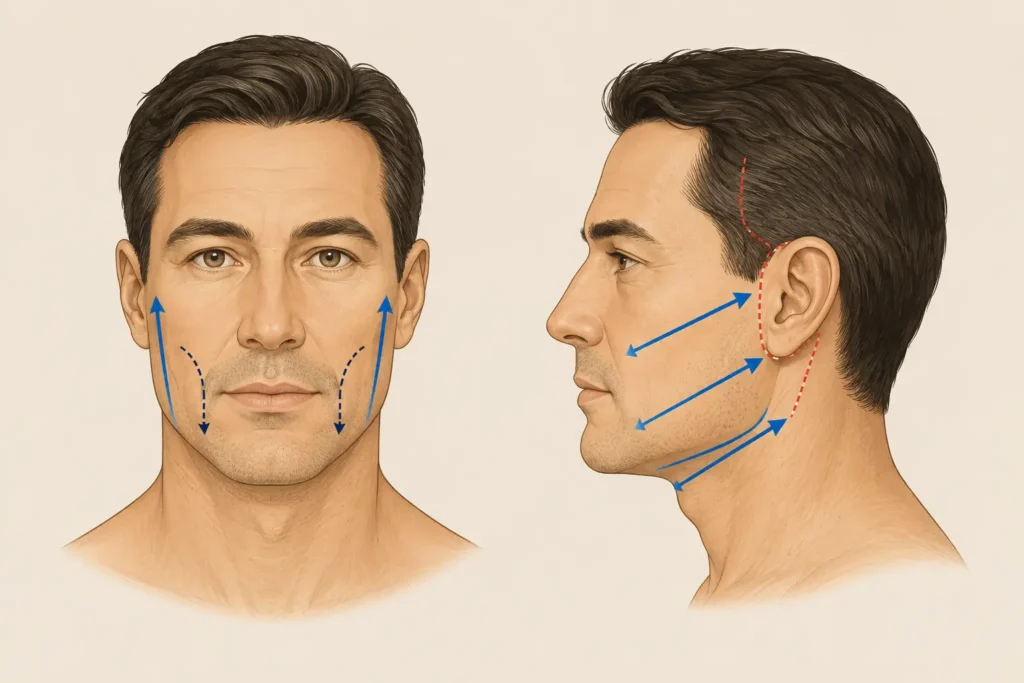
While female facelifts often focus on restoring midface volume and soft curves, the primary goal of a facelift for men is to restore structural sharpness.
Men rarely look for volumetric perfection or a dramatic transformation. Instead, they seek to eliminate the tired, weathered appearance caused by heavy jowls, submental fat accumulation, and a sagging neck line (platysmal bands). At ABmedi Team Clinic, we calibrate the direction of the tissue lift vertically and posteriorly to redefine the mandibular angle without altering your intrinsic facial character.
Surgical Techniques Tailored for Men
| Technique | Best Suited For | How It Works | Recovery | Longevity |
| Deep Plane Facelift | Men with moderate to significant tissue descent; thicker skin; those wanting the most durable result | Releases deep retaining ligaments; lifts SMAS and facial tissues as a unified structure using vertical vectors | 2–3 weeks to return to desk work; 4–6 weeks to resume exercise | 10–15 years |
| SMAS Facelift | Men with moderate aging, less severe descent; good skin tone | Lifts and repositions the SMAS layer without releasing the deepest ligaments | Similar to deep plane; slightly shorter healing curve in some cases | 7–10 years |
| Mini Facelift | Men in their early-to-mid 40s with early jawling and mild laxity | Shorter incisions in front of the ear; targets the lower face only | Under 2 weeks | 4–7 years |
The Deep Plane is my preferred approach for most male patients. Because male skin is heavier, pulling the skin surface alone produces an unnatural, wind-swept result almost immediately. Real, lasting lift must be anchored at the structural level — the SMAS and the retaining ligaments beneath it — repositioned as a unified tissue unit, not just tightened at the surface.
Incisions follow a discreet path: beginning at the hairline near the temples, running in front of the ear, and curving behind the earlobe into the natural hairline crease. These placements are chosen specifically to remain hidden even with short hair or close-cropped styles.
The Facial Hair Challenge: A Male-Specific Technical Consideration
This is one of the most underappreciated aspects of male facelift surgery, and it’s where inexperienced surgeons make avoidable mistakes.
Men have beard-growing skin on the lower face, cheeks, and neck. During a facelift, this skin is repositioned. If incisions are placed incorrectly, the result can be beard hair growing in the wrong area — behind the ear, for example — which is both cosmetically problematic and permanently disruptive to the patient’s grooming routine.
An experienced surgeon plans every incision to respect the natural boundaries of the beard. At ABmedi Team Clinic, we study each patient’s beard pattern as part of the surgical design, ensuring that repositioned skin doesn’t carry hair follicles into areas where they don’t belong.
Additionally, patients should expect to avoid shaving the affected areas for a period post-surgery while the incisions heal. Your care team will walk you through a temporary shaving protocol that minimizes friction on healing skin.
Managing Scars and the Hairline
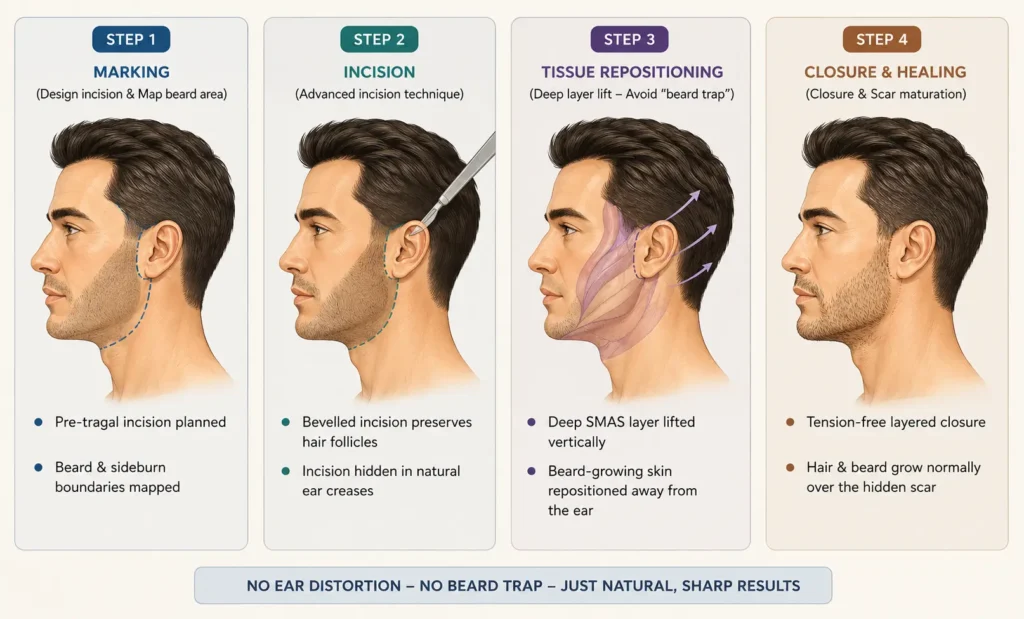
Scar visibility is one of the most common concerns men raise before surgery — especially those with shorter hair, a receding hairline, or those who keep their face clean-shaven.
Incisions placed within the natural crease in front of the ear, around the earlobe, and behind the ear into the hairline are designed to be essentially invisible once healed. In the temporal region, where the incision touches the hairline, the surgical plan must carefully avoid disrupting sideburn positioning or creating a visibly altered hairline.
In the first weeks after surgery, scars appear red and slightly raised — this is a normal part of healing, not a warning sign. The most noticeable fading happens between months 3 and 6. By the one-year mark, most patients find their scars are barely visible to anyone looking at them. Full maturation completes somewhere between 12 and 18 months, at which point scarring is near-invisible for the vast majority of men.
To support optimal healing, we recommend consistent use of scar-care products, diligent sun protection of incision areas, and avoiding smoking both before and after surgery.
Preserving the Eyes and Brow — With Masculine Proportions
When addressing the upper face, a conservative approach is mandatory to prevent feminization.
- Male Blepharoplasty (Eyelid Surgery): Men naturally have a heavier, lower brow and more hooding in the upper eyelids. Removing too much skin or fat from the upper eyelids can hollow out the eyes, destroying a characteristically masculine look.
- Male Brow Lift: The male brow should sit right at or slightly above the supraorbital rim, flat and horizontal. A high, arched brow must be avoided at all costs.
Complementary Procedures Often Combined with a Male Facelift
To achieve a completely harmonious rejuvenation, a lower facelift is frequently combined with targeted ancillary procedures:
- Submental Liposuction & Plastymaplasty: Addresses a “double chin” by removing fibrous fat deposits and tightening the loose neck muscles to create a sharp 90-degree jaw-to-neck angle.
- Chin Augmentation (Chin Implant): A weak chin exacerbates the appearance of aging and jowls. Placing a structural chin implant during a facelift drastically enhances the definition of the jawline.
- Lower Blepharoplasty: Eliminates chronic under-eye bags and tear troughs that make you look constantly fatigued.
Recovery: What to Realistically Expect
Recovery from a male facelift follows a predictable trajectory, though individual healing varies.
| Phase | What’s Happening | Activity Level |
| Week 1 | Swelling, bruising, and tightness at peak; head elevation and cold compress advised | Rest at home; no strenuous activity |
| Week 2 | Bruising begins resolving; facial movements become more comfortable | Return to desk-based / remote work |
| Weeks 4–6 | Swelling steadily improving; face looks increasingly natural | Resume exercise and physical activity |
| Months 3–6 | Results clearly visible; incisions fading; swelling largely gone | Full normal activity |
| Months 6–12+ | Soft tissues settle fully; final result becomes apparent | Ongoing maintenance skincare recommended |
One note specific to male patients: shaving routines will need temporary modification during early healing. Your surgeon will advise on when and how to resume normal shaving without disrupting incision healing.
How to Avoid an Unnatural Result
The single most reliable way to ensure a natural-looking male facelift is choosing a surgeon with documented experience in male facial rejuvenation specifically. This is not the same as general facelift experience.
Before committing to a procedure, ask your surgeon:
- What percentage of your facelift patients are male?
- Can I see before-and-after photos of male patients with similar anatomy?
- Which technique do you recommend for me, and why?
At ABmedi Team Clinic, every male facelift begins with a detailed evaluation of the patient’s hairline, beard pattern, bone structure, and tissue quality. The surgical plan is built around what is already strong in your face — and engineered to protect it.
The measure of a truly successful male facelift is not how dramatically someone has changed. It’s whether the people in your life say you look well-rested, or focused, or somehow more like yourself — without being able to put their finger on why.
Is a Facelift Right for You?
Men who are well-suited for facelift surgery are typically in good general health and are bothered by one or more of the following: jawling along the jawline, loose or sagging neck skin, deepened nasolabial folds, or loss of definition in the lower face and chin area.
Age is less important than anatomy. Some men benefit from a mini facelift in their early 40s. Others require the full deep plane procedure in their 60s or 70s — and achieve excellent, long-lasting results.
If you’re considering male facial rejuvenation, the first step is a comprehensive consultation where your individual anatomy, goals, and expectations are carefully evaluated. That conversation, done honestly and thoroughly, is the foundation of every result we’re proud of at ABmedi Team Clinic.
📞 💬 WhatsApp / Chat: [http://wa.me/84975142666] 🌐 Book online: [+84-975-142-666]
Consultations are available in-clinic and online for international patients. Most patients leave their first appointment knowing exactly what they need — and feeling confident about the path ahead.
