


Combining a facelift with blepharoplasty is not only possible, it’s one of the most commonly requested procedure pairings in facial rejuvenation surgery. In my clinical experience, patients who address both the lower face and the eye area in a single session tend to achieve the most balanced, natural-looking transformation. This article walks you through what that combination actually involves, why it works so well, and what to realistically expect during recovery.
What Each Procedure Does
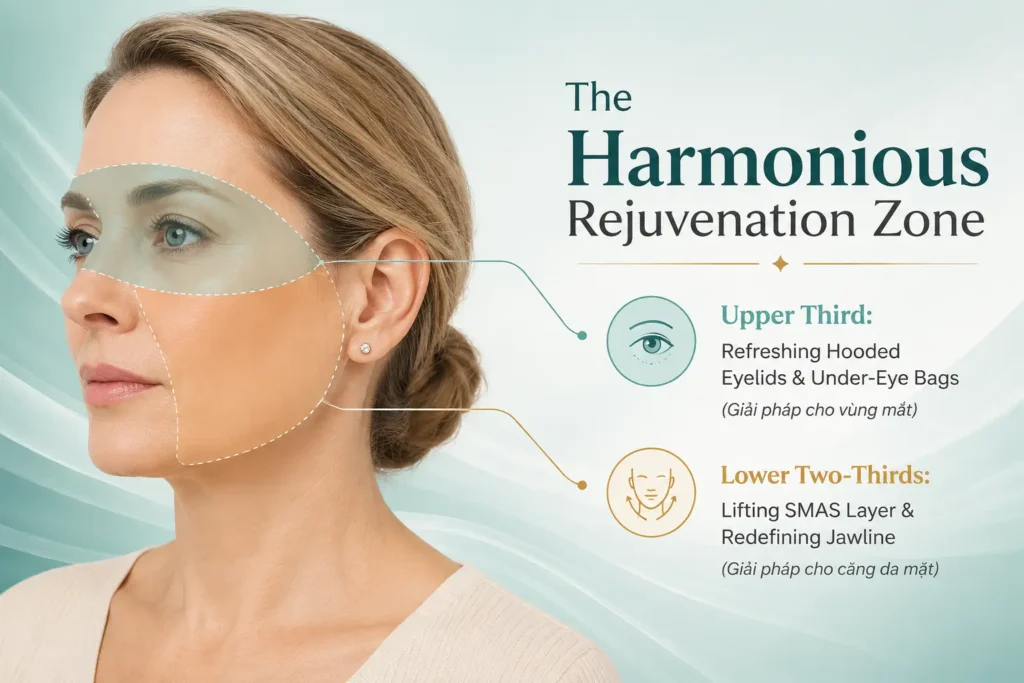
To understand why these two surgeries complement each other so perfectly, it helps to break down the anatomical targets of each procedure. Aging doesn’t happen in isolation, and each surgery addresses a distinct zone of the face.
A Facelift (Rhytidectomy) for the Lower Two-Thirds
A facelift focuses primarily on the middle and lower thirds of the face — specifically the cheeks, jawline, and neck. Modern facelifts at ABmedi Team Clinic do not simply pull the skin tight; instead, they target the deeper tissue layer known as the SMAS (Superficial Musculoaponeurotic System).
By lifting and tightening this structural foundation, the surgeon repositions fallen facial fat pads, smooths out deep nasolabial folds, eliminates jowls, and creates a sharply defined jaw contour. However, a traditional facelift stops at the cheekbones — it does not correct the signs of aging around the eyes.
Blepharoplasty (Eyelid Surgery) for the Upper Third
Blepharoplasty focuses entirely on refreshing the orbital area. Depending on your specific anatomy, this can be broken down into two techniques, which are often performed together during a full facial rejuvenation surgery:
- Upper Blepharoplasty: This technique addresses the heavy, drooping skin of the upper eyelids (hooded eyes) that can make you look chronically tired or even impair your peripheral vision. The surgeon removes excess skin and tightens the underlying muscle to restore a wide-open, alert appearance.
- Lower Blepharoplasty: This targets the under-eye area, specifically correcting permanent under-eye bags, puffiness, and structural hollows (tear troughs). Instead of just removing fat, our surgical team frequently employs fat repositioning to smooth the transition between the lower eyelid and the upper cheek, ensuring a youthful, natural-looking volume.
From a technical standpoint, performing these surgeries together allows the surgeon to perfectly address the lid-cheek junction — the critical transition zone where the lower eyelid meets the upper cheek. In a combined session, our surgical team can lift the fallen cheek tissue upward while simultaneously smoothing and repositioning the under-eye fat bags downward. This dual approach bridges the gap between the upper and lower face, ensuring a seamless, continuous contour that eliminates the harsh aging lines a single procedure might leave behind.
Why Combining Both Procedures Makes Sense
Aging does not affect just one part of the face. We lose volume, skin elasticity, and structural support across the entire face simultaneously — which is why a holistic approach tends to produce more satisfying outcomes.
Here’s what the combined approach offers:
2.1. Visual Harmony Across the Whole Face
When a facelift refreshes the lower face but tired, heavy eyelids remain untouched, the results can look incomplete or even discordant. Conversely, bright, rejuvenated eyes paired with a sagging jawline create a similar imbalance. Treating both zones together creates coherence — the face looks younger as a whole, not “worked on” in patches.
2.2. One Recovery Period Instead of Two
This is one of the most practical advantages. Undergoing both procedures simultaneously means a single anesthesia event, one surgical preparation, and one recovery period. Healing from two procedures concurrently does not double the downtime — you’re consolidating it. Patients at ABmedi Team Clinic frequently tell us this was a decisive factor in their decision to combine.
2.3. Cost Efficiency
Operating costs — anesthesia, surgical facility fees, pre-operative testing — are shared across both procedures rather than incurred twice. This typically makes the combined approach more economical than two separate surgeries.
2.4. More Comprehensive, Natural Results
Restoring multiple areas of the face in one session allows the surgeon to balance proportions in real time, ensuring the final outcome looks harmonious rather than surgically altered.
Is It Safe to Combine These Procedures?
For most healthy patients, yes. Both procedures are well-established, and performing them together is standard practice in experienced hands. That said, a thorough preoperative assessment is essential.
There are specific cases where staging the procedures separately may be the wiser approach:
- Patients with significant pre-existing dry eye disease may tolerate lower blepharoplasty better when it is performed on its own, with careful pre- and post-operative management.
- Extended operative time can slightly increase the risk of swelling or hematoma formation in some facelift patients. Your surgeon will assess whether the combined duration is appropriate for your individual health profile.
- Complex reconstructive needs — for example, patients requiring significant lower lid support or undergoing secondary (revision) surgery — may benefit from a staged approach for easier monitoring and recovery management.
At ABmedi Team Clinic, every surgical plan is individualized. The goal is always the safest path to the best outcome.
To guarantee this high safety standard during a combined session, strict pre-operative preparation is vital. Patients at ABmedi Team Clinic undergo a thorough health screening, including a dedicated ophthalmic evaluation to check baseline tear production. Furthermore, because a combined surgery utilizes a slightly longer anesthesia window, patients are required to avoid blood-thinning medications (like aspirin or ibuprofen) and completely cease nicotine use for at least 3–4 weeks prior. This rigorous preparation is key to ensuring proper blood circulation, minimizing early post-op bruising, and setting the stage for a smooth recovery.
What to Expect: Combined Facelift and Blepharoplasty Recovery Timeline
This is the question I hear most often in consultations, so I want to be straightforward about it.
| Timeline | What to Expect (Symptoms) | Practical Recovery Tips & Actions |
| Days 1–3
(Peak Swelling) |
Most noticeable swelling and bruising, especially around the eyes.
Tightness around the jaw and eyelids. |
Keep your head strictly elevated (even while sleeping).
Apply cold compresses to the eyelid area frequently. Rest completely and avoid screen time. |
| Days 7–10
(Suture Removal) |
Incisions begin to close.
Bruising starts to fade noticeably from purple to yellow. |
Visit ABmedi Team Clinic for suture removal.
Light daily activities can be gradually reintroduced. Note: You may use camouflage makeup only after surgical clearance. |
| Days 10–14
(The “Presentable” Milestone) |
Swelling subsides significantly.
Most patients feel comfortable and confident appearing in public. |
This is the general benchmark for returning to non-strenuous work.
Continue wearing sun protection (sunglasses and wide-brimmed hats). |
| Weeks 3–6
(Activity Resumption) |
Residual swelling continues toresolve quietly.
Facial contours look much more defined and natural. |
Light exercise and normal gym routines can be gradually resumed.
Social activities become progressively more comfortable. |
| 3–6 Months
(Final Transformation) |
All micro-swelling completely subsides.
Incision scars mature, flatten, and fade into natural skin creases. |
Enjoy your final, comprehensive facial rejuvenation results.
Maintain a medical-grade skincare routine to prolong the outcome. |
Where Are the Incisions Placed in a Combined Surgery?
One of the most common concerns patients have is visible scarring. When combining a facelift with blepharoplasty, our surgical team utilizes meticulous techniques to ensure all incisions follow the natural contours of your face, making them virtually unnoticeable once fully healed.
- Facelift Incisions: The incision typically starts in the hairline at the temples, extends downward around the natural curve in front of the ear, and wraps behind the earlobe into the lower scalp. This allows the surgeon to lift the deeper SMAS layer while keeping the final scar hidden along natural skin creases.
- Upper Blepharoplasty: The incision is placed precisely within the natural fold of the upper eyelid. When your eyes are open, the scar is completely concealed.
- Lower Blepharoplasty: Depending on your anatomy, the incision is either made just below the lower lash line (transcutaneous) or hidden entirely inside the lower eyelid (transconjunctival) if only fat redistribution is needed.
Who Is a Good Candidate for the Combined Approach?
You may be a strong candidate for combining a facelift with blepharoplasty if:
- You notice sagging or laxity in the cheeks and jawline and heaviness, drooping, or puffiness around the eyes
- You are in good general health with no contraindications to surgery
- You have realistic expectations and understand that results develop gradually over months
- You want to minimize total downtime and consolidate your surgical experience
The best way to determine candidacy is through a one-on-one consultation with an experienced facial surgeon who can evaluate your anatomy, skin quality, and aesthetic goals in person.
Can Blepharoplasty Be Combined with Other Procedures Too?
Absolutely. At ABmedi Team Clinic, blepharoplasty is frequently performed alongside:
- Brow lift — to address forehead descent and brow ptosis that can worsen the appearance of upper eyelid heaviness
- Neck lift — as an extension of the facelift for greater lower face and neck definition
- Fat grafting — to restore midface volume lost to aging
- Laser skin resurfacing — to improve skin texture, tone, and fine lines around the eyes and across the face
Each combination is planned based on the individual patient’s specific concerns and anatomy.
A Note on Realistic Expectations
Surgery — even when expertly performed — is not a permanent pause on aging. A combined facelift and blepharoplasty will turn back the clock meaningfully, but the underlying aging process continues over time. Most patients enjoy their results for many years and often find that the investment in comprehensive facial rejuvenation gives them a confidence boost that extends well beyond the cosmetic change.
If you have questions about whether combining a facelift with blepharoplasty is the right approach for you, our surgical team at ABmedi Team Clinic is happy to walk you through the options during a personalized consultation.
Frequently Asked Questions
Q1) Can you have a facelift and blepharoplasty together?
Yes, absolutely. In fact, combining a facelift with blepharoplasty is one of the most effective ways to achieve complete facial harmony. While a facelift tightens the deep SMAS layer to lift the cheeks and redefine the jawline, eyelid surgery refreshes tired, drooping eyes. Performing them in a single session means you undergo anesthesia only once and experience a consolidated recovery period, rather than stretching your downtime across two separate surgeries.
Q2) Should I get a facelift or blepharoplasty first?
If you choose not to combine them, the decision of which to perform first depends entirely on your primary area of concern. If heavy, hooded eyelids or prominent under-eye bags are aging you the most, you should start with a blepharoplasty. However, if sagging jowls and a loose neck line are your main frustrations, a facelift takes priority. That said, when moderate to advanced aging is present in both zones, high-end facial surgeons strongly recommend a combined approach to avoid an imbalanced appearance where one half of the face looks significantly younger than the other.
Q3) What is a Cinderella facelift?
It is important to clarify that a “Cinderella facelift” is a non-medical marketing term rather than a defined surgical procedure. In the aesthetic industry, this name is often used to describe various temporary, non-surgical treatments—such as specific thread lifts paired with dermal fillers—designed to offer a quick, “fairytale” lifting effect with minimal downtime. Because it is unbranded and varies widely from one practice to another, patients should always ask their provider exactly what treatments are included and have realistic expectations about its temporary nature compared to a true surgical facelift.
Q4) Why are celebrities getting rid of hooded eyes?
The recent wave of public figures addressing their eye area stems from a mix of functional and aesthetic reasons. Medically, heavy upper eyelid skin can cause visual obstruction and chronic eye fatigue. Aesthetically, the social media landscape between 2024 and 2026 has seen a massive shift away from over-filled, frozen faces toward sharp, open, and refreshed orbital areas. Today’s celebrity trends focus on subtle, identity-preserving results—using upper blepharoplasty to clear away the tired look while carefully maintaining the patient’s unique facial character.
Q5) Do people regret blepharoplasty?
Clinical studies consistently show that eyelid surgery has one of the highest satisfaction rates in plastic surgery, with 93% to 95% of patients reporting highly positive outcomes. The small percentage of individuals who experience regret or dissatisfaction usually point to root causes such as over-resection of skin (leading to a “surprised” look), asymmetrical healing, or asymmetric expectations. At ABmedi Team Clinic, we minimize these risks through exhaustive pre-operative consultations, ensuring our surgical goals perfectly align with your natural anatomy.
📞 💬 WhatsApp / Chat: [http://wa.me/84975142666] 🌐 Book online: [+84-975-142-666]
Consultations are available in-clinic and online for international patients. Most patients leave their first appointment knowing exactly what they need — and feeling confident about the path ahead.
