


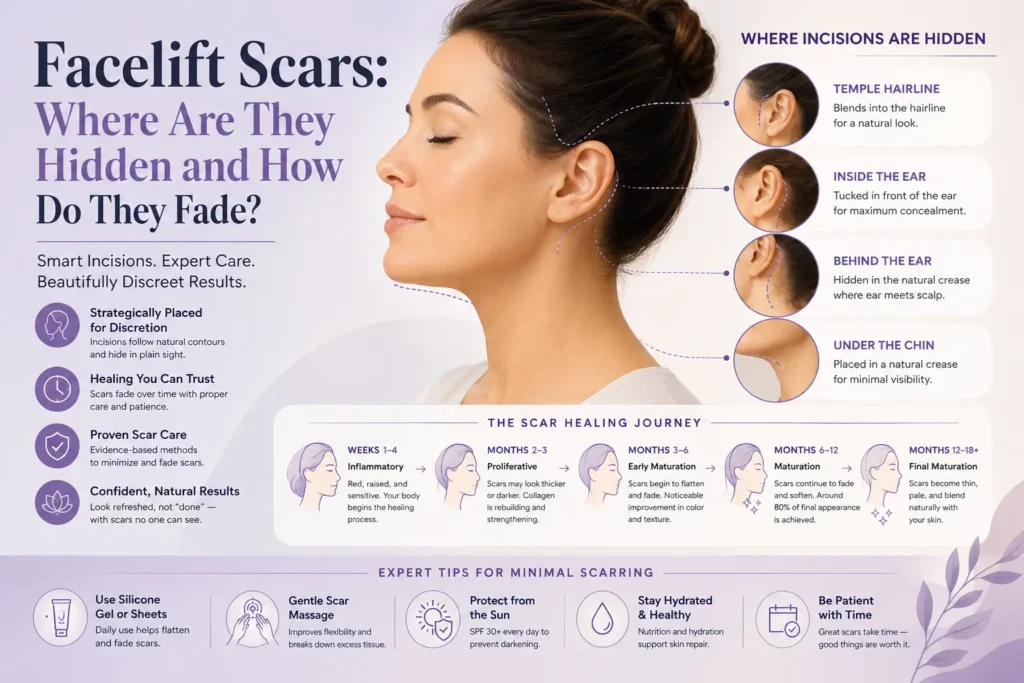
One of the most common questions I hear during facelift consultations is this: “Will people be able to tell I had surgery?” The short answer is — not if the incisions are placed correctly and the healing process is managed well. After performing hundreds of rhytidectomy procedures, I can tell you with confidence that facelift scars, when done right, are among the most discreet in all of plastic surgery.
Let me walk you through exactly where incisions go, what to expect during recovery, and what you can do to help your scars fade as completely as possible
Do Facelifts Actually Leave Scars?
Yes — every surgical procedure that involves an incision creates a scar. But “scar” doesn’t have to mean visible. The goal of modern facelift surgery isn’t to eliminate scarring entirely (that’s biologically impossible), but to place incisions in locations where they blend naturally into your anatomy and become imperceptible over time.
The fundamental principle is this: rather than making a central facial incision — which would leave an obvious scar — we work around the ears and along the hairline, where we can lift and reposition the underlying tissue without leaving marks in the middle of the face. This approach, combined with careful surgical technique, means most facelift patients are surprised at how little they notice their scars once healing is underway.
Where Are Facelift Incisions Placed?
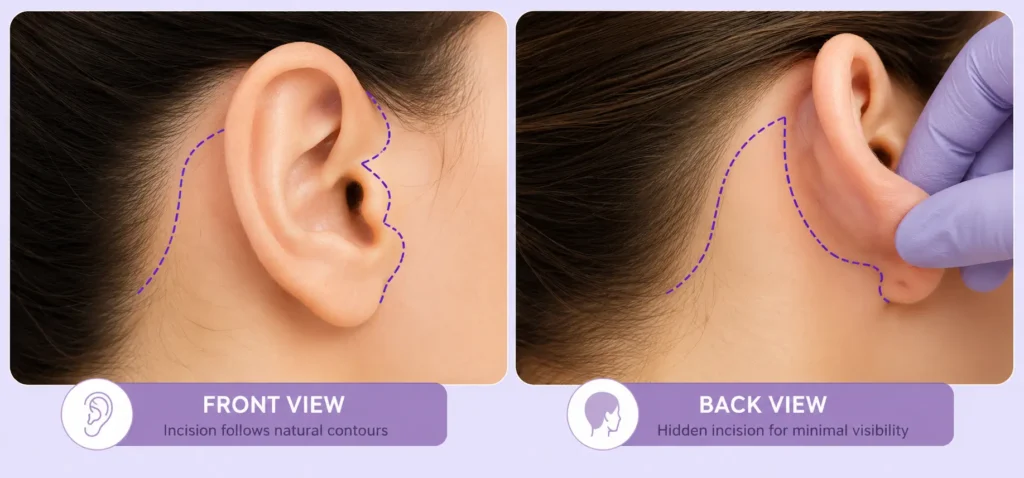
| Incision Location | Detailed Camouflage Technique | Aesthetic Outcome |
| Inside the Ear (Retrotragal) | The incision does not run in a straight line in front of the ear; instead, it curves behind the small cartilage flap (tragus) at the ear opening. By following the ear’s natural contours, the scar avoids the straight lines that the human eye easily detects. | Virtually Invisible: Tucked inside the ear; undetectable even at close range. |
| Temple Hairline | Utilizing the Trichophytic (beveled) technique: The incision is made at a precise angle to preserve hair follicles. This allows natural hair to actually grow through the scar tissue as it heals. | Natural Hairline: No distortion; safe for ponytails or short hairstyles. |
| Behind the Ear (Postauricular) | The incision is placed deep within the natural crease where the back of the ear meets the scalp, then extends discreetly into the posterior hairline. | Absolute Discretion: Completely hidden by the ear’s natural position. |
| Under the Chin (Submental) | A micro-incision (approx. 2–3cm) is placed precisely within a natural skin crease under the chin. | Minimal Visibility: Blends into existing skin folds and visual “blind spots.” |
What About the Neck or Under the Chin?
Some facelift procedures — particularly those targeting the neck — include a small additional incision beneath the chin. This heals in a natural skin crease and is typically invisible once fully matured.
The 3 Phases of Scar Healing (Month by Month)
Understanding the biology of scar formation helps set realistic expectations. Healing doesn’t happen in a straight line — it follows a predictable sequence, and knowing what’s coming prevents unnecessary worry.
Phase 1 — Inflammatory (Weeks 1–4)
Immediately after surgery, the incision sites will appear red, slightly swollen, and raised. Sutures are usually removed within the first week. This phase looks the most dramatic, but it’s completely expected — your body is rushing collagen and repair cells to the wound site.
What you’ll see: Red, raised incision lines. Some tightness or numbness.
What to do: Keep the area clean and dry. Apply petroleum jelly or silicone gel as directed. Avoid any activity that strains the incisions.
Phase 2 — Proliferative (Months 2–3)
This is when many patients worry unnecessarily — scars often look worse before they look better. The body is producing new collagen rapidly, which can make scars appear thicker, darker, or more prominent than they did initially. This is normal and temporary.
What you’ll see: Pinkish-red, sometimes firm scar tissue. Possible itching or sensitivity.
What to do: Begin gentle scar massage (circular movements with fingertips, 5–10 minutes, 2–3 times daily). Introduce silicone gel or sheets. Continue strict sun protection.
Phase 3 — Maturation (Months 3–18+)
This is where the transformation happens. The scar gradually flattens, softens, and fades from pink to a pale tone that increasingly matches the surrounding skin. By the six-month mark, most patients find their scars are significantly less noticeable. Full maturation can continue for up to 18–24 months.
Month-by-month snapshot:
| Timeframe | What to Expect |
| Week 1–2 | Red, raised, most visible |
| Month 1–2 | Redness starting to reduce, swelling down |
| Month 2–3 | May look thickest/darkest — stay the course |
| Month 3–6 | Noticeable improvement; scar flattening and fading |
| Month 6–12 | Mostly faded; roughly 80% of final appearance |
| Month 12–18+ | Near-complete maturation; thin, pale, and discreet |
Are Facelift Scars Permanent?
Technically, yes — scar tissue is a permanent structural change. But “permanent” doesn’t mean “visible.” With well-placed incisions, proper post-operative care, and time, the vast majority of facelift scars become undetectable to casual observation. Many patients find their scars so discreet that they feel comfortable wearing their hair up, pulled back, or cut short — without a second thought.
What matters most is the quality of your surgeon’s technique and your commitment to the aftercare protocol.
How to Minimize Facelift Scarring: Evidence-Based Tips
At ABmedi team Clinic, we counsel every patient on the following practices, all of which are supported by clinical evidence:
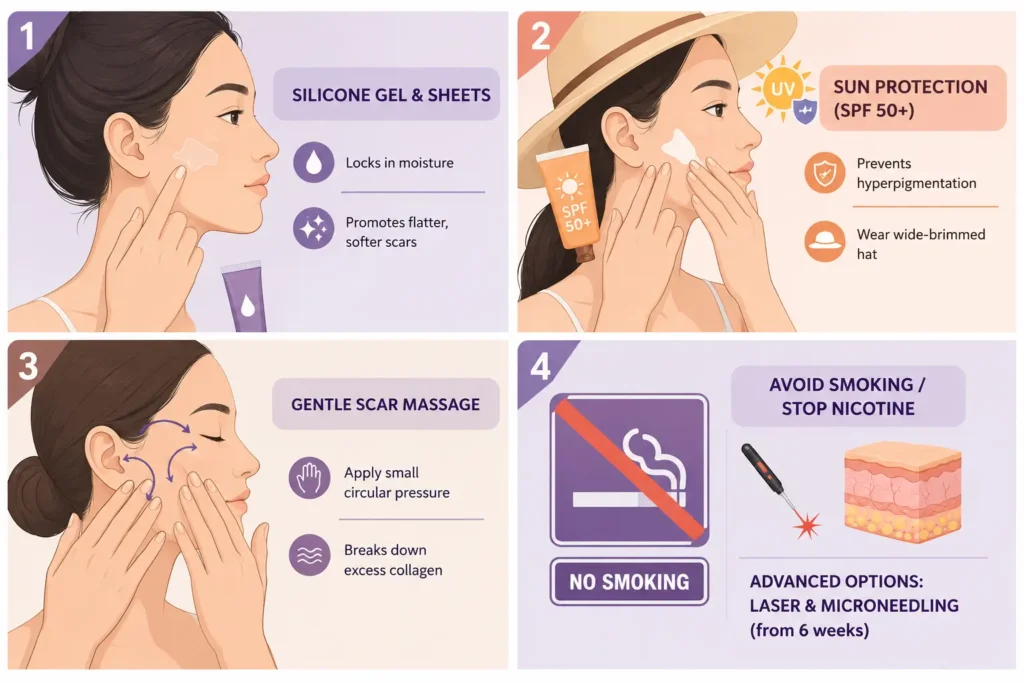
Silicone Gel and Sheets
Silicone is the leading method in surgical scar management due to its ability to lock in moisture and regulate collagen production. By creating a semi-occlusive film over the surface, silicone prevents scars from becoming thick, firm, or raised, ultimately promoting a flatter, softer, and more rapidly faded appearance. For areas with natural folds and curves like the face, silicone gel is generally preferred over adhesive sheets for its superior aesthetics and flexible application.
To achieve optimal results, you should begin applying silicone gel between weeks 3 and 4 post-surgery, once the incision has fully closed. The core principle is consistency, requiring at least 12 hours of contact per day for 8 to 12 consecutive weeks. Note that silicone does not provide UV protection, so it is essential to apply SPF 30+ sunscreen over the gel layer when outdoors to protect the scar from sun-induced hyperpigmentation.
Sun Protection — Non-Negotiable
Scar tissue lacks the normal concentration of melanin found in healthy skin, making it particularly vulnerable to UV damage. Sun exposure on a healing scar can trigger hyperpigmentation that is difficult to reverse and can effectively “lock” the scar in a darker, more visible state for far longer than necessary.
From day one after surgery, protect all incision areas with a broad-spectrum sunscreen (SPF 30 or higher) and wear a wide-brimmed hat when outdoors. This is especially important for the first 12 months. Even if scars eventually become invisible, UV exposure can still cause them to reappear — so long-term protection is worthwhile.
Avoid Smoking
Smoking impairs blood circulation to the skin and significantly slows wound healing — two factors that directly increase the risk of more prominent, slower-fading scars. Patients at ABmedi team Clinic are asked to stop smoking before surgery and to remain smoke-free throughout the recovery period.
Scar Massage
Beginning around 4–6 weeks post-surgery (once the incisions are fully closed and your surgeon gives the go-ahead), gentle massage helps break down excess collagen and improves the flexibility and texture of the scar. Use small circular movements with the fingertips, 5–10 minutes at a time. Cocoa butter, vitamin E, or a specialized scar gel can be used as lubricant during massage.
Advanced Options: Laser and Microneedling
For patients whose scars remain more prominent than expected, professional treatments can accelerate the maturation process. Fractional laser resurfacing and CO₂ laser treatments are effective at reducing redness, improving texture, and stimulating remodeling of collagen in the scar tissue. Recent research has also shown that microneedling, when started as early as 6 weeks post-surgery, can produce significant visible improvements by the 4-month mark — earlier than previously thought. At ABmedi team Clinic, we offer individualized scar management programs that incorporate these options where appropriate.
What Makes a Facelift Scar “Bad”?
Not all facelift scars are created equal. The most common complaints we see from patients who’ve had surgery elsewhere involve:
- Scar displacement — incisions placed in front of the ear in a straight, visible line rather than within the ear’s natural anatomy
- Hairline distortion — irregular or notched hairlines caused by incorrect placement at the temple or behind the ear
- Earlobe distortion (pixie ear) — when the earlobe is pulled downward or forward due to excessive skin tension, a telltale sign of a poorly executed facelift
- Visible scar trails below the ear — scars that run down toward the neck rather than staying concealed in natural creases
Modern technique — specifically the deep plane facelift approach, which repositions underlying muscle and fatty tissue rather than simply pulling skin — places far less tension on the incision sites. Less tension means better scar healing and a more natural result.
A Final Word on Expectations
I always tell patients: the people who notice your facelift result first will be the ones noticing how refreshed and youthful you look — not where your incisions are. Friends and colleagues tend to focus on the overall transformation, not the fine details around your ears.
That said, choosing the right surgeon and clinic matters enormously. At ABmedi team Clinic, every facelift begins with a detailed consultation that includes discussion of incision planning tailored to your individual anatomy, hair type, hairstyle preferences, and healing history. These aren’t one-size-fits-all decisions.
If you have concerns about scarring or want to understand what your personal healing journey might look like, I encourage you to schedule a consultation with our surgical team. We’re here to give you clear, honest, experience-based guidance every step of the way.
Frequently Asked Questions (FAQs)
Q1: How are facelift scars hidden during surgery?
A: Modern plastic surgery techniques prioritize maximum concealment. Facelift incisions are strategically placed along the natural contours and shadows of your face where they are virtually invisible to the naked eye. The incision typically begins within the hairline above the ear, follows the natural curve of the front ear cartilage (retrotragal incision), wraps tightly around the earlobe, and extends back into the lower scalp hairline. This ensures that once healed, the scars are completely camouflaged by your hair and natural skin creases.
Q2: How long does it take for facelift scars to fade completely?
A: The maturation of a surgical scar is a gradual process that follows a predictable clinical timeline:
- Weeks 1–6: Incisions appear as thin, pinkish-red lines. This is a sign of healthy blood flow actively working to knit the tissues back together.
- Months 3–6: The redness begins to soften, shifting to a lighter pink or flesh-toned hue as inflammation decreases.
- Months 12–18: The scars undergo full maturation. At this final stage, they typically fade into a faint, flat, silver-white line that is nearly indistinguishable from the surrounding skin.
Q3: What can patients do to disguise facelift scars during the healing phase?
A: While your scars are in the early stages of healing, you can easily camouflage them using simple, non-invasive methods:
- Hairstyle Adjustments: Wearing your hair down or styling it to softly frame your ears completely covers the fresh incision lines during the first few weeks.
- Medical Makeup: Once the stitches are removed and the skin is fully closed (usually around day 10–14), you can safely apply a high-coverage, medical-grade concealer with SPF.
- Accessories: Utilizing stylish accessories like oversized sunglasses, silk scarves, or wide-brimmed hats offers an elegant way to block both public view and harmful UV rays.
Q4: Is a customized “Cinderella Facelift” a viable alternative to minimize permanent scarring?
A: Yes, for patients who are strictly scar-aversive and have only mild-to-moderate skin laxity, a Cinderella Facelift concept serves as a beautiful non-surgical alternative. This approach combines premium energy-based lifting technologies (like High-Intensity Focused Ultrasound) with precise injectable contouring. Because it relies on micro-incisions or needle injection points rather than traditional surgical incisions, it leaves absolutely no permanent scarring, making it an “invisible” refresh option for early aging.
Q5: Should a 70-year-old worry about facelift scars, and do older skin types heal differently?
A: Paradoxically, a 70-year-old patient often heals with even less visible scarring than a younger patient. As skin ages, its immune response softens, which actually minimizes the risk of overactive scar tissue formation (such as hypertrophic scars or keloids). Additionally, the natural wrinkles, fine lines, and skin laxity around the ears of a 70-year-old provide the perfect structural “camouflage,” allowing the surgeon to tuck incisions deep inside existing creases for a flawlessly natural, undetectable outcome.
