


If you’ve just had a facelift — or you’re preparing for one — understanding the recovery process is just as vital as the surgery itself. At ABmedi Team Clinic, we believe that well-informed patients experience less anxiety and achieve superior outcomes. Swelling and bruising are not complications; they are signs of your body’s natural healing response. Here is your professional guide to managing them effectively.
Why Swelling and Bruising Happen After a Facelift
During a facelift, the surgeon repositions deeper facial tissues, removes excess skin, and separates tissue planes — all of which inevitably disrupts small blood vessels and soft tissue. When those vessels are disturbed, blood seeps into the surrounding tissue, which is what we see as bruising. Simultaneously, the body launches an inflammatory response, sending extra fluid to the area to initiate repair. That’s swelling.
Both are completely expected. Neither should alarm you. What matters is how you manage them in the days and weeks that follow.
What to Expect: A Realistic Recovery Timeline
Understanding the typical progression of swelling and bruising is essential to staying calm and on track. While every patient heals at their own pace, most follow a predictable recovery curve.
Use the timeline below to plan your social calendar and understand your body’s signals:
| Timeline | What to Expect | Core Action Plan |
| Day 1-3 | Peak swelling and bruising. Feeling of “tightness.” | Consistent cold compresses & maximum elevation. |
| Day 4-7 | Swelling begins to subside; bruising turns yellow-green. | Transition to gentle walking to boost circulation. |
| Weeks 2-3 | Most visible bruising resolves. “Socially presentable.” | Resume non-strenuous work; avoid intense heat. |
| Weeks 4-6 | Majority of swelling is gone. Subtle puffiness remains. | Final tissues settling; resume moderate activity. |
| Months 1-6 | Residual swelling fades for final refinement. | Patience is essential for the final contour. |
Pro-Tip for Expats: If you notice that one side of your face is swelling more than the other during the first two weeks, don’t worry. Healing is rarely symmetrical; your body will balance out as the deep tissues settle.
Proven Strategies to Reduce Swelling and Bruising

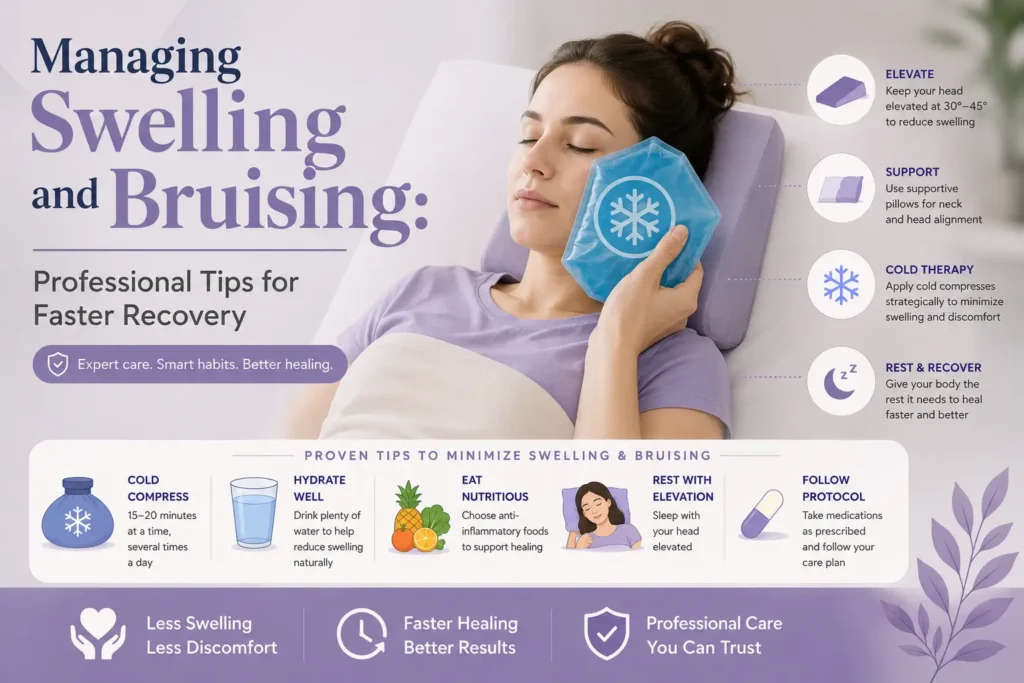
3.1. Keep Your Head Elevated — Day and Night
Gravity is your best ally. Keeping your head above heart level encourages fluid to drain away from the face.
- The Setup: Use a medical-grade wedge pillow or sleep in a reclined chair for at least the first two weeks.
- Avoid: Lying flat, side-sleeping, or stomach-sleeping, as these increase pressure on incisions and prolong puffiness.
3.2. Use Cold Compresses (The First 48–72 Hours)
Cold therapy constricts blood vessels and provides natural pain relief.
- How to: Apply a wrapped cold pack for 15–20 minutes at a time, several times a day.
- Strict Rule: Never apply ice directly to the skin or over the incision sites. Discontinue after 72 hours, as excessive cold can hinder later-stage circulation.
3.3. Follow Your Medication Protocol Precisely
Follow the tailored plan provided by ABmedi Team Clinic exactly.
- Avoid Blood Thinners: Do not take aspirin, ibuprofen, vitamin E, or fish oil supplements unless cleared, as these significantly increase bruising.
- Arnica & Bromelain: Many of our international patients find Arnica Montana (homeopathic) and Bromelain (pineapple enzyme) helpful in reducing discoloration. Consult your surgeon before starting these.
3.4. Wear Your Compression Garment as Directed
Do not underestimate the chin garment. It controls fluid accumulation and supports the newly repositioned tissues. Consistent use can shave days off your visible recovery time.
3.5. Eat an Anti-Inflammatory, Low-Sodium Diet
Sodium causes water retention, worsening facial swelling.
- Yes: Pineapple, papaya, antioxidant-rich berries, and leafy greens.
- No: Processed foods, high-salt meals, and alcohol (which dilates blood vessels and increases swelling).
- Hydration: Focus on water and electrolytes to flush inflammatory byproducts.
3.6. Rest — But Stay Mobile
Your body needs energy to repair, but total bed rest is not recommended.
- Week 1: Prioritize rest. Avoid heavy lifting or bending over.
- Activity: Start short, gentle walks around your home by Day 2. This supports lymphatic drainage without raising blood pressure to dangerous levels.
3.7. Consider Manual Lymphatic Drainage (MLD)
MLD is a specialized massage that accelerates the removal of metabolic waste and fluid.
- Important: This must be performed by a certified therapist. At ABmedi Team Clinic, we can provide referrals to qualified MLD practitioners experienced in post-surgical care.
3.8. Avoid Heat Sources
Heat dilates blood vessels and increases swelling. For the first 3–4 weeks, avoid:
- Hot showers directed at the face.
- Saunas, steam rooms, and the intense Southeast Asian sun.
- Daily application of broad-spectrum sunscreen is mandatory once incisions have closed.
Warning Signs That Need Immediate Attention
Swelling and bruising are normal. But certain symptoms are not, and knowing the difference could be important for your safety.
Contact ABmedi Team Clinic promptly if you experience:
- A sudden, significant increase in swelling — particularly on one side of the face
- Severe or rapidly worsening pain that isn’t controlled by your prescribed medication
- Signs of infection: increasing redness, warmth, discharge from incision sites, or fever
- Bleeding that does not stop with gentle, sustained pressure
- Any symptom that feels wrong to you, even if you’re unsure
When in doubt, call. There is no such thing as an unnecessary check-in during surgical recovery.
A Word on Final Results
Healing from a facelift is a gradual process that unfolds over months, not weeks. The face you see at day seven is not your result. Neither is the face you see at week four. Full tissue settling, including the resolution of subtle residual swelling in deeper layers, can take anywhere from three to six months — sometimes longer.
This is why photographs taken early in recovery rarely reflect the outcome. Trust the process, follow your aftercare plan, and give your body the time it genuinely needs.
At ABmedi Team Clinic, our surgeons provide personalized recovery guidance and remain available throughout your healing journey. If you have questions about your specific recovery, don’t hesitate to reach out to our team directly.
Frequently Asked Questions (FAQs)
Q1: How do you make post-op bruising and swelling go away fast?
A: The fastest way to eliminate post-operative swelling and bruising is to combine strict physical protocols with clinical remedies during the critical first 72 hours. First, implement intermittent cold therapy (cold compresses) to constrict blood vessels and limit fluid buildup. Second, keep your head elevated at a 45-degree angle, even while sleeping, to let gravity naturally drain interstitial fluids away from your face. Finally, supplement your routine with approved medical-grade topical treatments or natural anti-inflammatory supplements to accelerate the body’s fluid reabsorption.
Q2: What heals bruises the fastest after surgical procedures?
A: Arnica Montana and Bromelain are clinically proven to heal surgical bruises the fastest. Arnica is a homeopathic remedy available in topical gels or oral pellets that dramatically stimulates blood circulation to clear away trapped red blood cells beneath the skin. Bromelain, a natural enzyme extracted from pineapples, works dynamically to break down the proteins that trap fluids and trigger discoloration. Additionally, switching from cold compresses to warm compresses after Day 4 increases localized blood flow, safely flushing out residual bruising.
Q3: How do you speed up the body’s natural healing of internal swelling?
A: Speeding up the reduction of internal swelling requires optimizing lymphatic drainage and maintaining dynamic hydration. Drinking plenty of water is essential, as it prevents your body from holding onto fluid reserves out of dehydration shock. You should also strictly limit sodium (salt) intake, as excess sodium binds to water and worsens facial puffiness. Once your surgeon clears you, performing gentle, short walks will stimulate your lymphatic system to pump trapped surgical fluids out of facial tissues and back into circulation for disposal.
Q4: Can you completely heal a surgical bruise in just 3 days?
A: No, it is medically impossible to completely heal a deep surgical bruise in 3 days, as the cellular breakdown of trapped blood takes time. However, you can dramatically reduce its intensity and prevent it from worsening within that 3-day window. By rigorously applying cold therapy, avoiding blood-thinning supplements (like high-dose vitamin E or aspirin), and utilizing specialized concealment makeup once the skin closes, you can effectively minimize the visibility of a bruise so it looks faint and manageable by Day 3.
Q5: What is the “10-4 bruising rule” in clinical recovery?
A: In cosmetic surgery rehabilitation, the 10-4 bruising rule serves as a helpful diagnostic and psychological timeline for patients to monitor their healing progress:
- The 10-Day Window: Represents the average time it takes for major, dark-colored surgical bruising (deep purple, blue, or red) to break down and fade into a faint yellowish-green shadow that is easily coverable with light makeup.
- The 4-Week Baseline: Represents the point where residual, deep-tissue swelling and minor discoloration completely clear up, leaving the treated areas fully settled, soft, and beautifully integrated with your natural facial anatomy.
This article is intended for general educational purposes. It does not replace individualized medical advice. For guidance specific to your procedure and health history, always consult directly with your surgeon at ABmedi Team Clinic.
📞 💬 WhatsApp / Chat: [http://wa.me/84975142666] 🌐 Book online: [+84-975-142-666]
Consultations are available in-clinic and online for international patients. Most patients leave their first appointment knowing exactly what they need — and feeling confident about the path ahead.
