


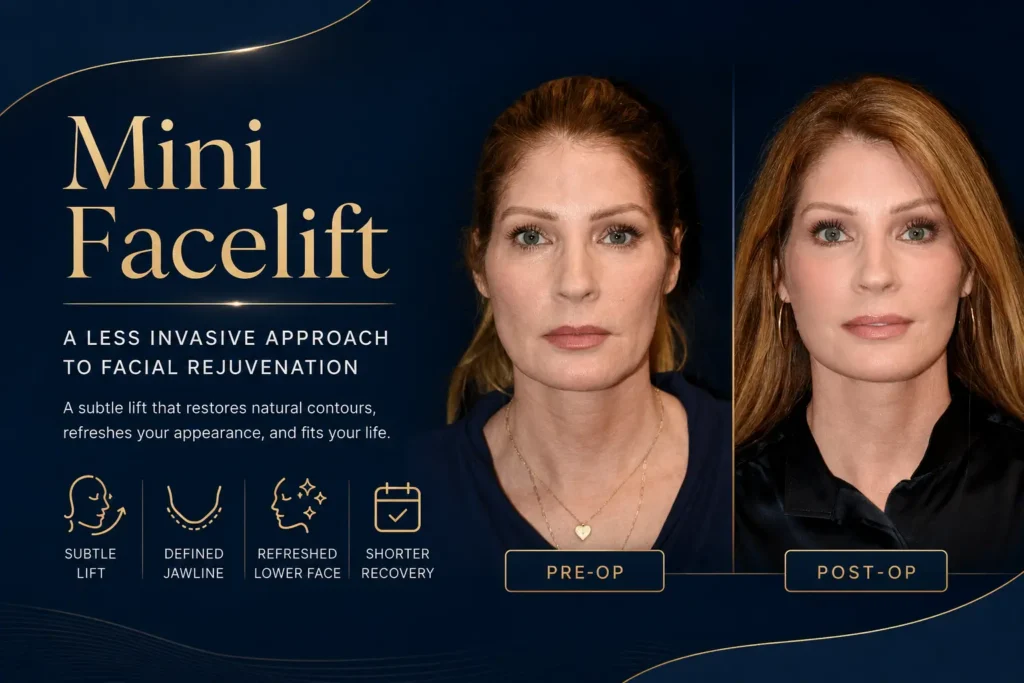
The mini facelift gets a lot of attention – and for good reason. But “less downtime” isn’t the whole story. As a surgeon, I’d rather you understand exactly what this procedure can and cannot do before you decide whether it’s right for you.
Every week, patients come in having already researched the mini facelift online. They’ve read that it’s quicker, simpler, and easier to recover from than a full facelift – and all of that is broadly true. What’s less clearly communicated is that a mini facelift is not a scaled-down version of a full facelift. It’s a fundamentally different procedure with a narrower scope of correction. Understanding that distinction is what separates a great outcome from a disappointing one.
This guide covers everything you actually need to know: what the procedure involves technically, who genuinely benefits from it, what the recovery looks like week by week, how it stacks up against both non-surgical options and more comprehensive surgery, and – most importantly – how to answer the question honestly: is a mini facelift enough for what you’re trying to achieve?
What Is a Mini Facelift, Really?
A mini facelift – also called a short-scar facelift or mini rhytidectomy – is a surgical procedure that targets mild skin laxity in the lower face and jawline using shorter incisions, typically hidden around and behind the ear. It lifts and repositions sagging soft tissue of the lower face with less disruption to underlying structures than a full facelift. It is not a marketing term for any particular technique; it describes a category of less-invasive facial rejuvenation surgery.
One thing worth clarifying upfront: the term “mini facelift” is not standardized. Different surgeons use it to describe different things – some include limited SMAS work, others do not. This variability matters because the scope of tissue work largely determines how long the results last and how comprehensive the improvement will be. When consulting with a surgeon, always ask specifically what the procedure will involve anatomically, not just what it’s called.
Generally speaking, a true mini facelift addresses the lower third of the face – jowls, the jawline, early marionette lines – through shorter incisions with reduced operating time and recovery. It does not comprehensively address the mid-face, deep nasolabial folds, neck laxity, or forehead. Those areas require additional or more extensive procedures.
How the Procedure Works
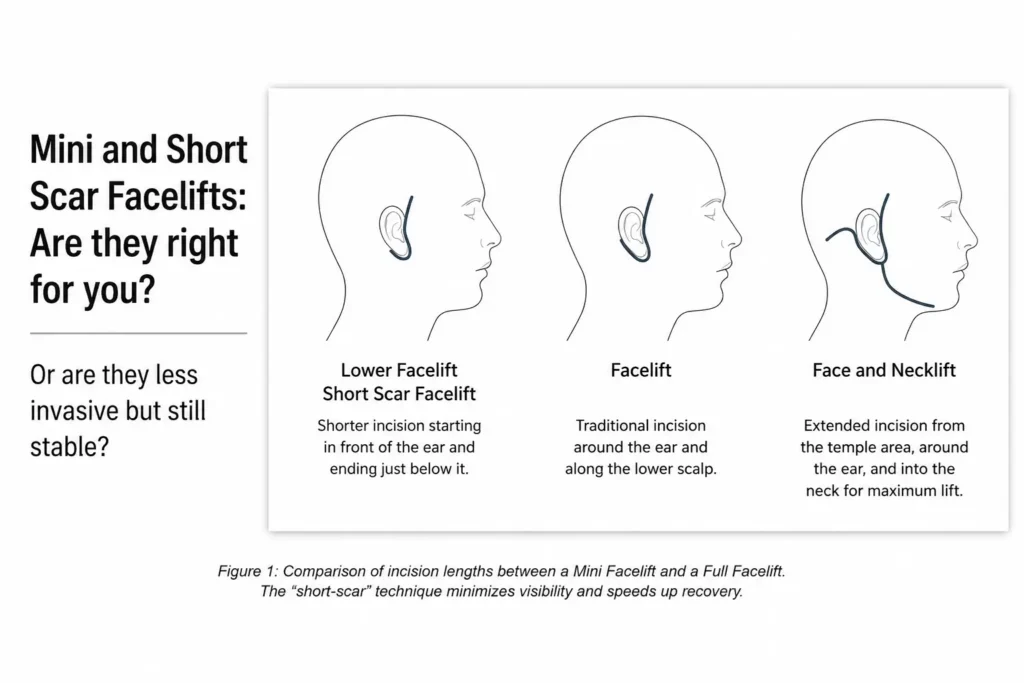
The incision is typically placed in front of the ear, often extending slightly behind it, following the natural skin crease to minimize visible scarring. Through this access, the surgeon lifts and repositions the superficial soft tissue of the lower face – removing excess skin and securing the tissue in a higher, more youthful position.
In more refined versions of the mini facelift, the surgeon also addresses the SMAS (Superficial Musculoaponeurotic System) – the fibromuscular layer beneath the skin – to provide a more durable structural lift rather than just pulling the skin. How deeply this layer is engaged depends on the technique and the surgeon’s approach. Even with SMAS involvement, the dissection is more limited than in a full facelift; the retaining ligaments are generally not released, which is the key distinction between a mini facelift and a deep plane technique.
Most mini facelifts can be performed under local anesthesia with sedation, which is one of the genuine advantages over full facelift surgery. Operative time typically ranges from one to two hours. Patients typically go home the same day.
Who Is a Good Candidate?
✓ Good Candidates
|
✗ Not Ideal Candidates
|
Age is a useful – but imperfect – guide. Many patients in their 40s and early 50s are excellent candidates; some 60-year-olds with good skin quality still qualify. The more reliable determinant is the degree and distribution of laxity, not a number. At AbMedi Team Clinic, every candidate assessment includes evaluation of skin thickness, subcutaneous fat, the location of tissue descent, and the patient’s realistic expectations for improvement.
The mini facelift works beautifully when it’s the right tool for the problem. The mistake I see most often – not just in consultations but in revision cases – is patients who were a borderline candidate and either weren’t told that clearly, or chose the less invasive option hoping it would be enough. It usually isn’t, and then they’re back in consultation sooner than they expected. Honest patient selection is the most important part of this procedure.
– AbMedi Team Clinic Surgical Team, Board-Certified Facial Plastic Surgery
Mini Facelift vs. Full Facelift: Comparison
| Factor | Mini Facelift | Full Facelift |
| Target Area | Lower face, jawline, early jowls | Lower face, mid-face, neck, jawline — comprehensive |
| Incision Length | Shorter — primarily in front of the ear | Longer — extends behind the ear into the hairline |
| Tissue Depth | Superficial to SMAS; limited deeper work | SMAS or deep plane; retaining ligaments often released |
| Anesthesia | Often local + sedation | Usually general anesthesia |
| Operating Time | 1–2 hours | 3–5 hours |
| Social Downtime | 7–14 days | 14–21 days |
| Full Recovery | 4–6 weeks | 6–8 weeks or more |
| Result Longevity | 3–7 years, varies by technique | 7–15 years depending on technique (SMAS vs. Deep Plane) |
| Mid-face Correction | Minimal to none | Significant, especially with deep plane |
| Neck Correction | Limited — surface tightening only | Comprehensive, including platysmaplasty if needed |
| Best For | Early intervention, mild aging | Moderate to advanced aging, comprehensive rejuvenation |

Mini Facelift vs. Non-Surgical Options
This is where the conversation gets more nuanced. Many patients come in asking whether they should try injectables, thread lifts, or energy-based devices first — and whether any of those can delay or replace surgery altogether.
The honest answer is: non-surgical treatments and surgery operate on fundamentally different mechanisms. They aren’t competing options so much as tools that address different problems.
Neuromodulators (like Botox) relax specific facial muscles, reducing dynamic lines around the forehead, eyes, and mouth. They do nothing for structural laxity or descended tissue. Dermal fillers add volume in specific areas and can temporarily soften nasolabial folds or improve jawline definition — but fillers don’t lift; they fill. Thread lifts offer a temporary mechanical repositioning effect that typically lasts 12–18 months in favorable cases and often significantly less. Energy devices (radiofrequency, ultrasound) stimulate collagen and can tighten mildly lax skin over several months — appropriate for mild skin quality improvement, not for structural tissue descent.
If you have mild jowling and are considering a mini facelift vs. non-surgical options, the surgical path offers one key advantage that no non-surgical procedure can match: actual repositioning of descended tissue rather than masking or filling around it. The results are more defined, more reliable, and longer-lasting. The trade-off is recovery time and the nature of surgical intervention itself. At AbMedi Team Clinic, we often recommend a complementary approach — surgical correction for structure, non-surgical maintenance afterward for skin quality and volume.
Recovery Timeline: Week by Week
Days 1–2
Rest is the priority. Expect mild discomfort, tightness, and light bandaging. Keep your head elevated — even while sleeping. Cold compresses help manage early swelling. You’ll need someone to assist you during this window. Do not plan to be productive.
Days 3–4
Swelling and bruising typically peak around this point — the face may look more dramatic than it will remain. This is normal and expected. Discomfort lessens compared to the first two days. Continue cold compresses and avoid any exertion.
Days 5–7
Most patients feel well enough for light walking and basic household tasks. Bruising begins to shift from deep purple to yellow-green. Sutures may be removed at a follow-up visit. Avoid bending, lifting, or anything that increases blood flow to the face.
Weeks 2–4
The majority of visible bruising and swelling resolves. Most patients return to work and social settings, often with minimal makeup. Some residual puffiness or firmness in the tissues is normal — this is not the final result. Continue avoiding strenuous exercise.
Weeks 4–6
Most patients feel close to fully normal. Exercise can usually be gradually resumed with surgeon clearance. Scars continue to mature and fade. The refreshed contour is now clearly visible, though subtle refinement continues.
6 Months+
The final result is fully mature. Scars have faded significantly and blended into the natural skin lines. The improved jawline definition and reduced jowling are visible with natural, uninhibited facial movement.
One practical note many sources understate: while social downtime averages 1–2 weeks, full healing takes 6–8 weeks. Planning around social events should account for that longer window, particularly if the event is formal or involves professional appearances. We advise giving yourself a comfortable 8-week buffer before any high-stakes public appearance.
How Long Do Results Last?
This is perhaps the most important question patients don’t ask often enough. Mini facelift results typically last between 3 and 7 years — a significant range that depends on the technique used, how much SMAS work was included, the patient’s skin quality, lifestyle factors (sun exposure, smoking, weight fluctuations), and the natural pace of individual aging.
A mini facelift performed with superficial skin lifting only may begin to relax within 2–4 years. One that includes quality SMAS work can hold well for 5–7 years. Neither approaches the longevity of a well-performed deep plane facelift, which routinely holds for 10–15 years or more due to structural repositioning of deeper tissue.
This is not a criticism of the mini facelift — it’s an honest framing of the value exchange. A shorter, less invasive procedure with a lower commitment threshold, performed at the right time in the aging process, can deliver excellent results that hold well for years. The key is choosing it for the right reasons: early intervention on genuine early aging, not as a compromise when a more comprehensive procedure would actually serve the patient better.
Scar Management and What to Expect
Because incisions are shorter and placed in natural skin creases around the ear, mini facelift scars are generally well-concealed and heal reliably. That said, scar management in the healing phase does make a real difference.
Scar Care Best Practices — AbMedi Team Clinic Protocol
Keep incisions clean and moisturized; avoid crust formation that can impair scar quality
Apply silicone gel or sheeting once the incision has closed — this is evidence-supported for scar flattening
Avoid direct sun exposure on healing scars; use broad-spectrum SPF 50 daily and reapply as directed
Sleep with head elevated for the first 2–3 weeks to reduce swelling and scar tension
Eat a protein-rich diet during healing — tissue repair is metabolically demanding
Avoid smoking: nicotine significantly impairs wound healing and increases complication risk
How to Maintain and Extend Your Results
A mini facelift is not a permanent stop to aging — it’s a reset. Patients who take a proactive approach to skin health after surgery typically see their results hold longer and age more gracefully. At AbMedi Team Clinic, we recommend building a maintenance protocol that complements your surgical result:
Sun protection is non-negotiable. UV exposure accelerates skin laxity, collagen breakdown, and pigmentation changes — all of which can compromise the quality and longevity of your result.
Neuromodulators and fillers, used thoughtfully, can maintain youthful expression, address volume loss, and complement the structural improvement that surgery creates. These are best used as adjuncts to surgery, not substitutes.
Skin quality treatments — including laser resurfacing, microneedling, and medical-grade topical regimens — support collagen production and skin texture over time. None of these replace structural surgery, but they preserve and extend what surgery achieves.
The Honest Answer: Is a Mini Facelift Enough?
It depends entirely on what you actually need.
If you’re in your 40s or early 50s with genuine early lower-face aging — mild jowling, softening jawline, skin that’s beginning to descend — and you want a natural-looking correction with a manageable recovery commitment, a mini facelift performed with proper SMAS technique can be exactly the right move. It is a legitimate, well-studied procedure that delivers real structural improvement. It is not a gimmick.
If you have moderate to advanced facial descent, significant neck laxity, deep nasolabial folds, or mid-face volume loss, a mini facelift will not fully address your concerns. You will likely see partial improvement that doesn’t meet your expectations — and you’ll be back in consultation sooner than you’d hoped. In that scenario, a full facelift (SMAS or deep plane, depending on your anatomy) is the more appropriate and ultimately more cost-effective choice.
The most important factor is a surgeon who will tell you which category you’re actually in — not one who agrees with whatever you came in hoping to hear.
Frequently Asked Questions
- Can a mini facelift be done under local anesthesia?
Yes — this is one of the genuine advantages of the mini facelift over a full facelift. Many mini facelift procedures are performed under local anesthesia with sedation (twilight anesthesia), avoiding the systemic effects of general anesthesia. This also contributes to faster recovery. The specific anesthesia approach should be discussed with both your surgeon and anesthesiologist based on your individual health history.
- Will I look natural, or obviously “done”?
When performed correctly and for the right candidate, a mini facelift should look natural — a refreshed, rested version of you, not an operated appearance. Because the procedure is targeted and the incisions are smaller, there is less risk of over-correction than with more extensive surgery. The risk of an unnatural result is higher when the procedure is used to address aging that exceeds what it can realistically correct.
- How does the mini facelift compare to a thread lift?
They are meaningfully different. A thread lift is a non-surgical procedure that temporarily repositions tissue mechanically using absorbable threads placed through the skin. Results typically last 12–18 months and are often subtle. A mini facelift is surgical — actual tissue is repositioned and secured, skin is removed, and the result is both more significant and much longer-lasting. For patients who are genuine surgical candidates, a thread lift is generally a poor substitute; for those who want a non-surgical option with modest expectations and no recovery commitment, it may be appropriate as a temporary measure.
- What can’t a mini facelift fix?
A mini facelift does not comprehensively address the mid-face or cheek descent, deep nasolabial folds, forehead or brow position, significant neck laxity, or under-eye hollowing. It also does not restore volume to areas of fat loss — that typically requires fat grafting or filler. Patients with concerns in these areas need to discuss additional procedures or a more comprehensive surgical approach.
- Can I combine a mini facelift with other procedures?
Yes, and this is common. Mini facelifts are frequently combined with eyelid surgery (blepharoplasty), brow lifts, fat grafting, or laser resurfacing in a single surgical session to comprehensively address multiple areas of aging simultaneously. Combining procedures can be both more efficient and more cost-effective than staging them separately — and it allows for a single recovery period. The appropriateness of combination procedures depends on your overall health, the expected operative time, and your surgeon’s recommendation.
- When is the right age to consider a mini facelift?
There’s no universal “right age” — the right time is when the problem the procedure addresses actually exists. Most patients who benefit from a mini facelift are in their 40s to early 50s, but some are younger with genetic predisposition to early jowling, and some are older with naturally good skin quality. The more useful question is: do the signs of aging you want to address fall within the scope of what a mini facelift corrects? That’s the question your surgeon should help you answer honestly.
