


Every week, patients sit across from me and ask some version of the same question: “Is a facelift actually worth it? How long will it last? Will I regret it?” These are the right questions to ask — and they deserve honest, data-backed answers rather than marketing reassurances.
After years of performing facial rejuvenation procedures and following patients through long-term outcomes, here is what the research — and real clinical experience — actually tells us.
What the Satisfaction Data Shows
Let’s start with the numbers, because they’re compelling.
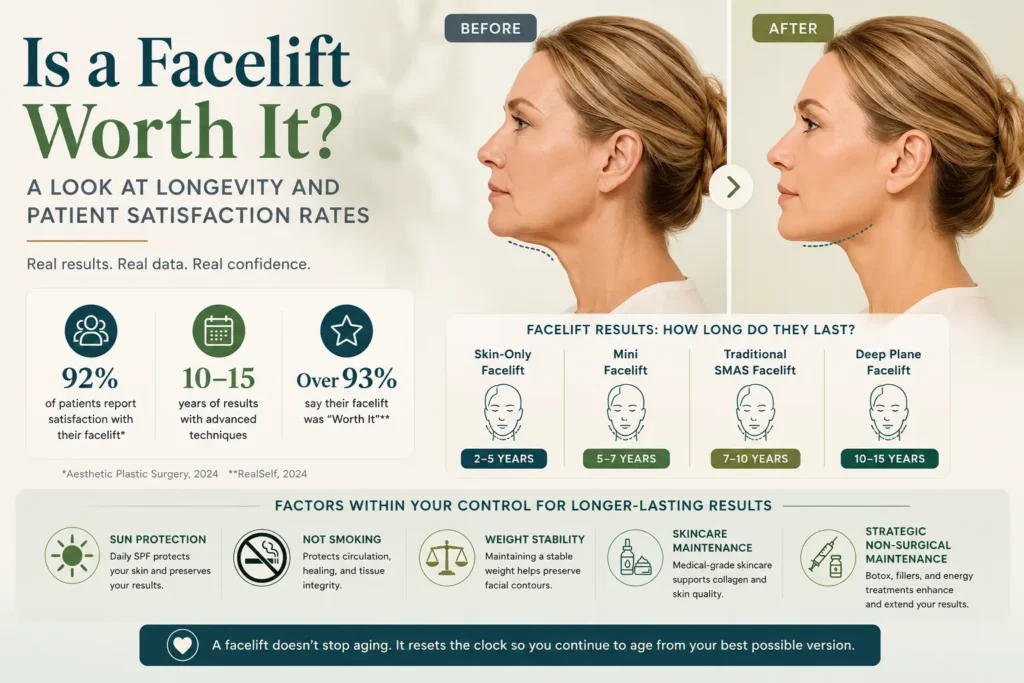
A 2024 peer-reviewed study published in Aesthetic Plastic Surgery analyzed 2,153 facelift patient reviews and found that 92.24% were positive. The two most common drivers of satisfaction? The aesthetic outcome itself, and the quality of the patient-physician relationship. That second finding tells me something important: results aren’t just about surgical technique — they’re about whether patients felt heard and well-prepared going in.
On the consumer platform RealSelf, facelifts carry a consistent 93% “Worth It” rating — among the highest of any cosmetic procedure listed.
Going deeper into the clinical literature:
- A well-known long-term outcomes study following SMAS-platysma facelift patients found 97.8% satisfaction at one year post-surgery. At an average follow-up of 12.6 years, 68.5% still rated their improvement as very good or better — and the same percentage reported feeling that a decade or more had been added to their apparent age.
- A separate study by Dr. Eric Swanson, in which 93 deep plane facelift patients were interviewed one month post-operatively, found that 96.7% reported looking younger — by an average of nearly 12 years. Over 40% said the results exceeded their expectations. 93.5% said they would recommend the procedure, and 82.8% reported improved self-esteem.
- A 2024 systematic review and meta-analysis covering more than 6,000 patients across 21 studies reported patient satisfaction of 94.4% for deep plane facelifts and 87.8% for SMAS facelifts.
These are not outlier results. Across different study designs, timeframes, and surgical techniques, the pattern is consistent: when performed well, facelifts produce outcomes that patients are genuinely glad they pursued.
How Long Do Results Actually Last?
This is where technique matters enormously. The honest answer is: it depends on what kind of facelift you have.
| Technique | Typical Longevity |
| Skin-only facelift | 2–5 years |
| Mini facelift | 5–7 years |
| Traditional SMAS facelift | 7–10 years |
| Deep plane facelift | 10–15 years |
Why the difference? Procedures that only tighten the skin — without addressing the deeper structural layers — relapse relatively quickly as the underlying tissues continue to descend. The more durable results seen with SMAS and deep plane techniques come from repositioning the actual scaffolding of the face: the musculoaponeurotic layer, the facial ligaments, and in some cases the deeper fat compartments.
A peer-reviewed study measuring outcomes at 5.5 years post-surgery found that jowl correction was still statistically significant at that time point (p < 0.0001), even though some relapse had occurred. That’s a clinically meaningful result — not just a temporary change.
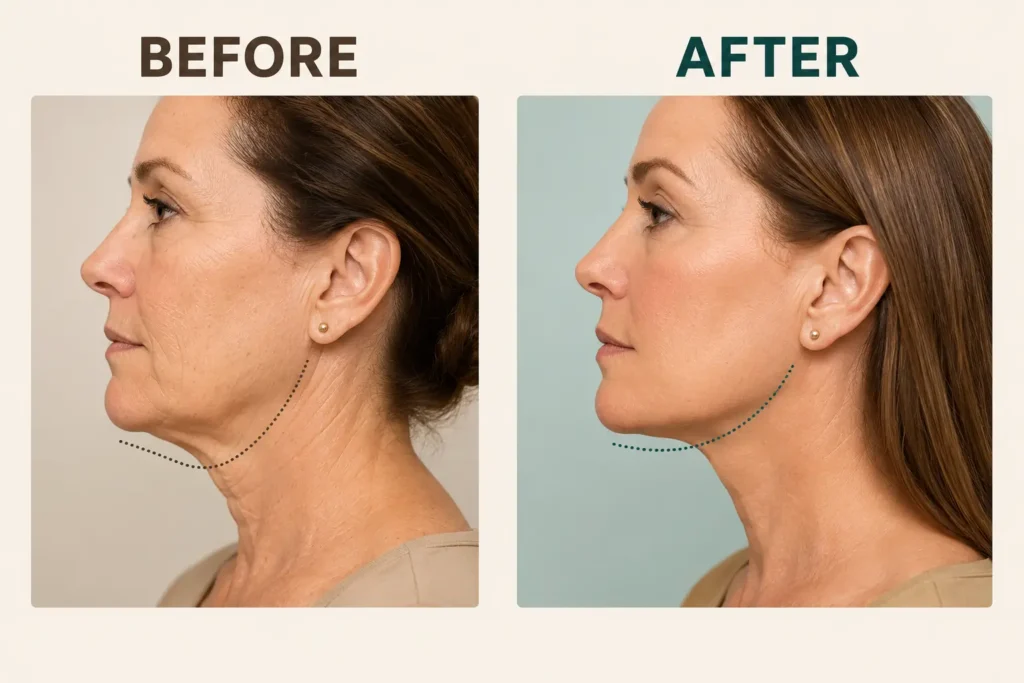
One thing I tell every patient at ABmedi Team Clinic: a facelift doesn’t stop aging; it resets the baseline. After surgery, you continue to age naturally — but always from a younger starting point. A patient who looks 45 at surgery may look 50 by year ten, while a peer who skipped surgery might look 60 by the same age. The gap persists.
Research supports this framing. A 2013 study had observers estimate the ages of facelift patients from photographs; they guessed an average of five years younger than the patient’s actual age. Patients themselves consistently reported perceiving even greater gains.
What Affects How Long Results Last?
Several variables are within your control — and some are not.
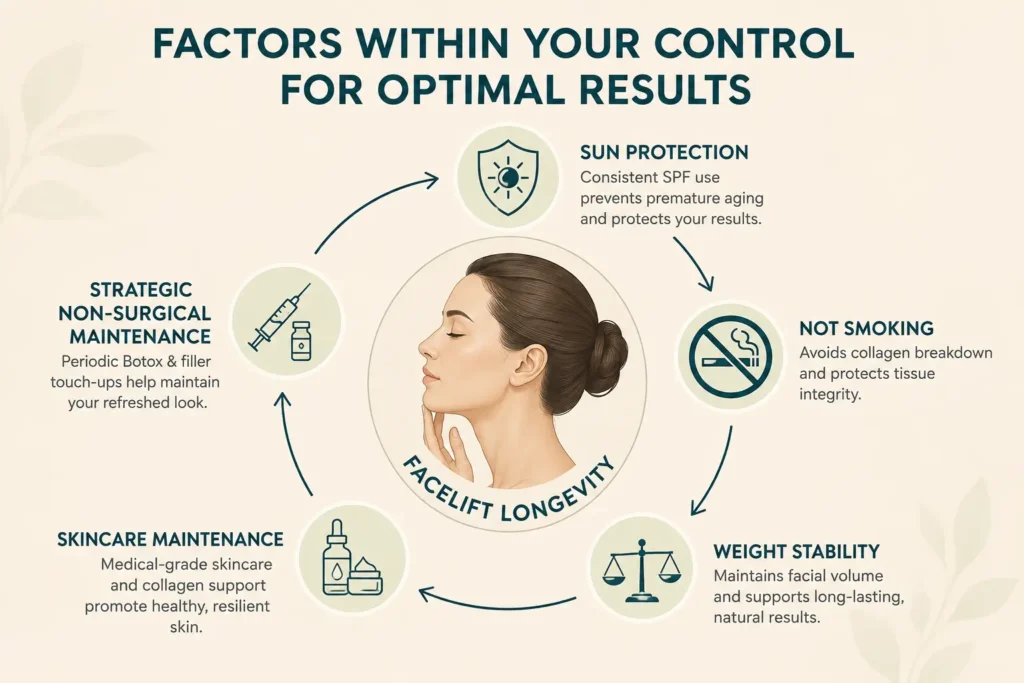
Factors within your control:
- Sun protection — UV exposure is among the leading drivers of accelerated skin aging and breakdown of collagen. Consistent SPF use meaningfully extends results.
- Not smoking — Smoking compromises circulation and impairs tissue integrity. It also dramatically increases surgical complication risk (studies have shown up to a 12-fold increase in skin necrosis for smokers). This is non-negotiable before and after surgery.
- Weight stability — Significant fluctuations in weight can alter facial volume and soften the definition created by surgery.
- Skincare maintenance — Medical-grade skincare, including retinoids and growth factor serums, supports ongoing collagen production.
- Strategic non-surgical maintenance — Many of my patients combine periodic neuromodulator (Botox) treatments, small-volume filler touches, or energy-based skin tightening with their surgical result to slow the natural progression. Surgery and maintenance are not mutually exclusive.
Factors not in your control:
- Genetics — Skin quality, bone structure, and the pace of your individual aging are hereditary. Patients with strong facial bone structure and good skin elasticity tend to hold results longer.
- Age at surgery — Skin operated on earlier, when it retains more elasticity, holds tension better. Patients under 50 often get slightly longer-lasting results than older patients, though excellent outcomes are absolutely achievable in the 60s and 70s.
Surgical vs. Non-Surgical: An Honest Comparison
I work with both surgical and non-surgical modalities, so I have no incentive to oversell either.
The relevant longevity comparison looks like this:
- Botox/neuromodulators: 3–4 months
- Dermal fillers: 6–18 months
- Thread lifts: 1–2 years
- Facelift surgery: 7–15 years
Here’s what that means financially for a typical patient. Dermal fillers for facial rejuvenation often run $2,000–$5,000 per year when used to address moderate-to-advanced laxity. Over 10 years, that adds up to $20,000–$50,000 — often with diminishing returns and, at higher volumes, an increasing risk of a heavy or distorted appearance.
A well-executed facelift at ABmedi Team Clinic provides results that outlast those cumulative costs, with a single recovery period.
That said, non-surgical options have their place. They’re the appropriate starting point for patients in their 30s and early 40s with early-stage volume loss and minimal laxity. The decision to move to surgery isn’t a failure of non-surgical care — it’s a recognition that once significant tissue descent has occurred, structural repositioning is the more reliable tool.
At a certain point, adding more filler volume to compensate for descended tissue can actually make the face look heavier and less natural. When I see patients who have reached that threshold, the more honest and effective recommendation is surgery.
The Pros and Cons — Clearly Stated
As with any surgical procedure, balance matters. I want patients to walk in with a realistic picture.
What speaks in favor of a facelift:
- Long-lasting structural correction that non-surgical options cannot replicate
- High patient satisfaction sustained across multiple independent studies over decades
- Meaningful quality-of-life improvements — improved self-esteem reported in over 80% of patients in published research
- Aging from a younger baseline — even as time passes, you remain ahead of where you would have been without surgery
- Potential long-term cost efficiency when compared to annual non-surgical maintenance regimens
What to weigh carefully:
- Significant upfront investment — total all-in costs range from $15,000 to $45,000+ depending on technique and location
- Recovery commitment — plan for 1–2 weeks of visible swelling and bruising; most patients return to normal activity by week two, with continued refinement over several months
- Surgical risks — the most common complication is hematoma (blood pooling under the skin), occurring in roughly 1–2% of cases. Infection and nerve injury are possible but rare, particularly with an experienced surgeon in an accredited facility
- Not permanent — results are durable but not indefinite; aging continues
- Not covered by insurance — this is an out-of-pocket investment
Who Gets the Best Results?
Based on both published research and clinical experience at ABmedi Team Clinic, patients who tend to achieve the highest satisfaction share certain characteristics:
- Realistic expectations — they want to look like a fresher, more rested version of themselves, not a different person
- Good general health, with no uncontrolled chronic conditions
- Non-smokers (or willing to quit well before surgery)
- Stable weight and commitment to maintaining it
- Genuine motivation that comes from their own goals, not external pressure
- Willingness to invest in post-operative skin maintenance
Interestingly, research also suggests that patients under 50 tend to report higher satisfaction scores at long-term follow-up, likely because more resilient tissue produces longer-lasting results and a more gradual aging trajectory post-operatively. This doesn’t mean older patients shouldn’t have the surgery — excellent results occur in patients in their 60s and 70s — but earlier intervention, when appropriate, does carry some clinical advantages.
The Bottom Line
The data on facelift outcomes is more robust than many patients expect. Satisfaction rates consistently exceed 90% across independent studies, long-term follow-up data shows the majority of patients still perceive meaningful benefit more than a decade after surgery, and the structural results achievable with modern deep plane techniques are genuinely durable.
Is a facelift worth it? For the right patient, with realistic expectations, performed by a qualified surgeon — the evidence suggests yes, at a rate that would satisfy most investment analyses.
What makes the difference is not just whether you have a facelift, but how you approach it: choosing a board-certified facial plastic surgeon with a dedicated facelift practice, having a thorough consultation that aligns expectations with anatomy, and committing to the post-operative habits that protect your result over time.
At ABmedi Team Clinic, our consultations are designed to give you exactly that kind of clarity — including an honest conversation about whether surgery is the right tool for your goals right now, or whether a staged or non-surgical approach might serve you better.
📞 💬 WhatsApp / Chat: [http://wa.me/84975142666] 🌐 Book online: [+84-975-142-666]
Consultations are available in-clinic and online for international patients. Most patients leave their first appointment knowing exactly what they need — and feeling confident about the path ahead.
