


Patients researching a facelift abroad almost always end up with the same four countries on a shortlist: Vietnam, Thailand, South Korea, and Turkey. Each has real strengths, and I’d rather walk you through the honest trade-offs than pretend one country wins on every single metric — because it doesn’t, and a patient who books based on a marketing slogan instead of the actual data is the patient I worry about most.
Below is how these destinations genuinely compare on the factors that matter for a facelift specifically: surgical safety infrastructure, technique-specific cost, surgeon training pathways, and what your money actually buys once flights, hotel nights, and follow-up care are added to the surgical fee.
Vietnam vs. Thailand: Which Is Safer for Cosmetic Surgery?
Thailand built its medical tourism reputation over several decades, and that head start still shows in the numbers — it’s a well-established hub with more than 112,000 cosmetic procedures performed annually, placing it among the top 25 countries globally by surgical volume. That scale brought heavy investment in large hospital infrastructure and a mature system built specifically around international patients.
On pure hospital accreditation, Thailand currently holds an edge: it has more JCI-accredited facilities than Vietnam, though Vietnam’s leading hospitals now meet the same rigorous international safety benchmarks. What’s changed is the depth of the field beneath the top tier — Vietnam’s leading facilities such as ABmedi Team have closed much of the quality gap in the last several years, supported by strict government regulation of medical standards and a growing base of doctors trained across Europe, the US, Korea, and Japan.
Where the two destinations diverge more clearly is logistics and total trip cost. Vietnam tends to suit patients who want a more personal, closely coordinated experience, while Thailand’s advantage lies in its scale and long-established international hospital infrastructure. For price, patients can typically expect to save 50–70% versus US, UK, or Australian pricing in Thailand, and 60–80% in Vietnam — and once you factor in accommodation and the length of stay a facelift requires, Vietnam’s combination of shorter flight times and lower accommodation costs tends to produce a lower total trip cost for most international patients.
Bottom line: Thailand wins on sheer hospital scale and accreditation count. Vietnam wins on personalized care, total trip economics, and a safety standard at top facilities that has genuinely caught up in recent years. Neither is automatically “safer” — the deciding factor is which specific hospital and surgeon you choose, in either country.
Vietnam vs. South Korea: Cost and Technique Compared
South Korea’s reputation for facial surgery precision is well earned — Seoul in particular has an extraordinarily deep bench of surgeons who focus almost exclusively on advanced techniques like the deep plane facelift, often performing thousands of procedures over a career. If ultra-specialization is your top priority, Korea remains hard to beat.
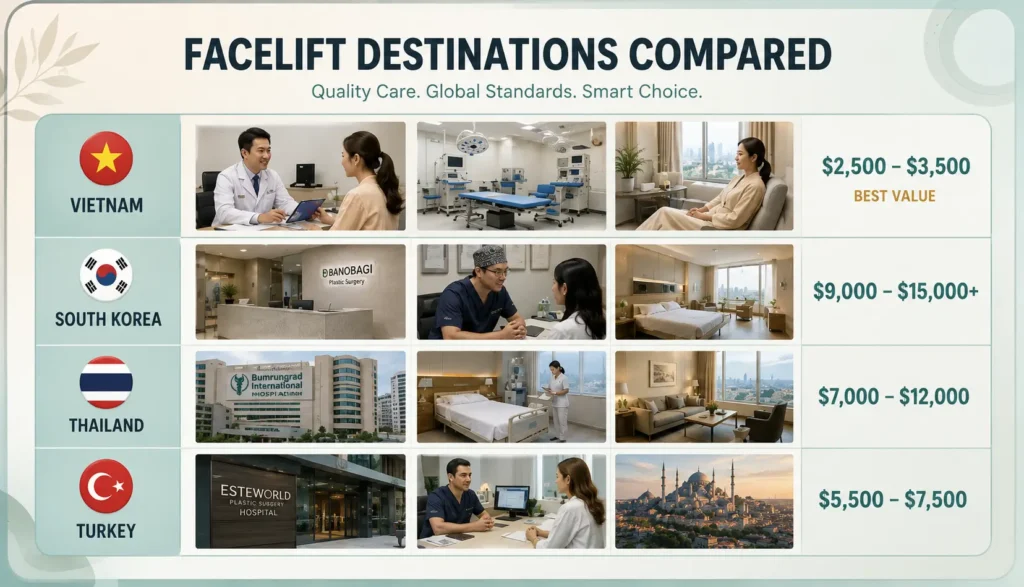
When comparing costs, Vietnam offers a distinct price advantage. A standard deep plane facelift in South Korea typically runs around $9,000–$14,100 (with premium luxury-recovery packages reaching up to $18,000+). In Vietnam, comprehensive deep plane facelift pricing generally falls between $5,000 and $9,000 — delivering a clear 50% to 70% savings compared to Western countries or top-tier Korean clinics, without compromising on surgical rigor.
Where Vietnam pulls ahead is everything surrounding the surgical fee itself. Lower hospital operating costs, government support for medical tourism, and a favorable currency exchange combine to deliver comparable implants, techniques, and safety standards at roughly 40–60% less than Korea or Thailand once total costs are compared. On technique, the gap has also narrowed considerably: Vietnam’s senior facelift surgeons frequently complete fellowship training directly in Seoul before returning home, which means the deep plane methodology taught in Korea is now practiced by many of the same surgeons operating in Hanoi and Ho Chi Minh City.
| Factor | Vietnam | South Korea |
| Deep plane facelift cost | $3,500–$4,500 | $9,000–$14,100 (up to $18,000+) |
| Surgeon specialization depth | Growing; many Korea-trained | Extremely deep; highly sub-specialized |
| Total trip cost (flights + stay) | Generally lower | Generally higher |
| Best suited for | Value-conscious patients wanting Korea-caliber training at lower total cost | Patients prioritizing maximum sub-specialization above all else |
Why Choose Vietnam Over Turkey for a Facelift?
Turkey deserves credit for what it’s built: a large, fast-moving medical tourism industry with genuinely skilled, board-certified surgeons at its better clinics. But it’s also the destination most associated with a specific, well-documented risk pattern that every patient researching facelift options abroad should understand clearly.
The core issue isn’t Turkey as a country — it’s the broker-driven model that dominates a large share of its medical tourism volume. Independent analysis makes the point directly: risk clusters around low-transparency, broker-led systems rather than around any single country. In practice, that means patients booked through high-volume packages sometimes don’t know which surgeon will actually operate on them until they arrive, and CDC medical tourism guidance specifically warns that this model can lead to complications, communication barriers, and real difficulty arranging follow-up care once a patient has flown home.
This isn’t a fringe concern. High-profile cases involving British patients have prompted UK health authorities to issue formal warnings about cosmetic surgery in Turkey, with problems typically traced back to facilities that prioritize cost-cutting over verified surgeon credentials and accreditation. At the same time, it’s fair to note that complication rates at Turkey’s properly JCI-accredited hospitals fall within the same global standard range — roughly 1–3% for serious complications — as accredited facilities anywhere else, which underscores that facility selection matters more than the country label itself.
What this means for you: If you’re evaluating Turkey, you can absolutely find safe, well-credentialed care — but you need to independently verify the operating surgeon’s identity, board certification, and hospital accreditation yourself, rather than trusting a package price alone. Vietnam’s model, by contrast, is built around named, individually
credentialed surgeons and hospital-based (not broker-routed) surgical care from the first consultation.
Surgeon Training and Credentials: How Vietnam Compares
Credentials are the one area where patients most often get misled, because “certified” sounds reassuring regardless of what it actually certifies. It’s worth understanding the real hierarchy before you compare countries at all.
Full board certification in plastic surgery typically requires a three-to-seven-year accredited residency followed by rigorous written and oral examinations, while a “cosmetic surgery certification” can involve a much shorter training period focused on a narrow set of procedures — these are not equivalent credentials, no matter how similar they sound on a clinic website.
In Vietnam, the credentials that actually matter are straightforward to verify: active membership in a recognized body such as the Vietnamese Society of Aesthetic and Plastic Surgery (VSAPS), completed fellowship training abroad in countries like South Korea, the United States, Australia, or Singapore, and confirmed operating privileges at a JCI-accredited hospital. Many of Vietnam’s leading facelift surgeons hold formal qualifications that are internationally authenticated through bodies like the Educational Commission for Foreign Medical Graduates, and a number are actively pursuing recognition through Western regulatory bodies as well.
By comparison, South Korean surgeons are held to certification through the Korean Society of Plastic and Reconstructive Surgeons (KSPRS), with reputable facilities also holding the Korean Accreditation Program for Hospitals Serving International Patients status — a rigorous, well-regulated system. The honest takeaway is that Vietnam, Korea, and accredited Thai facilities all maintain credentialing systems built on the same underlying principle: a genuine surgical residency plus verifiable board membership. Turkey’s system contains the same rigor at its accredited hospitals, but — as covered above — is more vulnerable to being bypassed entirely by broker-routed bookings.
What to verify before booking anywhere:
- The named surgeon’s board certification in plastic surgery specifically — not a general medical license
- Active membership in a recognized national or international surgical society
- Hospital accreditation (JCI or equivalent national gold-standard certification)
- Procedure-specific volume — how many facelifts, specifically, this surgeon performs per year
Which Destination Offers the Best Value for International Patients?
“Value” isn’t just the number on the surgical quote — it’s that number plus flights, plus the hotel nights your recovery actually requires, plus how much hand-holding you get if something feels off on day four. When you weigh all of that together, here’s how the four destinations tend to shake out for a facelift specifically.
| Destination | Strength | Trade-off |
| Vietnam | Best all-in value; Korea-trained surgeons; strong price-to-quality ratio; growing accreditation base | Fewer JCI-accredited facilities than Thailand overall |
| Thailand | Largest hospital infrastructure; most JCI-accredited facilities in the region | Higher total trip cost; longer, more complex travel for many patients |
| South Korea | Deepest technical specialization in advanced facelift methods | Highest total cost among the four; less personalized coordination for smaller clinics |
| Turkey | Very competitive pricing; fast scheduling | Requires careful independent verification due to broker-driven booking risk |
For most international patients coming from the US, Australia, or Canada specifically for a facelift, Vietnam tends to land as the strongest overall balance: technique quality that traces directly back to Korean training, total trip costs that are consistently lower once flights and accommodation are factored in, and a hospital-based, individually credentialed model rather than a broker-routed one.

Frequently Asked Questions (FAQ)
Q1. Is Korea or Thailand better for plastic surgery?
It depends on your goal. South Korea is the top choice for facial procedures (facelifts, rhinoplasty, jawline reshaping) due to its natural results and advanced techniques. Thailand excels in body contouring, breast surgery, and gender affirmation procedures, often at a 20%–30% lower cost.
Q2. Which country is the best for facelift surgery?
South Korea is widely considered the best country for facelift surgery due to its pioneering techniques like the Deep Plane and SMAS facelifts. The United States offers top-tier expertise at a much higher price, while Thailand and Vietnam provide high-quality, budget-friendly alternatives.
Q3. Is Vietnam good for face lifts?
Yes. Vietnam is a highly capable destination for facelifts, featuring board-certified plastic surgeons—many trained in Korea or France—and modern accredited facilities. Costs in Vietnam are 50% to 70% lower than in Western countries or Korea.
Q4. Where is the cheapest place in the world to get a facelift?
The most affordable countries for a facelift are Turkey, Mexico, Vietnam, and Thailand, where prices range from $2,500 to $6,000 USD (compared to $12,000–$25,000+ in the US). Always prioritize surgeon qualifications over low prices to ensure safety.
Q5. What is the average cost of a facelift in Korea?
The average cost of a facelift in South Korea ranges from $6,000 to $15,000 USD. A Mini Facelift costs around $4,000–$7,000, while a comprehensive Deep Plane or Full Facelift ranges from $10,000 to $18,000+.
