



By the time a patient reaches out to me about a facelift, the surgery itself is rarely what worries them most. What keeps them up at night is everything around it: which visa to apply for, how many days to block off work, whether it’s safe to fly home with stitches still healing, and whether they’ll be navigating a foreign hospital corridor alone. After guiding hundreds of international patients through this exact process, I’ve put together the travel playbook I wish every patient had before they booked their flight.
Do You Need a Special Visa for Medical Treatment in Vietnam?
No. There is no separate “medical visa” category for cosmetic surgery patients coming to Vietnam. A standard tourist entry is what covers your facelift, your consultations, and your recovery period — the same paperwork you’d use for a holiday.
What that entry looks like depends on your passport:
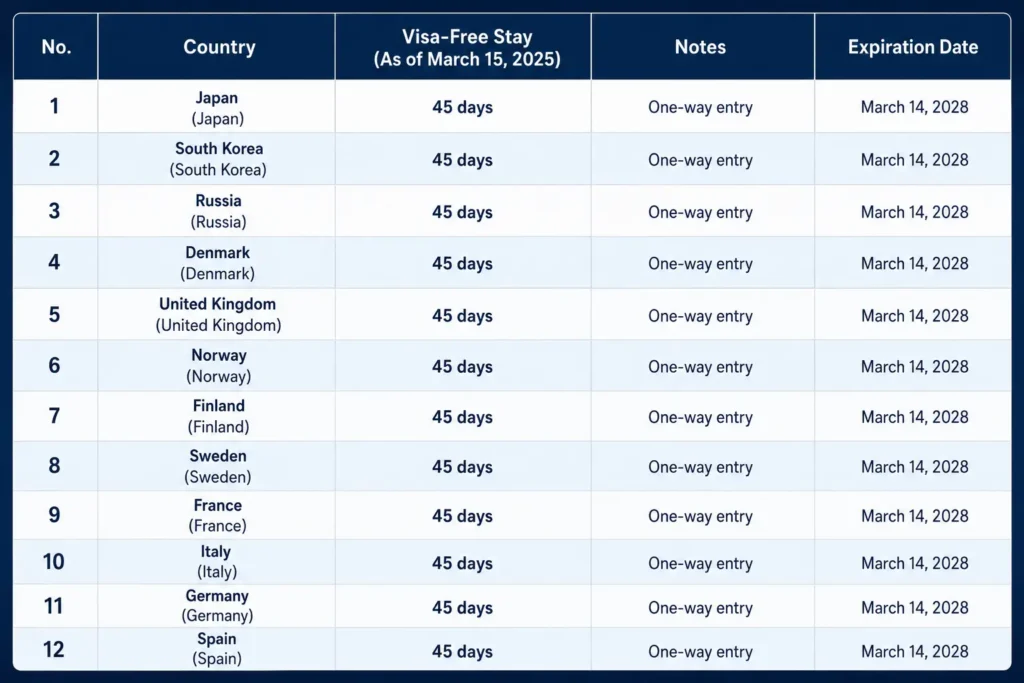
- Visa-exempt countries: Citizens of the UK, Sweden, Germany, and Italy can enter Vietnam visa-free for stays of up to 45 days, which is usually enough to cover the entire surgery-and-recovery window without any application at all.
- E-visa eligible countries: Most other nationalities, including the US, Canada, and Australia, apply online for an e-visa before departure. The e-visa permits a single entry and is typically valid for 30 days, and Vietnamese immigration authorities process applications through the official government portal.
- Extensions: If your recovery runs longer than expected, tourist visas can generally be extended by an additional 15 to 30 days through a local visa service or immigration office.
My advice: Apply for your e-visa at least two to three weeks before your travel date. Requirements shift periodically, so I always tell patients to verify the current rules for their specific nationality on Vietnam’s official immigration portal rather than relying on older blog posts — including this one, months from now.
Our patient coordination team at Metropole Clinic can also send you an invitation letter confirming your surgery date, which some patients like to keep on hand alongside their visa documents, even though Vietnamese immigration does not require it for tourist-category entry.
How Long Should You Stay in Vietnam After a Facelift?
This is the question I get asked in almost every consultation call, and the honest answer is: it depends on how conservative you want to be, but I never advise cutting it close.
For a standard facelift, I ask patients to plan on a minimum of 10 to 14 days in Vietnam after surgery. That window covers:
- The first 48 to 72 hours, when swelling and bruising peak and you’ll want to be near your surgical team, not in transit.
- Suture or staple removal, which for most facelift techniques happens between day 7 and day 12.
- A follow-up examination to confirm your incisions are healing cleanly and there’s no early sign of complication before you get on a long-haul flight.
If your procedure is combined with blepharoplasty, a neck lift, or fat transfer, or if you’re traveling from a country with a 20+ hour flight home, I generally recommend padding that timeline to 14-18 days. Patients coming from Australia or the West Coast of the US have more flexibility here since the flights are shorter; those coming from Europe often benefit from the extra buffer.
Rule of thumb I give my patients: Book your return flight only after your first post-operative follow-up confirms healing is on track — not before. A refundable or flexible-date ticket is worth the small extra cost.
Hanoi vs. Ho Chi Minh City: Which Is Better for Facelift Surgery?
Both cities have internationally connected airports and English-speaking medical staff at reputable facilities, so this decision usually comes down to logistics rather than surgical quality.
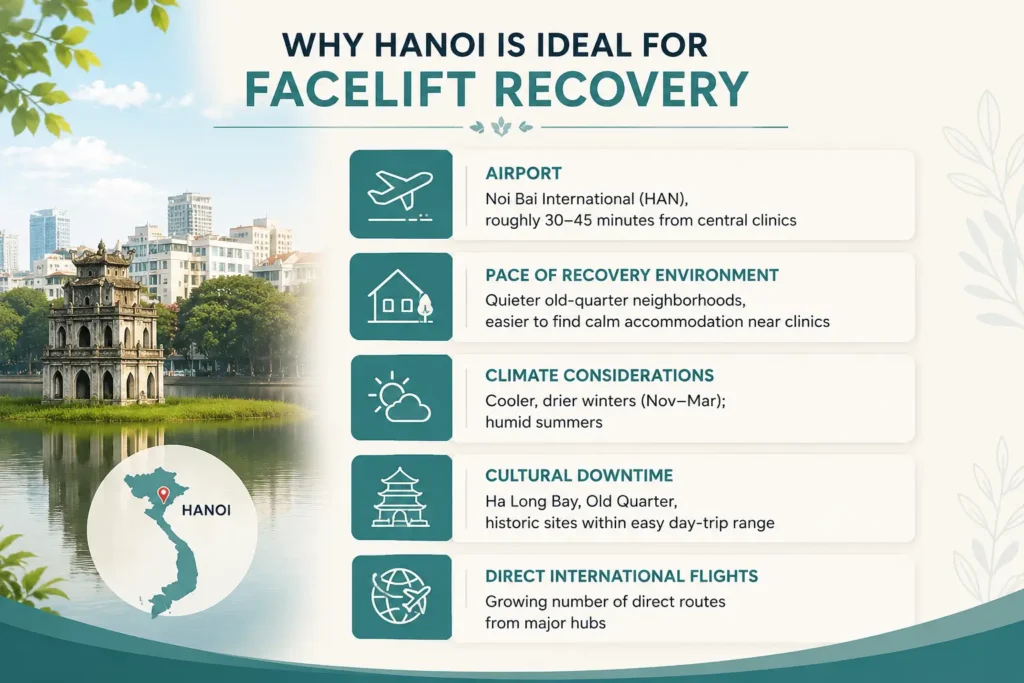
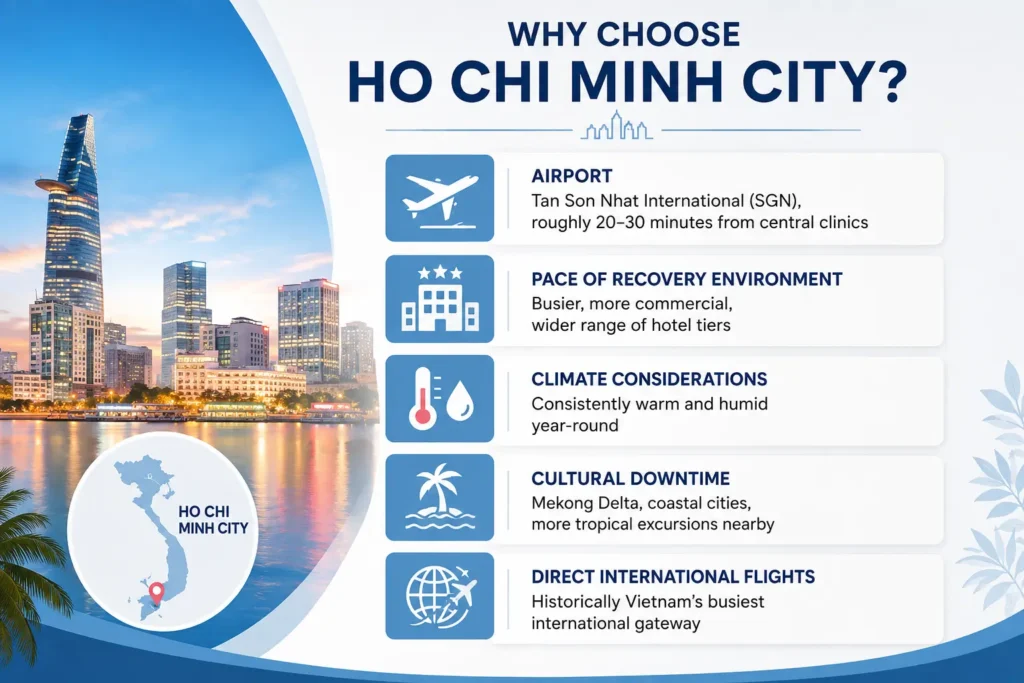
| Factor | Hanoi | Ho Chi Minh City |
| Airport | Noi Bai International (HAN), roughly 30-45 minutes from central clinics | Tan Son Nhat International (SGN), roughly 20-30 minutes from central clinics |
| Pace of recovery environment | Quieter old-quarter neighborhoods, easier to find calm accommodation near clinics | Busier, more commercial, wider range of hotel tiers |
| Climate considerations | Cooler, drier winters (Nov-Mar); humid summers | Consistently warm and humid year-round |
| Cultural downtime | Ha Long Bay, Old Quarter, historic sites within easy day-trip range | Mekong Delta, coastal cities, more tropical excursions nearby |
| Direct international flights | Growing number of direct routes from major hubs | Historically Vietnam’s busiest international gateway |
I’m based in Hanoi, so I’ll be transparent about my bias: I think the city’s cooler climate is genuinely kinder to facial swelling in the first week than Ho Chi Minh City’s year-round heat and humidity, which can make compression garments and dressings more uncomfortable. The quieter pace of the Old Quarter and West Lake areas also tends to suit patients who want to rest without the sensory overload of a larger commercial hub. That said, both cities are well-equipped for medical travelers, and the right choice often comes down to which surgeon and clinic you trust most, not the city itself.
Is It Safe to Fly Home Right After Surgery?
Flying too soon after a facelift is one of the few things I will actively delay a patient’s travel plans over. Here’s why.
Blood clot risk after surgery tends to peak between roughly the fifth and fourteenth day post-operation, and long periods of sitting on a plane compound that risk by slowing circulation in the legs. Facelift surgery adds a second layer of concern: cabin pressure changes and prolonged upright sitting can aggravate facial swelling, and blood pressure spikes from travel stress or lifting luggage can raise the risk of a hematoma while incisions are still fresh.
Most surgeons, myself included, will not clear a facelift patient for a long-haul flight before the two-week mark, and I evaluate every case individually based on:
- How your swelling and bruising are tracking at the one-week follow-up
- Whether your sutures or staples have been removed and the incision lines are stable
- Your personal clotting risk factors, including age, BMI, smoking history, and any prior history of DVT
- The length of your flight home
In-flight precautions I recommend to every patient: wear your prescribed compression garment, get up and walk the cabin every 60-90 minutes if you’re able, stay well hydrated since cabin air is notably dry, and keep your head elevated and supported to limit swelling. If your itinerary allows it, a window seat with something to lean against makes a real difference in comfort.
If anything about your recovery looks even slightly off at the pre-departure check — unusual swelling on one side, a low-grade fever, or a wound that hasn’t closed as expected — I will ask you to postpone your flight rather than risk complications in the air.
Can Someone Accompany You During Recovery?
Yes, and for most facelift patients I actively encourage it. While a companion isn’t a medical requirement for every cosmetic procedure, a responsible adult is commonly recommended after anesthesia, sedation, or surgery that may temporarily affect balance, alertness, or decision-making — all of which apply in the first 24-48 hours after a facelift.
A travel companion for this trip typically helps with:
- Communicating with hotel staff, taxis, and pharmacies while you’re still groggy from anesthesia
- Managing your medication schedule and cold compress routine in the first few days
- Handling logistics — airport transfers, luggage, check-ins — that you shouldn’t be lifting or navigating solo
- Simply being a familiar, reassuring presence in an unfamiliar country during a physically and emotionally vulnerable stretch
If traveling with a spouse, adult child, or close friend isn’t possible, Metropole Clinic can arrange a local patient care coordinator to check in on you during the early recovery days, help with transport to follow-up appointments, and act as a translator if needed. I still recommend having at least one person reachable by phone around the clock for the first 72 hours, wherever they happen to be in the world.
What to Pack for Facelift Recovery Abroad
Beyond the obvious — passport, e-visa confirmation, and travel insurance documents — here’s what I tell patients to pack specifically for the recovery side of the trip:
Medical & Comfort Essentials
- A copy of your surgical plan, discharge instructions, and Metropole Clinic’s 24-hour contact number, kept in your carry-on
- Any prescribed compression garments or chin straps
- Loose, front-zip or button-down tops that don’t need to be pulled over your head
- A travel pillow that supports the neck without pressing on the jawline or ears
- Sunglasses and a wide-brim hat to protect healing skin and reduce the urge to squint
- Fragrance-free, surgeon-approved skincare rather than whatever you’d normally pack for a holiday
Practical Items
- A phone charger and universal adapter, kept accessible for the flight and taxi rides
- A printed or digital copy of your passport, insurance policy, and travel documents stored separately from the originals
- A basic thermometer, useful for monitoring low-grade fever in the first week
- Extra face masks if you’re self-conscious about bruising during transit — entirely optional, purely for your own comfort
What to leave at home: alcohol, aspirin or other blood-thinning supplements, tight turtlenecks or pullover clothing, and an overly packed sightseeing itinerary for the first week. Recovery, not tourism, should own that first stretch of the trip.
Frequently Asked Questions
Q1. Is Vietnam a good place to get a facelift?
Answer: Yes, Vietnam has become a top-tier destination for medical tourism, especially for facial rejuvenation surgery. The country offers international-standard hospitals, highly skilled board-certified plastic surgeons trained globally, and cutting-edge surgical technologies. Additionally, the medical costs are significantly lower than in Western countries, allowing international patients to receive premium care and a comfortable recovery experience at a fraction of the price.
Q2. How much does a facelift typically cost in Vietnam?
Answer: The cost of a facelift in Vietnam generally ranges from $2,500 to $4,000 USD, depending on the complexity of the procedure (e.g., mini facelift, full traditional facelift, or deep plane facelift) and the clinic’s reputation. This is roughly 60% to 70% more affordable than in the US, Australia, or Europe, where the same procedure can cost between $12,000 and $25,000 USD, without compromising on medical safety or aesthetic quality.
Q3. Can I stay in Vietnam for 3 months?
Answer: Yes, international tourists can legally stay in Vietnam for up to 3 months (90 days) by applying for an e-visa (electronic visa), which now grants single or multiple entries for up to 90 days for citizens of all countries. This 3-month window is ideal for medical tourists, providing ample time for the surgery, initial healing, mandatory post-op follow-ups, and a relaxing vacation before flying home.
Q4. Where can I get a deep plane face lift in Vietnam?
Answer: To safely undergo a deep plane facelift, you should look for specialized aesthetic hospitals or premium plastic surgery clinics licensed by the Ministry of Health, primarily located in major medical hubs like Ho Chi Minh City or Hanoi. Ensure the facility features advanced operating rooms, transparent recovery protocols, and international board-certified surgeons who possess proven expertise in releasing facial ligaments and repositioning the deep SMAS layer.
Q5. How long will a deep plane face lift last?
Answer: A deep plane facelift is the longest-lasting facial rejuvenation method available, typically delivering natural-looking results that endure for 10 to 15 years. Because the surgeon repositions the deeper muscle layers (SMAS) and releases retaining ligaments rather than just pulling the skin, the facial structure ages much more gracefully compared to traditional facelift techniques.
