


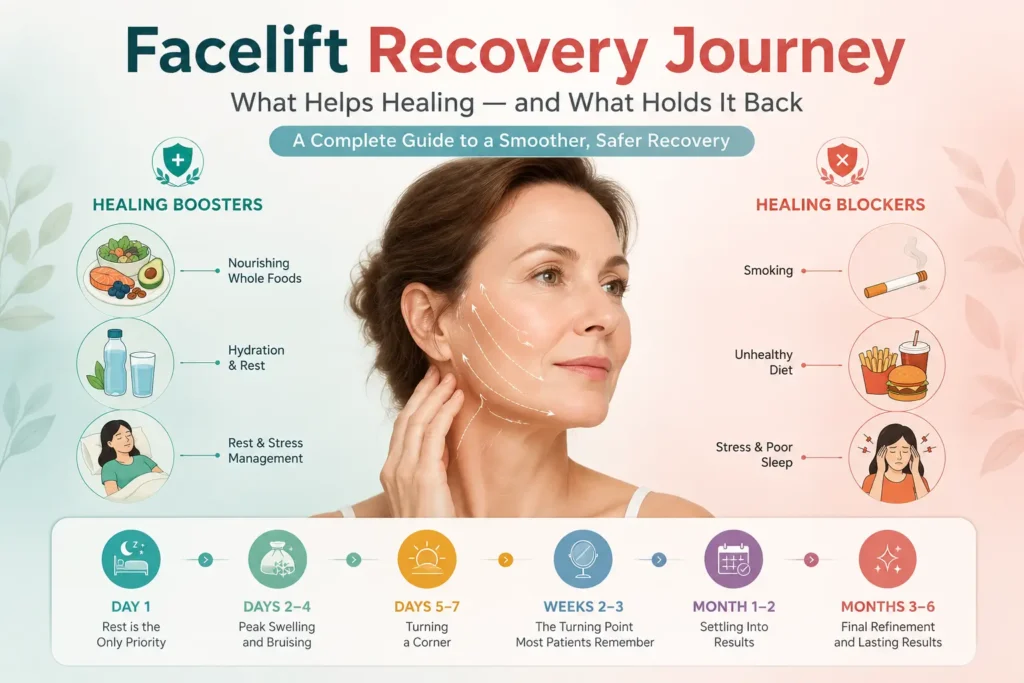
As a facial plastic surgeon, one of the most common questions I hear before any procedure is not “what will I look like?” — it’s “how long will recovery take?” That question matters just as much as the surgery itself. Understanding your recovery timeline removes uncertainty, helps you plan realistically, and ultimately leads to a smoother healing experience.
This guide walks you through what actually happens in your body from the moment you leave the operating room through your six-month milestone. Whether you are still in the research phase or already have a date scheduled, knowing these stages in advance puts you in a far stronger position.
How Facelift Recovery Actually Works
Recovery does not happen in a straight line. It unfolds in overlapping phases — inflammation, tissue remodeling, and gradual refinement — each with its own set of sensations and visible changes. What looks dramatic in week one often resolves significantly by week three. What feels permanent at six weeks typically continues to refine for months.
Several factors influence how your individual recovery unfolds: your age, skin elasticity, overall health, the surgical technique used (a deep-plane approach involves more tissue work than a mini facelift), and whether you combined procedures such as eyelid surgery or a neck lift. That said, the general trajectory is predictable, and most patients move through the same milestones.
.
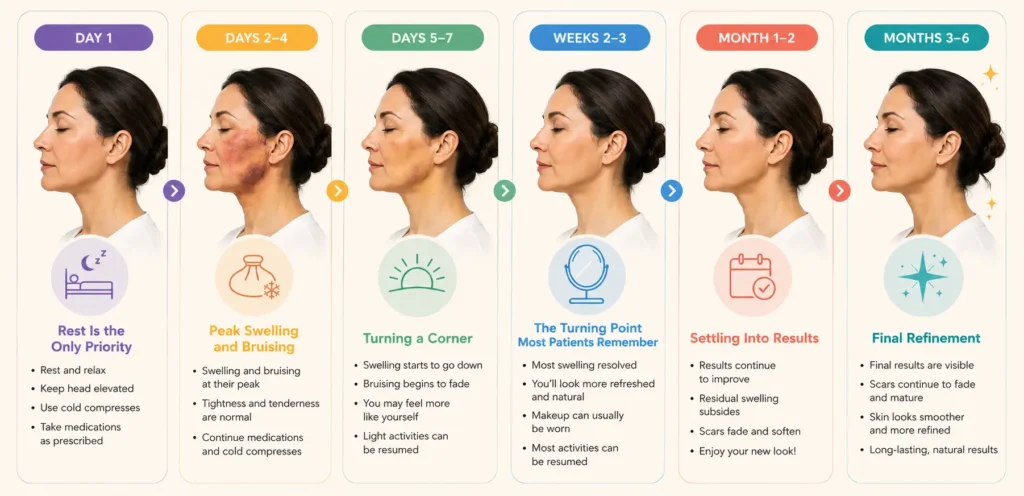
Day 1: Rest Is the Only Priority
The day of surgery is straightforward. You will feel groggy and unsteady from anesthesia, and you will need someone to drive you home and stay with you through the first night. This is not optional — it is essential.
Expect bandages to be in place around your face and neck. These support newly repositioned tissues and help contain early swelling. Some drains may be placed under the skin to remove excess fluid; these are typically removed at your follow-up visit within the first day or two.
Pain on day one is typically well managed with prescribed medication. Most patients describe the predominant sensation as tightness and pressure rather than sharp pain. Take your medication as directed, keep your head elevated on two to three pillows at approximately a 45-degree angle, and focus entirely on rest. This is the day when pain medication is needed most.
Days 2–4: Peak Swelling and Bruising
Your surgeon will schedule a follow-up visit around day two to check your incisions, remove any drains, and change your dressings. If you look in the mirror during these days, prepare yourself — this is typically the lowest point visually.
Swelling and bruising peak between days three and four. The face may feel heavy, tight, and look unfamiliar. It will be difficult to open your mouth wide or rotate your neck fully. Some patients experience nausea, either from anesthesia or from pain medication. Approximately 70–80% of patients experience some degree of bruising, which tends to concentrate around the mid-face, jaw, and neck.
This is the stage where the most important thing you can do is apply cold compresses for 15–20 minutes at a time (never ice directly on skin), avoid mirrors if they cause you distress, and rest. Swelling at this stage is not a sign that something went wrong — it is your body mobilizing healing factors to the surgical area.
Days 5–7: Turning a Corner
By the end of the first week, swelling begins to descend with gravity, which can temporarily create the appearance of a double chin — this resolves as healing progresses. Sutures are typically removed somewhere between days seven and ten, depending on your specific procedure and healing progress. Most patients find suture removal to be painless.
Your surgical dressings may be replaced with a lighter compression garment or facial sling, worn continuously to support healing tissues and minimize swelling. You may be able to shower and wash your hair once dressings are removed — use lukewarm water (heat worsens swelling) and pat the face dry gently rather than rubbing.
Prescription pain medication is usually no longer necessary by the end of week one. Most patients transition to over-the-counter options or need nothing at all.
Weeks 2–3: The Turning Point Most Patients Remember
Week two brings daily, visible improvement. Bruising begins to change color and fade. Swelling continues to descend and decrease. Many patients describe this period as when they first start to feel like themselves again.
By day 10 to 14, many patients are comfortable returning to light desk work and short walks outside. This is also typically when light makeup — mineral-based formulas are gentlest — can be applied over healing incision areas, provided your surgeon has confirmed the skin is sufficiently closed.
You may notice tingling, occasional pins and needles, or patchiness of sensation in areas around your ears, jaw, or cheeks. These sensations reflect nerve recovery in progress, not damage. New blood vessels are also forming to nourish repositioned skin, which can create temporary discoloration in front of and behind the ears. It resolves on its own.
Strenuous exercise remains off the table through week three. Activities that elevate blood pressure — bending over, heavy lifting, anything intense — increase the risk of swelling setback and should be avoided. Light walking, however, is encouraged throughout recovery as it supports circulation and mood.
At the three-week mark, approximately 80% of visible swelling has typically resolved. What remains is subtle and often functions like strategically placed natural volume — many patients actually prefer how they look at this stage compared to what they expected.
Month 1–2: Settling Into Results
By the end of the first month, the majority of people would not know you had a procedure. Incision lines carry a pinkish hue that continues to fade. Some residual tightness, mild numbness, or firmness in deeper tissues is entirely normal and continues to improve.
At around six to eight weeks post-surgery, skin and underlying muscles begin to stabilize, giving you a more accurate preview of your lasting results. This is also the point when you can typically resume more vigorous physical activity — though always follow your surgeon’s specific guidance, as timelines vary based on the scope of your procedure.
Numbness deserves special mention here. The sensory nerves most affected run from the jawline toward the ear and supply sensation to the earlobe, neck, and cheeks. These nerves regenerate at roughly 1 mm per day. Cheeks and temples are usually first to recover (two to four weeks), the jaw and jowl area follows (four to eight weeks), and sensation behind the ears and in the neck returns last, sometimes taking up to three months or longer. For most patients, full sensation is restored within six to twelve months. Permanent numbness is rare.
Months 3–6: Final Refinement
At three months, most patients report feeling fully back to normal in their daily lives. Incision scars are softening and fading. Deeper tissues continue to remodel beneath the surface, and swelling that was invisible to others but perceptible to you has largely resolved.
By month six, your results are essentially final. The lifted contours of your jawline, cheeks, and neck have settled into their new position. The refreshed, natural appearance that was the goal of surgery is now visible in full — not the tight, pulled look people worry about, but a version of your face that looks rested, balanced, and age-appropriate.
It is worth noting: a facelift does not freeze your appearance. You will continue to age, but studies and clinical experience consistently show that patients maintain a five-to-ten-year advantage in visible aging compared to where they would have been without the procedure.
Managing Specific Symptoms: A Practical Reference
| Symptom | Recommended Actions (Dos) | Precautions (Don’ts) |
| Swelling | Keep your head elevated at a 45° angle during sleep for 2–3 weeks. Use cold compresses only for the first 48 hours. | Avoid sodium, alcohol, and heat sources like saunas or hot showers aimed at the face for at least one month. |
| Bruising | Allow bruising to resolve naturally. It typically peaks between days 3 and 4 before fading. | Do not take blood-thinning supplements (Fish Oil, Vitamin E, Aspirin) unless prescribed. Never massage bruised areas without approval. |
| Pain | Take prescribed medications as directed. Medicate at the onset of discomfort rather than waiting for it to become severe. | Do not adjust your dosage or skip scheduled doses during the first 48–72 hours. |
| Numbness | Expect temporary tingling or numbness; this is a normal sign of nerve regeneration. | Do not aggressively stimulate or massage numb areas unless specifically instructed by your surgeon. |
| Incision Care | Keep sites clean and dry. Use silicone scar gels once incisions are fully closed to help them flatten and fade. | Avoid direct sun exposure for several months. UV rays can permanently darken healing scars. |
| Sleeping Position | Sleep strictly on your back with your head elevated for at least the first 2–3 weeks. | Do not sleep on your side, as this shifts facial tissues and puts unnecessary pressure on incisions. |
What Can Extend Your Recovery
Combining your facelift with additional procedures — eyelid surgery, a brow lift, fat grafting — extends the scope of tissue work and may add one to two weeks of visible downtime. This does not mean the results are worse; it simply means the body has more to heal simultaneously.
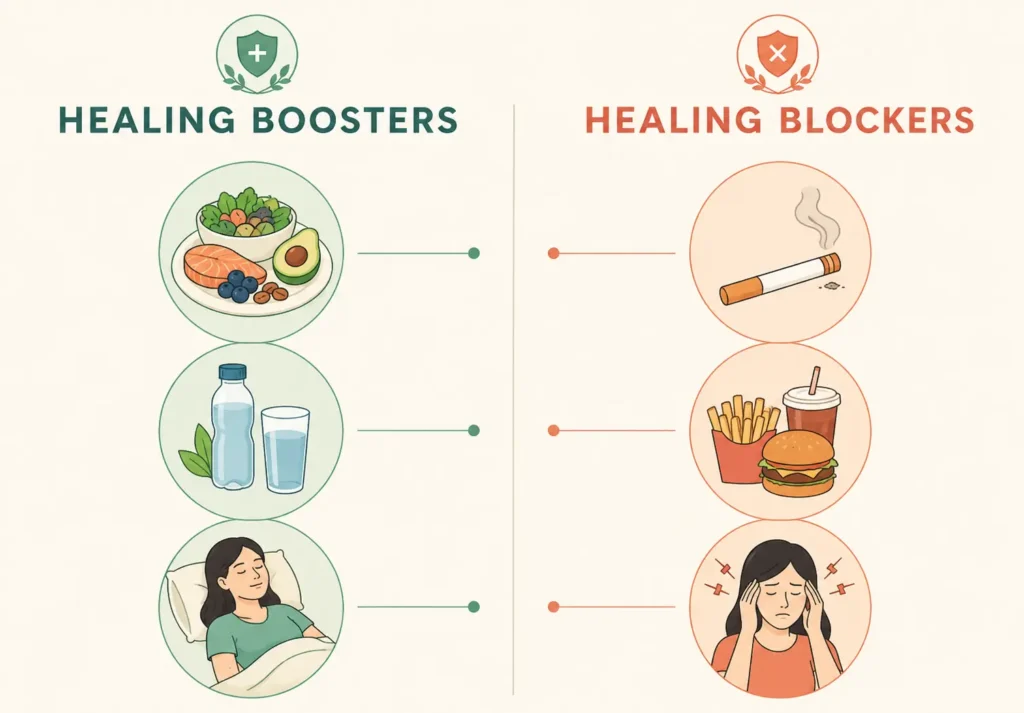
Smoking is the single most significant factor that delays healing and increases complication risk. Nicotine constricts blood vessels, limiting oxygen delivery to healing tissues and dramatically increasing the risk of skin complications. At ABmedi Team Clinic, we advise patients to stop smoking for a minimum of several weeks before and after surgery — not as a preference, but as a medical requirement for safe outcomes.
Stress, poor nutrition, dehydration, and disrupted sleep all slow the healing process. The weeks around your surgery are a period to prioritize your body. Protein-rich foods, plenty of water, and consistent rest are not optional extras — they are recovery tools.
Warning Signs to Watch For
Most recoveries are uneventful, but certain symptoms warrant immediate contact with your surgical team:
- Sudden, rapid increase in swelling on one side
- Pain that is intensifying rather than improving after day four
- Signs of infection: increasing redness, warmth, or foul-smelling discharge from incisions
- Spreading bruising that appears to be expanding
- Fever above 38°C / 100.4°F
These are not common, but recognizing them early allows for prompt intervention before minor issues become significant ones. Your surgeon’s team should always be reachable during your recovery period — do not hesitate to call.
The Bottom Line
Recovery from a facelift is manageable, predictable, and — for the vast majority of patients — far less difficult than anticipated. The first week looks worse than it feels. The second week looks better than it feels. By the third week, most patients wish they had done it sooner.
The key variables in your experience: choosing an experienced, board-certified surgeon who takes time to explain the process; following post-operative instructions precisely; and giving your body the rest and nutrition it needs to heal. At ABmedi Team Clinic, every patient receives a tailored recovery protocol and continuous follow-up throughout the healing process, because we understand that the surgery is only the beginning.
If you are considering a facelift and would like to discuss what your individual recovery might look like, we invite you to schedule a consultation. Understanding your unique anatomy, health history, and aesthetic goals allows us to give you a realistic and personalized picture of what to expect — before, during, and well after surgery.
Frequently Asked Questions (FAQs)
Q1: How long does it take for your face to feel normal after a facelift?
While you will look fantastic, presentable, and “camera-ready” by Week 3 or 4, it typically takes 6 months to a full year for your face to feel completely normal structurally. By Month 6, the deep muscular adjustments have fully anchored into place, internal tissue layers have softened, and sensory nerves have fully regenerated, removing any remaining tightness, firmness, or subtle numbness.
Q2: What are the worst days of a facelift?
The first 48 to 72 hours (Days 1–3) are the most uncomfortable days of a facelift recovery. During this phase, swelling and bruising peak rapidly, which causes a feeling of deep facial tightness, congestion, and mild throbbing. This is a normal inflammatory response, and the discomfort begins to ease noticeably by Day 4 as fluids start to drain.
Q3: What to expect 4 weeks after a facelift?
At 4 weeks post-facelift, you are past the major hurdles of recovery. You can expect:
- The vast majority of visible swelling and bruising to have cleared, making your results look highly presentable.
- Incisions will look like clean, closed, thin pink lines that can be easily hidden with light makeup or hair styling.
- You can safely resume normal work, social outings, and light exercise.
- A feeling of mild residual firmness or subtle numbness along the jawline and ears is still completely normal.
Q4: Why is my face still swollen 4 weeks after a facelift?
Seeing residual swelling at 4 weeks is a normal, expected part of deep-tissue healing. While major fluid retention drops dramatically by Week 2, micro-swelling within the deeper muscular layers takes several months to completely resolve. Swelling can also appear slightly asymmetrical (one side flattening faster than the other), which is a common occurrence and will balance out naturally over time.
Q5: Does walking help swelling after a facelift?
Yes, gentle walking is highly effective for reducing post-op swelling. Taking short 10-minute strolls around the house starting on Day 2 or 3 stimulates your blood circulation and activates your lymphatic system, helping your body process and flush out trapped surgical fluids. Ensure your pacing is relaxed; heavy cardio or power walking will raise your blood pressure, which can worsen swelling or cause bleeding.
Q6: What drink reduces face swelling?
Pure water is the single best drink to reduce facial swelling, as proper hydration prevents your body from holding onto fluid reserves. You can also integrate fresh pineapple juice (which contains Bromelain, a natural enzyme that accelerates the clearance of swelling and bruises) and organic green tea (rich in anti-inflammatory antioxidants). Avoid high-sodium sports drinks, sugary sodas, and alcohol, as they cause fluid retention.
📞 💬 WhatsApp / Chat: [http://wa.me/84975142666] 🌐 Book online: [+84-975-142-666]
Consultations are available in-clinic and online for international patients. Most patients leave their first appointment knowing exactly what they need — and feeling confident about the path ahead.
