


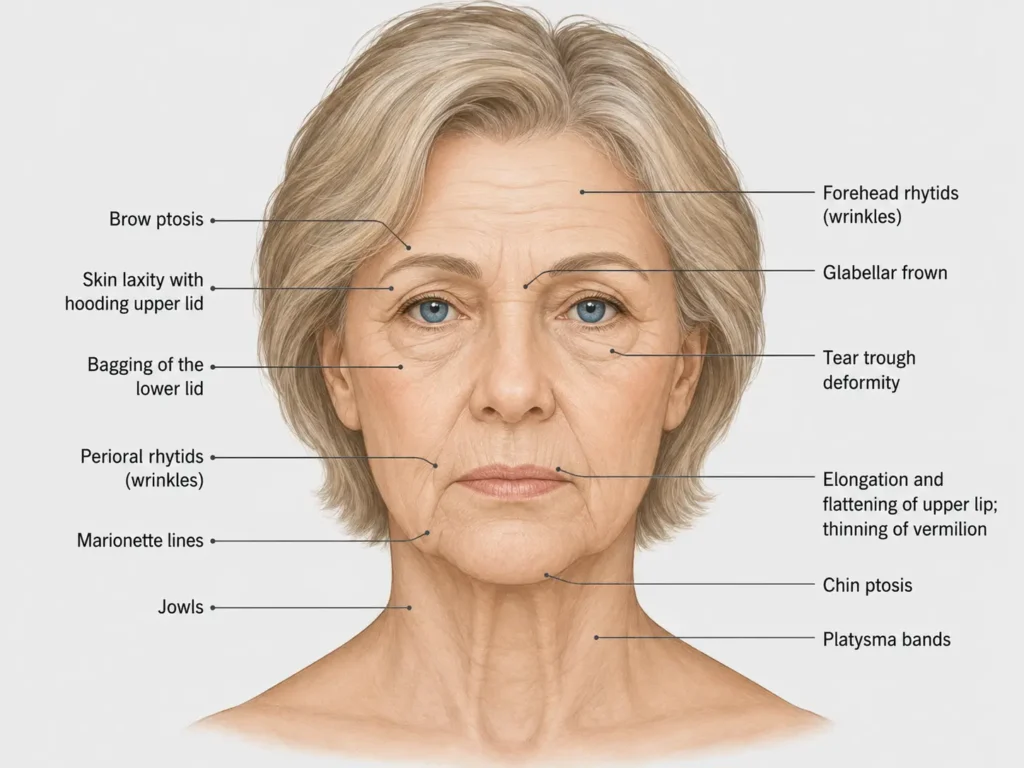
If you’ve started noticing a soft, rounded blur where your jawline used to be crisp, or vertical bands pulling at the front of your neck when you look in the mirror, you’re not imagining things — and you’re far from alone. Jowls and “turkey neck” are among the most common concerns I hear during consultations, and they tend to bother people more than almost any other sign of facial aging. The good news is that we understand exactly why they happen, and surgical solutions today are more refined, more natural-looking, and longer-lasting than ever before.
Why the Lower Face and Neck Age the Way They Do
Facial aging isn’t simply a skin problem. Beneath the surface, several structural changes happen at once:
The SMAS descends. The SMAS (Superficial Musculoaponeurotic System) is a fibromuscular layer sitting just below the skin. As it loses tone, the cheek fat pads shift downward, pooling along the jawline and creating what we call jowls. No amount of skincare or injectable treatment can reposition this layer — it requires surgical intervention.
Retaining ligaments stretch. Specific ligaments — the zygomatic and mandibular retaining ligaments — act like anchor points that hold facial tissue in position. When these loosen over time, tissue descent accelerates and the pre-jowl sulcus (the indentation just inside the jowl) becomes more visible.
The platysma separates. The platysma is a thin, flat muscle that runs from the collarbone all the way up through the neck and onto the lower face. With age, its inner edges pull apart, creating the visible vertical cords commonly called platysmal bands — the defining feature of a “turkey neck.” Once this separation occurs, the muscle also no longer supports the overlying skin, contributing to horizontal neck creases and overall cervical laxity.
Submental fat accumulates. Fat beneath the chin — the submental area — tends to increase with age or weight fluctuation, blurring the cervicomental angle (the sharp angle between the chin and neck) and contributing to a double-chin appearance.
Understanding this anatomy is essential for planning treatment. At ABmedi Team Clinic, every consultation begins with a detailed assessment of which anatomical layers are involved, because that determines the most appropriate procedure.
What’s the Difference: Neck Lift vs. Lower Facelift?
Patients frequently come to me wondering whether they need a “neck lift” or a “facelift.” These terms are often used interchangeably, but they address different anatomical zones. Here’s how they compare:
| Neck Lift (Cervicoplasty / Platysmaplasty) | Lower Facelift | Combined Procedure | |
| Primary Target | Neck only | Lower third of the face | Full lower face + neck |
| Addresses Jowls | ✗ Not reliably | ✓ Yes | ✓ Yes |
| Addresses Neck Bands | ✓ Yes | Partially | ✓ Yes |
| Addresses Submental Fat | ✓ With liposuction | Partially | ✓ Yes |
| Incision Location | Behind ears + under chin | In front of ear, into hairline | Both |
| Best For | Isolated neck laxity, banding, double chin | Jowls, mandibular line definition | Moderate–significant laxity in both zones |
| Result Longevity | 5–10 years | 7–12 years | 7–15 years (deep plane) |
The combined lower facelift and neck lift is the most comprehensive solution, and in most cases, it delivers the most balanced, harmonious result. Both the face and neck age as a connected anatomical unit — treating them together avoids the visual mismatch of a tightened neck attached to a jowl-heavy jawline. At ABmedi Team Clinic, we most commonly recommend this combined approach for patients with moderate to significant laxity in both zones.
The Surgical Techniques We Use
SMAS Manipulation and Deep Plane Dissection
The critical difference between a surface-level lift and a durable result lies in how the deeper tissues are handled. Traditional skin-only tightening produces that characteristic “pulled” look — and it doesn’t last. Our approach involves working at the level of the SMAS or deeper.
In deep plane dissection, a composite flap of skin and underlying fascia is elevated together. This improves the blood supply to the flap, allows direct release of the key retaining ligaments, and repositions the descended malar and jowl fat pads without placing tension on the skin. The result is a natural appearance — not tight, not windswept — and significantly longer-lasting correction compared to more superficial techniques.
Platysmaplasty
When platysmal bands are present, the platysma muscle must be directly addressed. Through a small, well-hidden incision beneath the chin, the separated medial borders of the muscle are sutured back together — a procedure known as corset platysmaplasty. This restores the midline support of the neck, softens the banding, and re-establishes a clean submental angle.
For patients with horizontal platysmal redundancy, lateral platysma repositioning — suturing the muscle to the periauricular fascia — is added as a complement to the midline repair. When deep-neck fullness from subplatysmal fat or prominent digastric muscles is contributing to the problem, these are addressed at the same time.
Neck Liposuction
Where submental fat is contributing to a double chin, targeted liposuction is performed through the same submental incision. Careful fat sculpting here defines the cervicomental angle and creates visible cervical contour that is otherwise impossible to achieve non-surgically in patients with true submental lipodystrophy.
Incision Design and Scar Concealment
A common concern before surgery is visible scarring. In experienced hands, facelift and neck lift incisions are planned very deliberately: in front of the ear (within the natural contour of the tragus), behind the earlobe, and along the hairline in the temple — all positions where healed scars are essentially invisible within a few months. The submental incision for platysmaplasty is placed in the natural chin-neck crease, where it disappears once healed.
Are You a Good Candidate?
Patients who typically benefit most from this combined procedure:
- Notice significant loss of jawline definition with jowling along the mandibular border
- Have visible vertical neck bands (platysmal bands) at rest
- Have submental fullness or a double chin that doesn’t respond to diet or exercise
- Have skin laxity along the neck that has progressed beyond what non-surgical treatments can address
- Are in good general health, non-smokers (or willing to stop several weeks before and after surgery), and have realistic expectations
If your concerns are mild and skin elasticity is still good, non-surgical options — radiofrequency tightening, HIFU, or Botox into the platysma — may be worth exploring first. But it’s important to be realistic: these treatments can offer modest improvement and are best suited for maintenance or early-stage laxity. They do not reposition the SMAS, cannot release retaining ligaments, and cannot directly correct platysmal banding or significant jowling.
Recovery Timeline: What to Expect After Surgery.
Recovery from a combined lower facelift and neck lift typically follows this timeline:
- Week 1: Swelling and bruising are at their peak. Most patients wear a light compression garment. Activity is limited to gentle walking.
- Weeks 2–3: Bruising resolves significantly. Social presentability returns for most patients around the 2-week mark, though some swelling persists.
- Months 1–3: Residual swelling continues to settle. The jawline definition becomes progressively clearer.
- Final result: Fully visible at 3–6 months. SMAS-based facelifts typically maintain results for 7–12 years; deep plane techniques may extend this to 15 years or more.
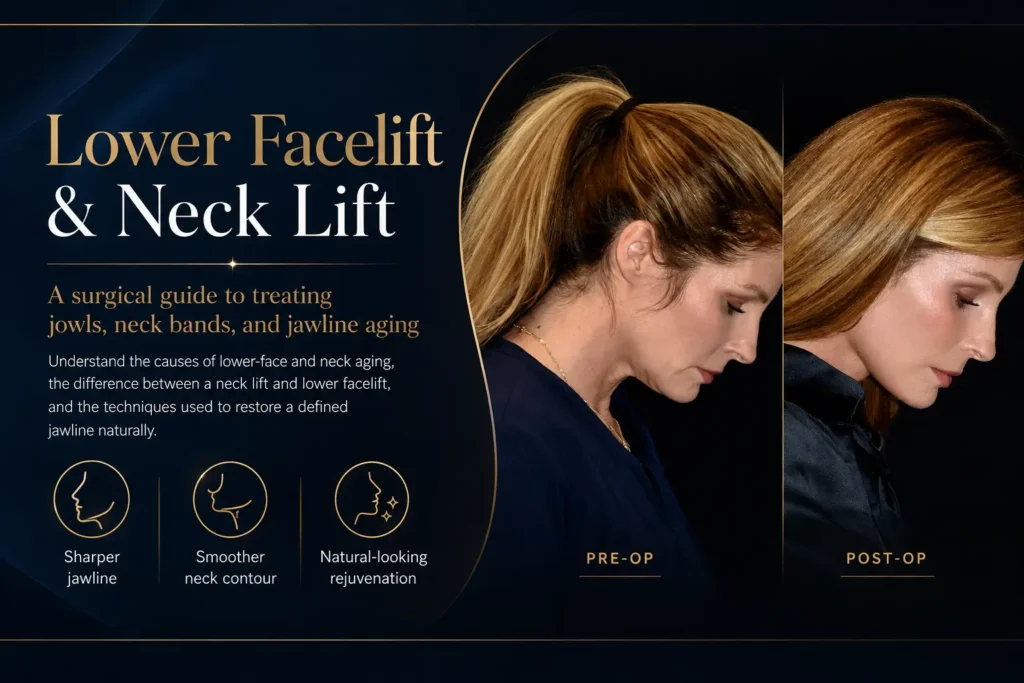
What you’ll see is a rejuvenated version of yourself — not a different person. The goal at ABmedi Team Clinic is never an “operated” appearance. Our surgical philosophy is to restore what time has displaced, not to fabricate something that was never there.
Frequently Asked Questions
Will a neck lift fix my jowls? Not reliably. A neck lift improves neck bands, submental fat, and cervical skin laxity, but it doesn’t directly address jowl tissue. A lower facelift — often combined with a neck lift — is the appropriate procedure for jowl correction.
Can I combine this with other procedures? Yes. Lower facelift and neck lift are commonly combined with upper blepharoplasty (eyelid surgery), brow lift, or fat grafting for comprehensive facial rejuvenation. This allows recovery from multiple procedures simultaneously rather than sequentially.
How long do results last? Results from an SMAS-based procedure typically last 7–12 years; a deep plane approach may last up to 15 years. Importantly, surgery does not pause the aging process — it sets the clock back significantly. Maintaining a healthy lifestyle, sun protection, and appropriate skincare will support the longevity of your results.
Is general anesthesia required? Procedures can be performed under either general anesthesia or intravenous sedation combined with local anesthesia. We discuss the safest and most appropriate option for each patient individually.
📞 💬 WhatsApp / Chat: [http://wa.me/84975142666] 🌐 Book online: [+84-975-142-666]
Consultations are available in-clinic and online for international patients. Most patients leave their first appointment knowing exactly what they need — and feeling confident about the path ahead.
ABmedi Team Clinic — Precision. Artistry. Natural Results.
