


What is a neck lift?
A neck lift — clinically called a lower rhytidectomy — is a surgical procedure designed to address the visible signs of aging in the neck and jawline. It targets concerns that non-invasive treatments simply cannot reach at a structural level: loose, sagging skin, excess fat beneath the chin, visible muscle bands running vertically down the throat, and the loss of a clean jaw-to-neck angle that many people associate with youth.
The procedure works by repositioning or removing excess skin, reducing fat through liposuction when indicated, and tightening the underlying platysma muscle — the thin sheet of muscle that runs from the collarbone up to the jaw. When that muscle laxes with age, it creates the characteristic “banding” and drooping that no amount of skincare can reverse.
At ABmedi team Clinic, we view the neck as one of the most revealing areas of the face — and one of the most frequently overlooked in aesthetic consultations. Many patients arrive having already addressed the upper face through fillers or other procedures, only to find the neck is lagging years behind. A neck lift restores that harmony.
Who is a good candidate?
Candidacy is more about anatomy than age. That said, most of our patients are between their 40s and 60s — old enough to have accumulated meaningful neck changes, young enough to still have reasonable skin quality. Here is what we typically look for during a consultation:
- Loose or sagging neck skin — sometimes called “turkey neck” or “turkey wattle”
- Excess submental fat — the double chin that persists regardless of weight
- Visible platysmal banding — those vertical rope-like cords beneath the jawline
- Jowling — where skin along the jaw has begun to descend
- Neck wrinkles and creases that have become static (present even at rest)
Good candidates are in stable overall health, are non-smokers or committed to quitting before surgery, and hold realistic expectations. If the upper face is still in good shape but the neck looks disproportionately aged, an isolated neck lift is often a better option than a full facelift — it delivers focused improvement with less surgical scope.
Surgeon’s note
Smoking significantly compromises blood flow to healing tissues. At ABmedi team Clinic, we require patients to stop smoking at least four weeks before and four weeks after surgery. This is non-negotiable — it directly affects both safety and outcome.
How the surgery is performed
A neck lift is an outpatient procedure typically performed under general anesthesia or intravenous sedation. Duration ranges from two to four hours, depending on whether it is being done in isolation or alongside other facial procedures.
There are two main technical components, often combined:
- Cervicoplasty — the removal of excess skin to reduce sagging and smooth the neck surface.
- Platysmaplasty — the tightening, and sometimes partial reshaping, of the platysma muscle to eliminate banding and restore a defined jaw angle.
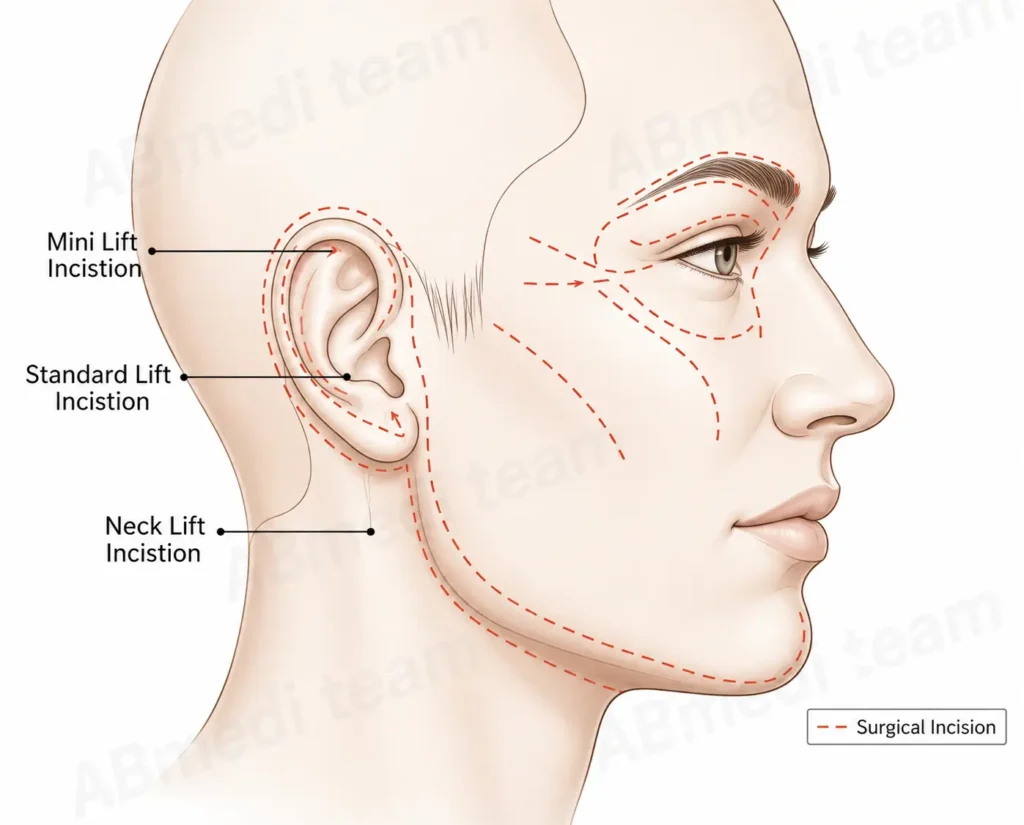
Incisions are placed strategically: one small cut behind each ear, and often a third beneath the chin in the natural crease. These locations allow good access to the deeper structures while keeping scars discreet — hidden within hairline folds and natural skin creases. When healed, most incisions become virtually undetectable.
Liposuction under the chin is frequently incorporated at the same time, particularly for patients with notable submental fat. The whole approach is highly individualized — no two neck lifts at ABmedi team Clinic follow the exact same plan.
What to expect beforehand
Avoid aspirin, ibuprofen, and blood-thinning supplements for at least two weeks prior. Arrange for someone to drive you home and stay with you overnight. You will not be permitted to drive yourself after general anesthesia.
Mini neck lift vs. full neck lift: which one is right for you?
This is the question I am asked most often during consultations, and the answer depends almost entirely on the degree of anatomical change we are dealing with — not on a preference for something less invasive.
| Factor | Mini Neck Lift | Full Neck Lift |
| Best for | Mild to moderate laxity, early jowling, early banding | Significant sagging, prominent bands, advanced aging |
| Ideal age range | 40s–50s | 50s–70s |
| Incisions | Smaller, limited to earlobe area | Behind both ears and under chin |
| Recovery | 1–2 weeks | 3–4 weeks |
| Results duration | 5–7 years | 10–15 years |
| Anesthesia | Local with sedation or general | General anesthesia |
A mini neck lift uses smaller incisions and focuses on surface-level skin repositioning. It works beautifully for someone in their 40s or early 50s who has good underlying skin elasticity and wants to address the early signs they are seeing in the mirror — a slightly softened jawline, a small amount of loose skin, perhaps a developing double chin. Results appear natural because the degree of correction matches the actual need.
A full neck lift goes deeper. It involves more extensive platysma work, often with suture suspension or direct muscle repair, and addresses a wider zone of the neck. For patients with significant skin redundancy or pronounced banding, it is the only approach that will deliver a meaningful, lasting correction. Doing a mini lift on someone who needs a full lift does them a disservice.
Both procedures can be combined with other facial surgery — brow lifts, eyelid surgery, fat grafting, or even a facelift — for patients who want comprehensive rejuvenation during a single recovery period.
Non-surgical neck treatments: what they can and cannot do
Several non-surgical technologies have improved considerably over the past decade, and they play a genuine role in neck rejuvenation — particularly for patients who are not yet ready for, or not good candidates for, surgery. Here is an honest assessment of the main options:
- Botulinum toxin (Botox) to the platysma — relaxes the vertical cords and can modestly soften neck wrinkling. Results last 3–4 months.
- Radiofrequency with microneedling — stimulates collagen remodeling in the dermis. Works well for texture and mild laxity; multiple sessions needed.
- Focused ultrasound (HIFU) — delivers energy to the SMAS layer below the skin to trigger some tissue tightening. Best results are modest and gradual.
- Injection lipolysis (e.g., deoxycholic acid) — dissolves localized submental fat. Useful for double chin reduction without surgery, though requires multiple treatments.
- Fractionated laser resurfacing — addresses surface texture, sun damage, and fine lines but does not lift sagging tissue.
Clinical perspective
Non-surgical treatments are not substitutes for surgery — they are complements or delay strategies. They cannot reposition muscle, remove excess skin, or recreate the jawline angle that a surgical lift achieves. For patients with true skin laxity or banding, surgery remains the only reliable solution. That said, combining non-surgical maintenance with surgical results extends longevity significantly.
Recovery timeline: what to expect day by day
Recovery is one of the most common areas where patients have unrealistic expectations. Below is an honest, clinically based timeline. Individual variation is real — some people heal faster, others slower — but this gives you a solid framework for planning.
Day 1–2
You will leave with a compression wrap around the neck and jaw. Some tightness, swelling, and mild discomfort are expected — most patients manage well with over-the-counter pain relief by day two. Rest is essential. Keep your head elevated, even during sleep.
Days 3–5
Bruising peaks and then begins to fade. Swelling is at its most visible. Compression garments remain on. Avoid bending, lifting, or any activity that raises your blood pressure — this is when post-operative bleeding risk is highest.
Week 1–2
Most bruising fades significantly. Sutures (if external) are typically removed around day 7–10. Patients often feel ready to be seen in public — with some camouflage — toward the end of week two. Light walking is encouraged; no strenuous exercise yet.
Weeks 3–4
Full neck lift patients begin resuming more normal activity. Residual numbness, tightness, or a pulling sensation in the neck is normal — nerve endings are regenerating. Mini lift patients are typically at or near full activity by this point.
Months 2–6
Final results continue to emerge as deeper swelling resolves and tissues settle into their new position. Most patients report that their neck looks best around the three-to-six month mark. Scars continue to fade and soften over the first year.
Sun protection on healing incisions is critical during the first year — UV exposure can permanently darken scars. We recommend SPF 30 or higher and physical barriers whenever you are outdoors.
Results: how long does a neck lift last?
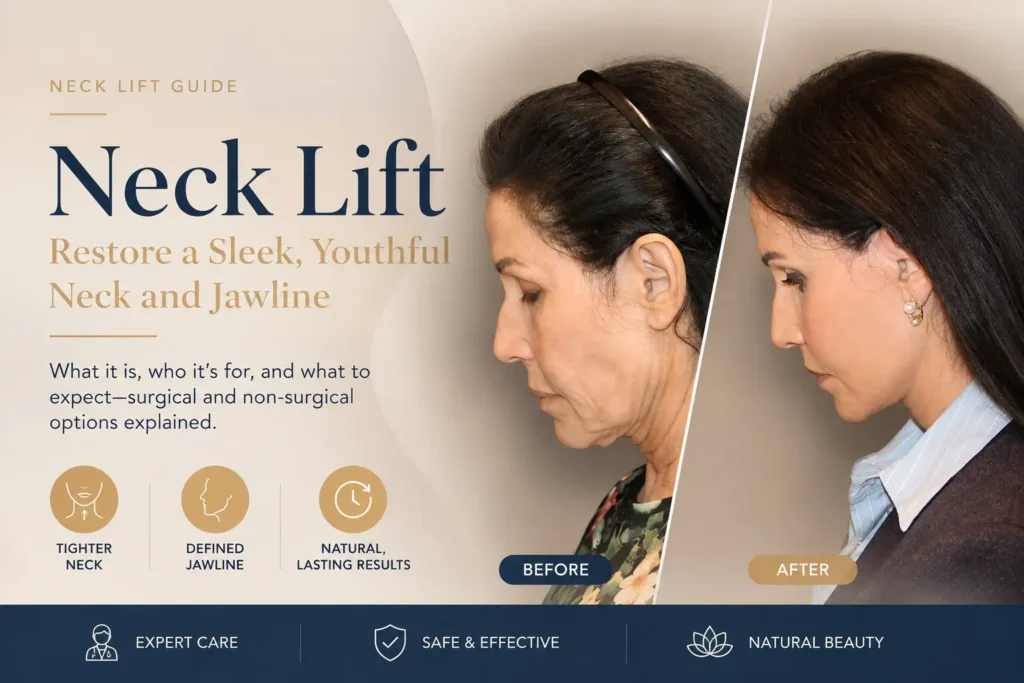
A neck lift does not freeze you in time — aging continues after surgery. What it does is set back the clock, often by a decade or more. The structural changes made during the procedure — tightened muscle, repositioned skin — are durable.
As a general guide: mini neck lift results typically last five to seven years before noticeable re-laxation occurs. A full neck lift, because of the more extensive work done at the muscle layer, tends to last ten to fifteen years. Individual factors that influence longevity include skin quality, genetics, sun damage history, and ongoing lifestyle habits like smoking.
Combining surgical results with periodic non-surgical maintenance — collagen-stimulating treatments, skin quality management, and targeted injectables — is one of the best ways to extend how long the improvement holds.
Frequently asked questions
- What is the best age to get a neck lift?
There is no single correct age — anatomy matters more than the number on your birth certificate. Skin thickness, elasticity, degree of laxity, and your personal goals all factor in. Patients in their 40s are often good candidates for a mini lift. Those in their 50s through 70s with more advanced changes typically benefit from a full lift. The right time is when the concern is meaningful to you and your anatomy supports a good outcome.
- What are the risks involved?
As with any surgical procedure, a neck lift carries inherent risks: infection, bleeding, hematoma formation, poor wound healing, nerve injury, scarring, and temporary or persistent numbness. At ABmedi team Clinic, we operate in accredited facilities with fully trained anesthesia teams to minimize these risks. Selecting a board-certified surgeon with documented experience in facial procedures is the single most important risk-reduction step you can take.
- Will the results look natural?
A well-executed neck lift should look like a well-rested, refreshed version of you — not a different person. The goal is to restore the neck and jaw contour you had several years earlier, not to create an artificially taut or “pulled” look. Overly tight results typically stem from poor surgical technique or removing too much skin. During your consultation at ABmedi team Clinic, we use before-and-after case reviews and open discussion of goals to align expectations with what is anatomically appropriate.
- Can a neck lift be combined with other procedures?
Yes, and it often makes practical sense to do so. Common combinations include eyelid surgery, a brow lift, fat grafting to restore facial volume, and facelift surgery for more comprehensive rejuvenation. Combining procedures means one anesthesia event and a single recovery period — which many patients prefer over multiple staged procedures. Whether combination surgery is appropriate depends on your health, the complexity of the work, and how long you can safely remain under anesthesia.
- Is the recovery really that disruptive?
Most people significantly overestimate how incapacitated they will be. The first few days require rest and some assistance at home. By the end of the second week, most patients are managing daily life independently. Many return to sedentary work around day 10–14. The bruising and swelling are the main social barrier — not pain. Planning two full weeks of downtime is a realistic and conservative target for most patients.
- Does insurance cover a neck lift?
In nearly all cases, neck lift surgery is considered an elective cosmetic procedure and is not covered by insurance. Exceptions are rare and typically involve documented functional impairment, which is uncommon with neck lift indications. ABmedi team Clinic offers financing options and transparent pricing — we discuss all costs in detail during your initial consultation so there are no surprises.
A final word from the surgeon
After years of performing facial rejuvenation surgery, the thing I notice most is not the technique — it is the shift in how patients carry themselves after the procedure. A cleaner neck, a more defined jawline — these are not just changes to appearance. For many people, it is reclaiming confidence in the mirror, in photographs, in the way they show up in rooms.
That said, I always speak plainly with my patients: a neck lift is a serious intervention, not a decision to be made in a hurry. Understanding what you actually need, why you need it, and whether the timing fits your health and life circumstances — that is the foundation of every sound surgical decision.
If you are considering this procedure, the first step is not booking an operation — it is an honest conversation. At ABmedi team Clinic, we will look carefully at your anatomy together, discuss the options that genuinely suit your situation, and if surgery is not the right answer at this point in time, we will tell you that directly. Our goal is the best outcome for you — not simply another procedure on the schedule.
Keep this in mind as you research
No before-and-after photo can replace a face-to-face consultation. Every face and every neck has its own structure — and the best treatment plan always starts from actually seeing you, not from a generic template. Ask questions, request real patient results, and only move forward when you feel genuinely confident in your decision.
📞 💬 WhatsApp / Chat: [http://wa.me/84975142666] 🌐 Book online: [+84-975-142-666]
Consultations are available in-clinic and online for international patients. Most patients leave their first appointment knowing exactly what they need — and feeling confident about the path ahead.
