


As an oculoplastic surgeon, one of the most rewarding parts of my practice is helping patients feel more confident and refreshed — simply by addressing the area around their eyes. The eyes are the first place where aging, genetics, and fatigue become visible. Whether it’s excess skin weighing down the upper lids, persistent under-eye bags, or a desire for a wider, more open eye shape, eyelid surgery offers targeted, long-lasting solutions. This guide covers everything you need to know about the key procedures available at ABmedi team Clinic.
Why the eye area ages faster than the rest of the face
The skin surrounding the eyelids is among the thinnest on the entire body, which makes it particularly susceptible to early signs of aging. Over time, the skin gradually loses its elasticity while gravity continues pulling tissues downward. This combination causes the upper lids to sag and hood over the lash line, creates puffiness from displaced fat pads beneath the lower eyes, and generates a persistently tired or sad facial expression — even when you feel perfectly well-rested.
In some patients, the upper eyelid droop becomes severe enough to interfere with peripheral vision, at which point surgery transitions from purely cosmetic to medically necessary. I always evaluate this during an initial consultation.
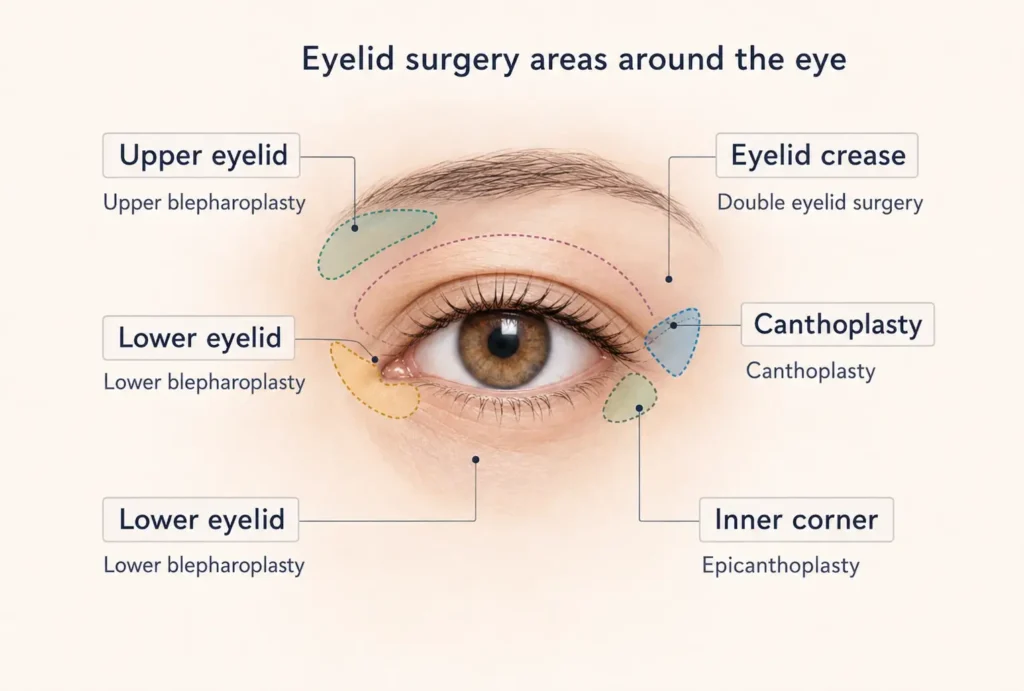
The procedures at a glance
Diagram showing the main eyelid surgery procedures and the areas of the eye they address.
Overview of common eyelid surgery procedures including upper and lower blepharoplasty, epicanthoplasty, canthoplasty and double eyelid surgery.
Upper lids
Upper blepharoplastyRemoves excess skin, fat, and muscle from drooping upper eyelids to restore a smooth, open contour and, when needed, improve the visual field. |
Lower lids
Lower blepharoplastyReduces under-eye bags, puffiness, and loose skin by repositioning or removing fat pads beneath the lower lids for a rested, youthful result. |
Outer corner
Canthoplasty / CanthopexyTightens and reconstructs the outer corner of the eye (lateral canthus). Canthopexy is the less invasive version using sutures alone — no tendon detachment. |
Inner corner
EpicanthoplastyReduces or removes the epicanthal fold at the inner corner of the eye, making eyes appear wider, more open, and better defined. |
Eyelid crease
Double eyelid surgeryCreates a visible upper eyelid crease in patients with a single (mono) lid, enhancing definition and making the eyes appear larger and brighter. |
Upper blepharoplasty — addressing droopy eyelids
This is one of the most commonly performed procedures at ABmedi team Clinic. The goal is to remove redundant skin (a condition called dermatochalasis) and any protruding fat from the upper lid, restoring a clean, natural eyelid contour. The incision is made precisely along the natural crease of the upper eyelid, so any residual scar is virtually invisible once healed.
The procedure typically takes 45 minutes to one hour under local anesthesia. Most patients return to light daily activities within a week and notice full results once the swelling resolves, usually within two to three weeks. Results are long-lasting — most patients enjoy their refreshed appearance for seven to ten years before any re-treatment becomes relevant.
From my clinical experience: patients who come in asking “why do I always look tired?” often have mild upper lid ptosis alongside the excess skin. I always assess both simultaneously, since correcting the skin alone without addressing weak levator muscle function can leave a patient disappointed. A thorough pre-operative evaluation at ABmedi team Clinic accounts for both conditions.
Lower blepharoplasty — eliminating eye bags
Under-eye bags result from a combination of weakening orbital septum support, downward migration of fat pads, and loss of skin elasticity. Lower blepharoplasty addresses all three. The incision is placed either just below the lower lash line or, in cases where only fat needs to be addressed, entirely inside the eyelid (transconjunctival approach), leaving no visible scar on the skin surface.
I frequently combine upper and lower blepharoplasty in a single operative session. Doing so means one recovery period, balanced final results, and overall greater efficiency for the patient. Swelling and bruising typically resolve within ten to fourteen days, after which the eyes appear noticeably smoother, brighter, and more rested.
Canthoplasty vs canthopexy — outer corner reshaping
| Procedure | Technique | Best suited for | Recovery |
| Canthoplasty | Lateral canthal tendon is detached and reattached to the orbital bone at a new position | Significant eyelid laxity, ectropion, or cosmetic reshaping toward an almond eye | Longer; more swelling |
| Canthopexy | Sutures tighten and support the existing tendon without cutting it | Mild to moderate laxity; often performed alongside lower blepharoplasty | Shorter; less bruising |
At ABmedi team Clinic, canthopexy is frequently paired with lower blepharoplasty because it reinforces the lower lid position, reduces the risk of ectropion post-operatively, and contributes to a more natural-looking result.
Epicanthoplasty — opening the inner corner
The epicanthal fold is a skin fold that covers the inner corner of the eye. It is genetically more prominent in individuals of East Asian descent and can make the eyes appear smaller, closer together, or restrict the development of a clean upper eyelid crease — even after double eyelid surgery.
There are two main approaches. Medial epicanthoplasty targets the inner corners to widen the distance between the eyes and create a smoother, more open appearance. Lateral epicanthoplasty, less common, addresses the outer corners instead. The choice depends entirely on each patient’s anatomy and goals.
Important: If you are planning double eyelid surgery but have a prominent epicanthal fold, I strongly recommend discussing epicanthoplasty at the same consultation. Without it, the inner portion of the new eyelid crease may appear weak, discontinuous, or create an undesirable “forked” look where an infold and outfold conflict at the inner corner.
Double eyelid surgery — creating an upper eyelid crease
Approximately 50% of individuals of East Asian descent are born with a single eyelid (monolid). Double eyelid surgery creates a visible crease, making the eyes appear wider, more defined, and livelier. There are two primary techniques:
- Suture ligation (non-incisional)
Small sutures are placed through minimal puncture points to form a crease. Shorter recovery but higher long-term failure rate; cannot address excess skin or fat.
- Incisional technique
A surgical incision along the desired crease line allows removal of excess skin, fat, and muscle before permanently fixing the crease anatomy. More durable and compatible with concurrent epicanthoplasty or ptosis correction.
Benefits patients consistently report
| Brighter, more alert eyes
Lifting heavy tissue reveals more of the iris and gives an energised expression. |
Smoother under-eye area
Reduction of bags and puffiness creates a well-rested look. |
| Improved vision
Removal of obstructing upper lid skin expands the peripheral visual field. |
Long-lasting outcome
Results typically last seven to ten years; lower lid surgery rarely needs repeating. |
| Natural appearance
Incisions follow natural lid creases, leaving minimal visible scarring. |
Boosted confidence
Most patients report others notice they look refreshed — not that they had surgery. |
Recovery: what to realistically expect
- Days 1–2
Cold compresses every hour for ten minutes. Keep your head elevated. Gentle saline cleansing around incisions.
- Days 3–7
Non-dissolvable sutures removed around day five. Light reading and screen use are fine; avoid strenuous activity.
- Weeks 2–4
Swelling and bruising resolve. Avoid direct sun exposure; no eye makeup until cleared by your surgeon.
- 3–6 months
Final scar maturation completes. Incision lines fade significantly. Full results visible.
Eyelid Surgery Recovery
From Precision Suturing to Natural Definition: Monitoring the 12-Week
Healing Process.
Am I a good candidate?
The ideal candidate is in good overall health, does not smoke, and has realistic expectations. A preoperative consultation at ABmedi team Clinic includes a visual field assessment, eyelid anatomy measurements, review of medical history, and an honest discussion of what each procedure can and cannot achieve. Patients with uncontrolled thyroid disorders, significant dry eye, glaucoma, detached retina, or uncontrolled cardiovascular conditions may need medical clearance or may not be suitable candidates.
The bottom line: what eyelid surgery can truly do for you
In over a decade of performing oculoplastic procedures, I have seen firsthand how impactful eyelid surgery can be — not just cosmetically, but emotionally. Patients regularly tell me that colleagues stopped asking if they were tired, that they stopped avoiding photographs, or simply that they finally feel their outside appearance matches how vibrant and energetic they feel inside.
That said, I always counsel patients with honesty: surgery refines and refreshes — it does not stop the clock entirely. Aging continues, and lifestyle factors like sun exposure, sleep quality, and smoking all influence how long results last. What eyelid surgery gives you is a meaningful, durable head start — typically seven to ten years of looking noticeably younger and more rested than you would have otherwise.
“The best eyelid surgery is the kind no one notices. Patients should look refreshed, natural, and like themselves — just well-rested. That is always the goal at ABmedi team Clinic.”
Oculoplastic & Reconstructive Surgery Team, ABmedi team Clinic
Why patients choose ABmedi team Clinic
10+
Years of specialised oculoplastic experience
98%
Patient satisfaction in post-op follow-up surveys
1-day
Outpatient procedure — home the same day
7–10 yrs
Average duration of long-lasting results
Frequently asked questions
Is eyelid surgery painful?
Most procedures are performed under local anesthesia with light sedation, so you feel no pain during surgery. Afterward, mild discomfort and a sensation of tightness are normal and managed well with standard pain relief for the first two to three days.
Can I combine multiple eyelid procedures in one session?
Yes – and it is often the most practical approach. Combining upper and lower blepharoplasty, or pairing either with epicanthoplasty, canthoplasty, or a brow lift, means a single recovery period and a more harmonious overall result. We assess each combination individually to ensure safety and optimal outcomes.
Will there be visible scarring?
Incisions are deliberately placed along the natural creases of the eyelids and lash margins, where they are well concealed. Most patients find their scars are virtually undetectable within three to six months as the skin heals and the lines fade.
When will I see the final results?
Swelling resolves significantly within the first two weeks. You will look noticeably refreshed by week three. Full final results – including complete scar maturation – are typically visible at the three to six month mark.
How do I know which procedure is right for me?
This is exactly what our consultation at ABmedi team Clinic is designed to determine. The right procedure depends on your unique eyelid anatomy, the specific concerns you want addressed, and your overall facial proportions. A thorough in-person assessment is always the starting point.
Ready to Rediscover Your Body’s True Shape?
Let’s Design Your Results Together.
Book a consultation at ABmedi team Clinic — no obligation, no pressure.
📞 💬 WhatsApp / Chat: [http://wa.me/84975142666] 🌐 Book online: [+84-975-142-666]
In one appointment, our board-certified facial plastic surgeons will:
- Assess your skin quality, tissue depth, and the specific areas of concern
- Recommend the one procedure — or combination — that matches your anatomy and goals
- Give you a clear, honest timeline for recovery and results
- Answer every question you have, in plain language
