


The face staring back at you in the mirror the morning after surgery is not the face you will keep — the swelling and bruising are temporary, and knowing exactly what to expect at each stage is the best tool you have for staying calm. This guide walks you through every phase of forehead lift recovery, from the first raw days to the moment your final result settles in, so you can plan your schedule, manage side effects confidently, and protect the work we did together.
The Reality of Forehead Lift Post-Op: How Painful Is It?
Good news first: a forehead lift is one of the more comfortable facial procedures from a pain standpoint. The majority of our patients at ABmedi Team Clinic describe the post-operative sensation not as sharp pain but as a dull pressure and tightness — similar to a very tight headband clamped across the brow. True pain, when it occurs, responds well to prescribed medication, and most patients transition to over-the-counter acetaminophen within the first two to three days.
What tends to be more unsettling than pain is the appearance. The forehead and eye area swell dramatically in the first 72 hours, and bruising can track down toward the cheeks. This is completely expected — it is your body’s healing response, and it is not a signal that anything went wrong. What we want to prepare you for, honestly, is this: you will not look like yourself for about 10 to 14 days, and that is entirely normal.
Other sensations you should anticipate and not fear:
- Tightness across the scalp and forehead — the most universal complaint; it fades over weeks as tissues settle.
- Numbness or altered sensation — small sensory nerves are disrupted during surgery. Numbness in the forehead and scalp is common and typically resolves over one to three months as nerves regenerate.
- Itching — a positive sign that nerves are healing and new tissue is forming. Do not scratch the incision area.
- Asymmetric swelling — it is common for one side to swell or bruise more than the other. The body is not perfectly symmetrical in its healing, and this evens out.
From the Surgeon’s Chair
When a patient calls us on day two worried that something is wrong because of the swelling, my answer is almost always the same: this is exactly what I expect to see. The goal of our pre-operative counseling — and this article — is to make sure none of this comes as a shock.
Forehead Lift Recovery Timeline: Day by Day & Week by Week
Recovery does not move in a straight line — there are distinct phases, each with its own character. Here is what you can realistically expect at each stage.
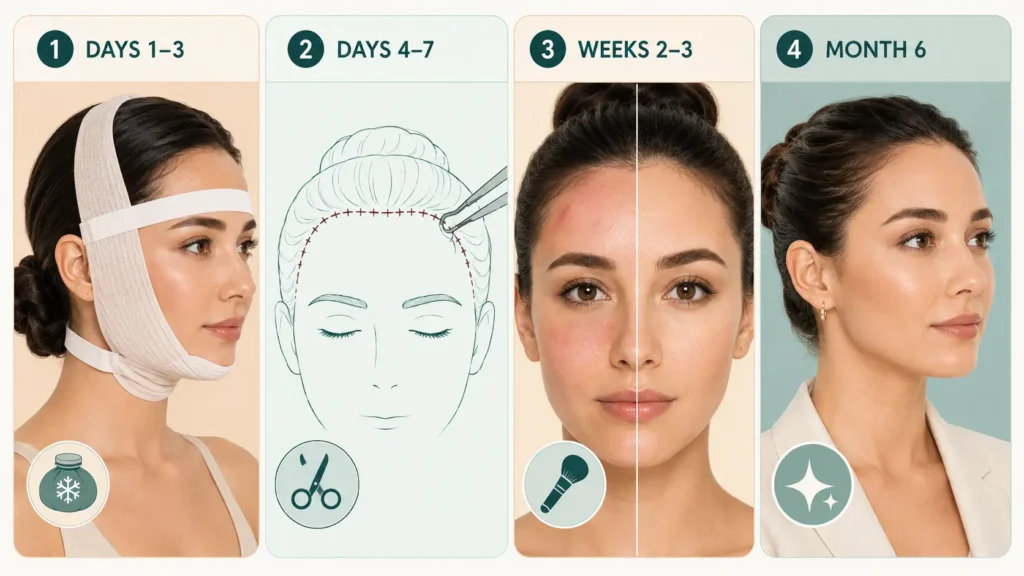
Days 1–3: The Peak of Swelling and Bruising
The first day home is about rest, elevation, and letting the anesthesia clear your system. If you had general anesthesia, mild nausea is possible — inform your escort if it persists, as medication is available. Your forehead will be bandaged, and you will have a headband-style dressing supporting your brow position.
Swelling and bruising typically peak on days two through four. The eye area often bears the brunt — puffy lids and discoloration extending toward the cheeks are both normal. Keep your head elevated above your heart at all times, including during sleep. Use a wedge pillow or stack regular pillows; slipping flat even for a nap will noticeably worsen swelling the following morning.
Pain management in this phase is straightforward: take your prescribed medications on schedule rather than waiting until pain escalates. Cold compress application on the eye area (not directly on the bandaged forehead) provides meaningful relief and reduces puffiness. Apply for 10–15 minutes at a time, with equal rest periods in between, using a clean cloth — never apply ice directly to skin.
Avoid Immediately
Do not bend at the waist (pick things up by squatting), do not blow your nose forcefully, and do not take aspirin, ibuprofen, fish oil, or any supplements not pre-approved by your surgeon. All of these elevate the risk of increased bleeding and swelling.
Days 4–7: Initial Healing and Removing Stitches
By day four, most patients notice a meaningful reduction in swelling — not gone, but clearly past its worst. Bruising begins its classic color shift from deep purple toward yellow-green, which signals that the body is actively breaking down the pooled blood. This is progress, even if it does not look that way.
Around day five to seven, you will return to ABmedi Team Clinic for your first post-operative appointment. Sutures or staples will be removed at this visit — a quick, minimally uncomfortable process. Many patients are surprised by how much better they feel immediately afterward as tension is relieved from the scalp. Your surgeon will assess healing, clean the incision sites, and give you updated activity guidelines.
By day seven, most patients feel comfortable being seen by close friends and family. The forehead may still feel tight and slightly numb, but these sensations are clearly trending in the right direction. Light, gentle walking is encouraged during this phase — circulation supports healing without raising your heart rate enough to increase swelling.
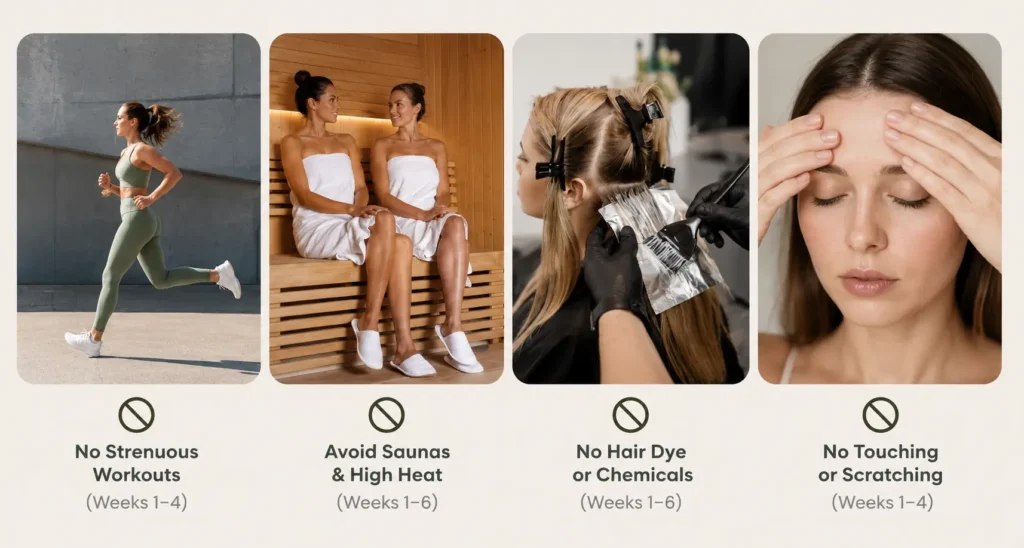
What to avoid through the end of week one: hot showers, saunas, steam rooms, hot yoga, any exercise that elevates heart rate, heavy lifting, or bending over.
Weeks 2–3: When Can I Return to Work and Social Activities?
This is the window most patients care about most, and the honest answer is: it depends on what your work and social life look like.
By days 10 to 14, visible bruising is largely resolved or can be covered with light makeup. Swelling has softened significantly, and the b row begins to look more natural and less “surgical.” Most patients feel ready to return to desk work, remote meetings, and everyday errands during this window.
If your role involves significant face-to-face interaction, public appearances, or physical labor, a full two weeks off is the minimum to plan for. Many of our patients who work in client-facing or appearance-conscious roles schedule two to three weeks to feel fully comfortable before returning to their professional environment.
Social activities — dinners, casual outings, light socializing — are generally appropriate by the end of week two for most patients. Avoid large events, situations with heavy sun exposure, or environments with smoke or airborne particles.
Practical Scheduling Note
At ABmedi Team Clinic, we advise patients to book their surgery on a Friday if possible, giving them a full 10-day buffer before the following Monday week. Combine this with careful application of mineral makeup, and most patients are presentable for non-intensive work by day 12.
Weeks 4–6: Watching the Subtleties Fade
By week four, the dramatic part of recovery is behind you. Residual swelling at this stage is mild — the kind only you and your surgeon will notice. Incision lines are fading; those placed within the hairline are well-concealed, and any visible scars are easily managed with mineral makeup while they continue to mature.
Numbness or scalp tightness that persisted through the first weeks will continue to gradually improve. Some patients notice that sensation returns in waves rather than all at once — a mild tingling or “pins and needles” feeling means nerves are regenerating, which is exactly what we want to see.
Most patients are cleared for light to moderate exercise at the one-month mark, provided their surgeon approves. Begin with walking and gentle stretching; hold off on anything high-impact — running, HIIT, heavy weightlifting — until week six or your surgeon specifically clears it. Never resume exercise to the point of a throbbing forehead or significant facial flushing.
Month 6: How Long Until Final, Refined Results?
The six-month milestone is where your result becomes permanent. By this point, residual swelling has fully resolved, incision lines have faded to near-invisible, and the brow position has settled into its final location. Any lingering numbness is typically resolved or nearly so.
Patients frequently describe the six-month result as looking “more like themselves, but better” — more rested, more open, more youthful, without looking obviously altered. This is the hallmark of a well-executed forehead lift. The goal was never to look different; it was to restore what time had gradually changed.
Many patients continue to notice subtle improvements even beyond six months as scar maturation completes and any remaining soft tissue settles. Final photographs taken at your six-month follow-up appointment at ABmedi Team Clinic serve as your true baseline for the long-term result.
Crucial Post-Op Care: What Can I Do After Forehead Lift Surgery?
Sleep Position and Head Elevation
Keep your head elevated at a 30 to 45-degree angle for the first 10 to 14 days, including during sleep. This is non-negotiable: gravity is working against you when you lie flat, and even short periods of flat sleeping will be visible in morning swelling. A wedge pillow is the most practical solution; if you do not own one, stacked firm pillows work. Sleeping on your side or stomach during the first two weeks is not recommended, as any compression on the face increases swelling and can disturb healing tissue.
Cold Compress Protocol
For the first 48 to 72 hours, apply cold compresses to the eye area only — not directly on the surgical site if it is bandaged. Use a clean, soft cloth with ice wrapped inside, never loose ice or a frozen gel pack applied directly to skin. Apply for 10 to 15 minutes per session, then rest for at least 15 minutes before reapplying. After 72 hours, transition from cold to warm compresses to support circulation and help resolve residual bruising more quickly.
Incision Care and Hygiene
Follow your surgeon’s specific instructions for cleaning the incision lines. In general: gentle cleansing with hydrogen peroxide and application of antibiotic ointment is standard in the first week. If redness or irritation occurs around the incision, transition to plain Vaseline until you can consult with your surgeon. Do not allow shampoo, conditioner, or styling products to contact the incision lines until you have been specifically cleared to do so — usually after suture removal.
Foods and Supplements to Avoid
Sodium dramatically increases post-operative swelling. Avoid salty, processed, and canned foods for at least two weeks. Alcohol is strictly off-limits for the first full week and should be minimized through week three — it dilates blood vessels, impairs healing, and interacts poorly with pain medication. A diet rich in lean protein, leafy greens, and vitamin C actively supports tissue repair.
Supplements and Medications to Stop
Before and after surgery, avoid aspirin, ibuprofen (Advil, Motrin), naproxen, fish oil, vitamin E, garlic supplements, and ginkgo biloba. All thin the blood and increase bleeding risk. Only resume these with explicit approval from your ABmedi Team Clinic surgeon.
Sun Exposure
Healing incisions are highly susceptible to hyperpigmentation when exposed to UV radiation. Keep incision areas out of direct sunlight for a minimum of six weeks, and apply SPF 50 or higher whenever outdoors. A wide-brimmed hat is your best tool during this period.
Activity Restrictions
No strenuous exercise for four to six weeks. No bending at the waist (always squat). No heavy lifting — nothing heavier than a full grocery bag — for at least three weeks. No driving while taking narcotic pain medication. Sexual activity should be avoided for the first two weeks as it elevates heart rate and blood pressure, both of which worsen swelling and carry a small risk of reopening the surgical site.
Smoking
If you smoke, it is critical to stop at least two weeks before surgery and to remain smoke-free for a minimum of four weeks after. Smoking constricts blood vessels, slows wound healing, and meaningfully increases the risk of scarring, infection, and tissue complications. This is one instruction we do not negotiate on.
At-a-Glance Recovery Milestones
Use this table as a quick reference throughout your recovery. For any concern not addressed here, contact the ABmedi Team Clinic aftercare team directly.
| Timeframe | What to Expect | Allowed Activities |
| Day 1 | Bandaging in place; grogginess, mild nausea possible; minimal pain with medication | Rest at home; head elevated; cold compress on eyes; short supervised walks inside |
| Days 2-4 | Peak swelling and bruising; forehead and eye puffiness; tightness; possible asymmetry | Short, gentle walks; cold compress per protocol; prescribed medications on schedule |
| Days 5-7 | Swelling begins to soften; bruising shifts from purple to yellow-green; suture removal at clinic visit | Gentle walking; light daily tasks; light reading/screen time (no prolonged squinting) |
| Week 2 | Most bruising resolved or concealable; tightness and mild numbness ongoing; incisions healing | Desk/remote work; light makeup; driving (if not on narcotics); gentle walking; low-sodium diet |
| Weeks 3-4 | Minimal visible bruising; swelling subtle; brow position more refined; scalp sensation normalizing | Return to non-physical work; social activities; light outdoor walks with SPF 50; no exercise yet |
| Weeks 5-6 | Incision lines fading; most numbness resolved; residual swelling only noticeable to patient | Light to moderate exercise (surgeon-approved); most normal daily activities; regular hair washing |
| Months 3-4 | Major healing complete; incisions continue to lighten; natural contours becoming fully apparent | All activities including strenuous exercise; full sun with SPF; normal hair and skincare routine |
| Month 6 | Final result settled; brow position stable; incisions near-invisible; sensory changes resolved | All activities unrestricted; final post-op photography at ABmedi Team Clinic |
Frequently Asked Questions
Q1: How long does forehead lift recovery take?
The initial recovery — the period during which swelling and bruising are visible — lasts approximately 10 to 14 days. Most patients return to work within two weeks. Full, final results take up to six months to settle completely as residual swelling resolves and incision lines mature.
Q2: When can I go back to work after a forehead lift?
Desk work and remote meetings can typically resume around days 10 to 14, once bruising is either resolved or concealable with makeup. If your role involves significant in-person interaction, public appearances, or physical labor, plan for a minimum of two full weeks off.
Q3: Is a forehead lift very painful?
Most patients describe the discomfort as a dull pressure and tightness rather than sharp pain. True pain, when present, is well-controlled with prescribed medication. The majority of patients transition to over-the-counter pain relievers within two to three days.
Q4: When does swelling go down after a forehead lift?
Swelling peaks around days two to four and then gradually reduces. It is significantly improved by the end of week two and largely resolved by week three. Subtle residual swelling may persist for several months but is typically only noticeable to the patient and their surgeon.
Q5: Is it normal to feel numbness after a forehead lift?
Yes. Temporary numbness in the forehead and scalp is one of the most common post-operative sensations. It occurs because small sensory nerves are disturbed during surgery. Sensation typically returns gradually over one to three months as the nerves regenerate.
Q6: When can I exercise after a forehead lift?
Light walking is encouraged from day one. Moderate exercise (light jogging, yoga) can typically resume at the four-week mark with surgeon approval. High-impact activities — running, HIIT, heavy weightlifting — should wait until week six or until your surgeon specifically clears them.
Q7: When will I see my final results?
Meaningful improvement is visible by week two to three. The brow position looks substantially refined by week four to six. Your complete, settled final result is established at approximately six months post-surgery.
