


Understanding Liposuction: What It Can (and Can’t) Do for Your Body
Let’s start with a crucial distinction: liposuction is a tool for sculpting, not for weight loss. The patients who walk away most satisfied are those who are already close to their goal weight but have localized fat deposits that refuse to respond to diet or exercise — love handles that are simply genetic, a lower belly that won’t flatten despite consistent effort, or a double chin that undermines an otherwise defined jawline.
What liposuction does is permanently remove those fat cells from the body. The fat cells that are taken out do not return. However, the remaining fat cells can still expand if significant weight is gained post-procedure. That distinction matters — and it’s why I always tell patients that maintaining a stable weight after surgery is just as important as the surgery itself.
At ABmedi team Clinic, every liposuction consultation begins with an honest discussion of what is and isn’t achievable — before we ever talk about technique.
Choosing the Right Technology: Comparing VASER, Laser, and Tumescent
Not all liposuction is the same. The technology used to break down fat before it’s removed has evolved significantly, and the right technique depends on the treatment area, the amount of fat to be removed, skin elasticity, and whether body sculpting precision is a priority.
Here’s how the main techniques compare:
Tumescent Liposuction
Tumescent liposuction is the foundational technique that underpins almost every modern liposuction procedure. Before fat is removed, a solution of saline, lidocaine (a local anesthetic), and epinephrine (which constricts blood vessels) is injected into the treatment area. This causes the fat to swell — “tumescing” it — which serves three purposes: it numbs the area, significantly reduces bleeding, and makes the fat easier to extract.
A thin hollow tube called a cannula is then inserted through small incisions to suction the fat out.
Who it’s best for: Tumescent liposuction remains highly effective for larger-volume fat removal and is widely considered the safest liposuction technique available. It’s well-established, extensively studied, and can be performed under local anesthesia in many cases — reducing the risks associated with general anesthesia.
What to expect: Recovery typically involves bruising, swelling, and some discomfort for 1–3 weeks. Compression garments are worn for up to 3–6 weeks post-procedure.
VASER Liposuction
VASER stands for Vibration Amplification of Sound Energy at Resonance — essentially, it uses ultrasound waves to selectively liquefy fat cells before they’re suctioned out. A specialized probe emits high-frequency ultrasound energy that “shakes” fat cells apart while leaving surrounding structures — nerves, blood vessels, connective tissue — largely intact.
Importantly, VASER still incorporates the tumescent technique as its first step. The ultrasound step is what makes it distinct.
Why this matters clinically: Because surrounding tissues are preserved rather than disrupted, patients typically experience less bleeding, bruising, and postoperative swelling compared to traditional liposuction. Skin retraction — the skin’s ability to tighten after fat removal — tends to be better with VASER because the ultrasound energy also stimulates collagen production.
Who it’s best for: VASER excels at high-definition body sculpting — situations where you want to reveal or enhance underlying muscle definition, not just remove volume. It’s particularly well-suited for fibrous areas (flanks, chest, upper back) where denser fat is harder to break up mechanically, and for delicate areas requiring fine precision (chin, inner arms, knees).
What to expect: Most VASER procedures are performed under local anesthesia or light sedation. Recovery is generally faster than traditional liposuction, with many patients returning to sedentary work within a few days and resuming exercise within 3–4 weeks. Compression garments are still required.
Laser Liposuction
Laser liposuction uses laser energy delivered through a thin fiber inserted directly into the fat layer to heat and liquefy fat cells. The liquefied fat is then removed via gentle suction — or, in some non-surgical laser body contouring variants, the disrupted fat cells are processed and eliminated naturally by the body over several weeks.
A notable benefit of laser liposuction is that the thermal energy delivered to the undersurface of the skin stimulates collagen remodeling, producing skin tightening beyond what fat removal alone achieves.
Who it’s best for: Laser liposuction is particularly effective for smaller, more precise areas where skin tightening is a priority alongside fat reduction. It’s an excellent option for the chin and neck, inner arms, and areas where mild skin laxity accompanies the fat deposit. It’s a less aggressive option than VASER for high-definition sculpting, but its skin-tightening advantage is meaningful.
What to expect: Because it’s less invasive than traditional liposuction, recovery is faster — many patients are back to their routines within a few days. Bruising and swelling are generally milder. Multiple sessions may be needed for non-surgical laser fat reduction variants.
How the Three Techniques Compare
| Tumescent | VASER | Laser | |
| Fat removal volume | Highest | High | Moderate |
| Precision / sculpting | Good | Excellent | Good–Very Good |
| Skin tightening | Minimal | Moderate | Good |
| Recovery time | 2–4 weeks | 1–2 weeks | Days–1 week |
| Best for | Larger volume removal | High-definition sculpting | Small areas, skin laxity |
| Anesthesia | Local or general | Local or light sedation | Local |
At ABmedi team Clinic, we frequently combine techniques — using VASER in areas requiring precision, tumescent in areas where volume matters most — to optimize the overall outcome as a single procedure.
From Chin to Thighs: Targeted Solutions for Stubborn Fat
Abdominal Liposuction:
The abdomen is the most commonly requested area for liposuction — and for good reason. Stubborn fat deposits in the upper and lower belly, and along the flanks (love handles), tend to be among the most resistant to diet and exercise. These areas are anatomically accessible and respond extremely well to liposuction.
A few things I assess carefully here: whether the fat is subcutaneous (beneath the skin, accessible to liposuction) versus visceral (inside the abdominal cavity, which cannot be removed surgically), the degree of muscle laxity, and skin elasticity. Patients with significant abdominal muscle separation or excess skin after pregnancy may benefit more from a tummy tuck, or from combining liposuction with abdominoplasty.
For straightforward cases, abdominal liposuction delivers dramatic results — a flatter, more proportionate midsection with minimal visible scarring from the small incisions used.
Thigh Liposuction:
Inner and outer thighs are among the most popular liposuction sites, particularly among women, where fat in these areas is strongly hormonally driven and notoriously resistant to exercise. Inner thigh liposuction can eliminate chafing and create a cleaner leg silhouette. Outer thigh (saddlebag) reduction creates better hip-to-thigh proportion.
I pay close attention to skin elasticity here — the inner thigh skin is relatively thin, and over-aggressive liposuction can result in irregularities or loose skin. A conservative approach that removes the right amount, not the maximum possible, consistently produces the best long-term outcomes.
Thigh liposuction is commonly performed alongside hip and flank contouring for a more balanced overall result.
Arm Liposuction
Upper arm fat — particularly the “batwing” fat on the posterior arm — is another area that resists targeted exercise. Arm liposuction removes the excess fat from the triceps region and inner arm to create a more defined, proportionate limb.
For younger patients with good skin elasticity, liposuction alone produces excellent results. For patients with significant skin laxity, an arm lift (brachioplasty) may be necessary to address the loose skin that can remain after fat removal. I discuss this distinction carefully during every arm consultation.
Laser liposuction is a particularly useful technique for arms because the skin-tightening effect helps the skin contract around the new contour more smoothly.
Back Liposuction
Back fat is one of the most under-discussed but deeply frustrating areas for many patients — the rolls that appear around a bra strap, the fullness across the lower back, or the excess that folds over the waistband. These areas rarely respond to targeted exercise.
Liposuction of the upper, mid, and lower back can significantly improve the overall body silhouette. Because back fat tends to be denser and more fibrous than abdominal fat, VASER liposuction is often my preferred technique here — the ultrasound energy breaks up the fibrous tissue more effectively than mechanical suction alone.
Chin Liposuction:
Submental liposuction — removing fat beneath the chin — is one of the most transformative and fastest-recovering liposuction procedures available. A small cannula is inserted through a tiny incision hidden under the chin, and the submental fat is carefully suctioned out, revealing a sharper jawline and more youthful neck profile.
This procedure is equally popular among men and women, and because the treatment area is small, it is almost always performed under local anesthesia in an office setting with minimal downtime. Most patients feel comfortable in public within 5–7 days.
For patients whose primary concern is mild-to-moderate submental fat with good skin elasticity, chin liposuction alone delivers remarkable results. If significant skin laxity is present, a neck lift may need to be considered alongside or instead of liposuction.
Lipo 360 and Combined Area Treatment
Many patients benefit from treating multiple areas in a single session — a concept sometimes called “Lipo 360” when it encircles the full midsection (abdomen, flanks, back). Combining areas allows the surgeon to create proportionate, harmonious contours rather than isolated changes that may look unnatural in context.
At ABmedi team Clinic, the decision to treat multiple areas in one session is guided by volume limits, anesthesia safety, and expected recovery — not by how many areas we can bill. Patient safety and outcome quality always come first.
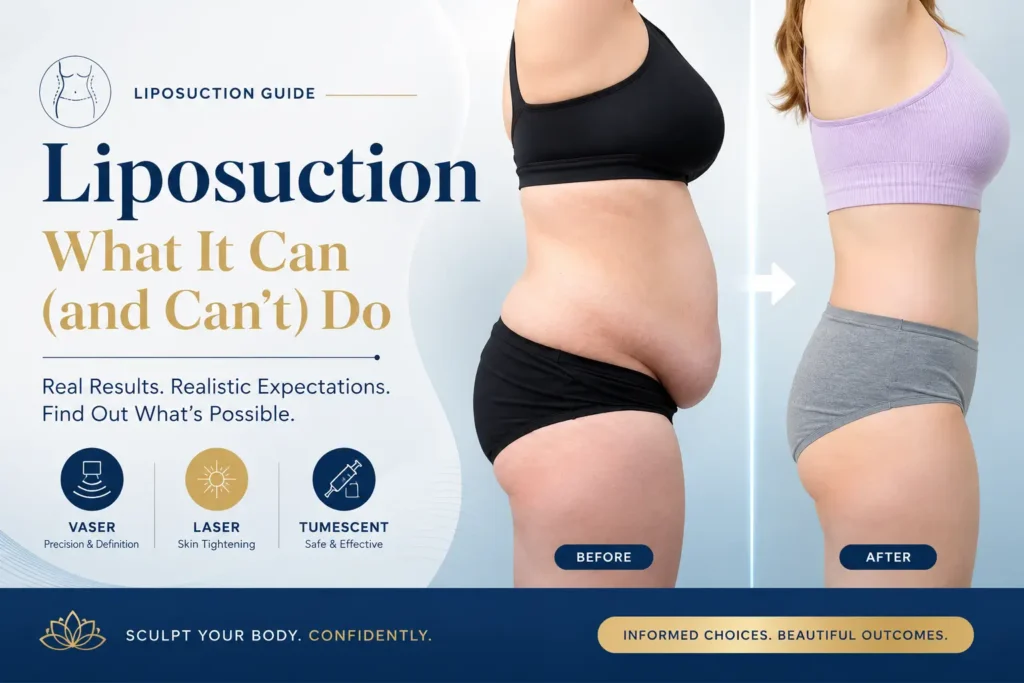
Before & After: Advanced VASER Liposuction for localized fat removal and waistline definition.
Am I a Good Candidate for Liposuction?
The most satisfied liposuction patients typically share these characteristics:
- At or near their goal weight — liposuction is a contouring procedure, not a tool for significant weight reduction
- Stable weight — weight that has been consistent for at least 6 months
- Localized fat deposits — one or more specific areas that haven’t responded to diet and exercise
- Good skin elasticity — skin with enough tone to contract around the new contour after fat removal
- Non-smoker — or willing to stop for several weeks before and after surgery
- Realistic expectations — understanding that liposuction reshapes, it doesn’t redefine health or weight
Patients who are significantly overweight are generally better served by working with a physician on weight management first. Liposuction of patients with poor skin quality or generalized obesity rarely produces satisfying results, and I’ll be honest about that in every consultation.
Certain conditions require special consideration: uncontrolled diabetes, blood clotting disorders, significant cardiovascular disease, and active infections are all contraindications that must be discussed before proceeding.
What Liposuction Cannot Do
This is a conversation I have in every single consultation, because mismatched expectations are the most common source of dissatisfaction after an otherwise technically successful procedure:
- Liposuction does not treat cellulite. Cellulite is a structural phenomenon involving fibrous bands between the skin and deeper tissue — fat removal does not address this and may occasionally worsen its appearance in susceptible individuals.
- Liposuction does not tighten significantly loose skin. If substantial skin laxity exists, a body lift, arm lift, thigh lift, or tummy tuck may be needed, either instead of or alongside liposuction.
- Liposuction is not a weight loss procedure. The amount of fat removed in a safe liposuction procedure rarely exceeds 4–5 liters; this is not enough to meaningfully impact a patient’s body weight.
- Results require lifestyle maintenance. The remaining fat cells after liposuction can still enlarge with weight gain. Patients who gain significant weight after surgery will see their results diminish.
Safe Recovery: Your Roadmap to Post-Liposuction Healing
Recovery varies depending on the technique used and how many areas are treated, but here’s a general timeline:
Days 1–3: Soreness, bruising, and swelling are at their peak. Drainage from the small incisions (residual tumescent fluid) is normal. Compression garments must be worn continuously.
Days 4–14: Most patients feel well enough for desk work and light activity. Bruising fades. Swelling persists but continues improving.
Weeks 3–6: The majority of visible swelling resolves. Patients can typically return to exercise at around 4–6 weeks depending on the extent of the procedure.
Months 2–3: Final contour results become fully apparent as residual swelling resolves completely. Some patients notice continued improvement for up to 6 months in areas where VASER or laser techniques were used.
Risks and Complications: What Every Patient Should Know
Liposuction performed by experienced, board-certified surgeons has an excellent safety profile, but no surgical procedure is without risk. The most common issues are:
- Temporary bruising, swelling, and numbness in the treated area
- Contour irregularities (lumpiness or unevenness) — more common with less experienced surgeons or when too much fat is removed
- Fluid accumulation (seroma) — typically managed with compression and, if needed, aspiration
- Infection — rare with proper technique and postoperative care
- Skin changes — color changes or reduced sensation that usually resolve over time
The most serious complications (fat embolism, deep vein thrombosis) are rare but real, which is why I take preoperative health screening seriously. We don’t rush to schedule surgery — we schedule surgery when it’s safe to do so.
Liposuction FAQs
1. How much does liposuction cost in 2026?
Liposuction pricing is highly individualized. It depends on the number of areas treated, the volume of fat removed, and the technology used (e.g., VASER vs. Laser). At ABmedi team Clinic, we provide a transparent, all-inclusive quote during your consultation, which covers the surgical fee, anesthesia, and comprehensive post-operative care.
2. VASER vs. Laser Lipo: Which one is better for skin tightening?
While both offer better tightening than traditional lipo, Laser Liposuction is often superior for skin retraction because its thermal energy specifically stimulates collagen production. However, VASER is better for “high-definition” sculpting. Our surgeons often combine both to achieve the best of both worlds: fat removal and firm skin.
3. Can I get liposuction after using weight-loss injections (GLP-1s)?
Yes. In 2026, many patients use liposuction as a “finishing touch” after reaching their goal weight via medical weight loss. If you have stable weight but localized “stubborn pockets” or mild skin laxity from rapid weight loss, you are likely an excellent candidate for VASER or Laser-assisted contouring.
4. Is the fat removal permanent? What happens if I gain weight?
Yes, the fat cells removed are gone forever. However, the remaining fat cells in your body can still expand. If you gain significant weight, it will likely be distributed more evenly across your body, but your new “sculpted” proportions will generally be maintained.
5. How soon can I return to work and exercise?
Desk Work: 3–5 days for most VASER or Laser procedures.
- Light Walking: Encouraged starting the day after surgery.
- Strenuous Exercise: Usually safe after 4–6 weeks.
- Tip: Wearing your compression garment consistently is the fastest way to reduce swelling and get back to your routine.
6. Will I have visible scars?
Scars from modern liposuction are minimal—usually 2-3mm in length. Our surgeons strategically place these tiny incisions in natural skin folds or “hidden” areas (like the belly button or bikini line). Most scars fade to a faint, barely-visible point within 6 to 12 months.
Why Technique and Surgeon Experience Both Matter
I’ve seen revision consultations from patients who had liposuction elsewhere and were left with uneven contours, visible dents, or loose skin that wasn’t addressed when it should have been. These outcomes aren’t inevitable — but they are more common when surgery is performed by insufficiently trained practitioners, when the wrong technique is applied to the wrong area, or when the patient wasn’t properly assessed in the first place.
At ABmedi team Clinic, we use the technique best matched to each patient’s anatomy and goals — not a one-size approach. VASER, laser, and tumescent liposuction each have their place, and knowing when to use which is where surgical experience genuinely matters.
Ready to Rediscover Your Body’s True Shape?
Let’s Design Your Results Together.
Book a consultation at ABmedi team Clinic — no obligation, no pressure.
In one appointment, our board-certified Plastic surgeons will:
- Assess your skin quality, tissue depth, and the specific areas of concern
- Recommend the one procedure — or combination — that matches your anatomy and goals
- Give you a clear, honest timeline for recovery and results
- Answer every question you have, in plain language
📞 💬 WhatsApp / Chat: [http://wa.me/84975142666] 🌐 Book online: [+84-975-142-666]
